


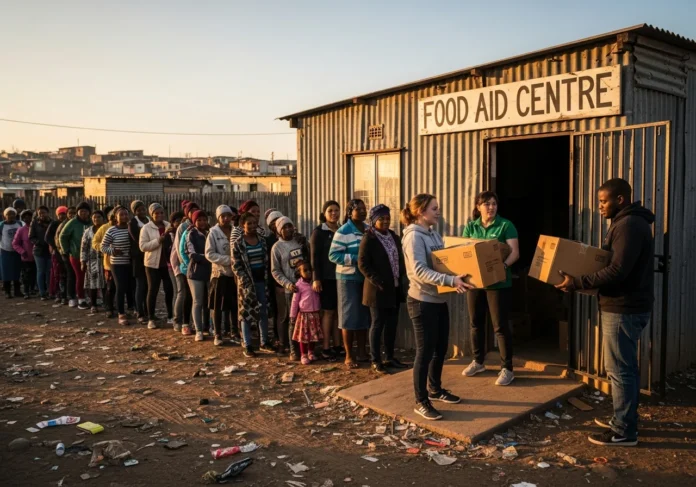
South Africa’s food insecurity crisis is worsening, even among households already receiving food assistance, according to new research that underscores the limits of emergency food aid in the face of rising living costs, unemployment, and structural inequality.
The State of Household Food Insecurity in South Africa 2026 report, produced by FoodForward SA in partnership with the University of Cape Town’s Southern Africa Labour and Development Research Unit (SALDRU), paints a stark picture of persistent and deepening hunger among the country’s most vulnerable households
Based on face-to-face interviews with 796 food-aid-dependent households across South Africa, the study finds that seven in ten households experience moderate to severe food insecurity, despite regular access to donated food.
One in four households falls into the most extreme category, reporting severe food insecurity marked by hunger, skipped meals, and, in some cases, entire days without eating.
Concerns raised in report
The findings echo concerns raised in recent reporting that food insecurity is becoming more entrenched, even as civil society organisations expand food distribution networks.
FoodForward SA alone provides surplus food to nearly one million people daily through more than 2 500 beneficiary organisations, yet the report shows that food donations are often insufficient in quantity, unpredictable in timing and constrained by transport and access costs.
The research highlights that food insecurity among food-aid recipients is not a temporary shock but a chronic condition.
Survey results using the internationally recognised Food Insecurity Experience Scale (FIES) show that food deprivation remains consistently high over both 12-month and 30-day periods, indicating long-term structural vulnerability rather than short-term crisis.
Nationally, between 2019 and 2023, the number of food-insecure people rose from 14.25-million to 17.8-million, while the number of severely food-insecure individuals increased from 5.2-million to 8-million, according to SALDRU and Statistics South Africa.
Most children in surveyed households live in moderately food-insecure environments, while between 25% and 33% experience severe food insecurity.
Adults frequently skip meals to protect children’s intake, but the report finds that this buffering strategy is increasingly insufficient under conditions of prolonged scarcity.
Nearly 78% of households reported talking to children about the lack of food, exposing them not only to hunger but also to the psychological stress associated with food deprivation.
Researchers warn that this dual burden of nutritional and emotional strain could have lasting consequences for child development.
Geographic hotspots
Food insecurity is most severe among female-headed households, households with children, and those reliant on unstable or informal employment.
Geographic hotspots include parts of the Eastern Cape, Limpopo, and North West, as well as low-income urban settlements, reflecting both rural poverty and the high cost of urban food systems.
While social grants provide some protection, more than 75% of surveyed households rely primarily on grants as their main income source, and the report concludes that grant levels have failed to keep pace with rising food prices.
Food shortages peak around grant-payment troughs and seasonal employment gaps, exposing households to cyclical hunger that food donations alone cannot resolve.
As food insecurity deepens, households move through a predictable but damaging sequence of coping strategies, such as reducing portion sizes, skipping meals, switching to cheaper staples, borrowing money, selling assets and, in extreme cases, foregoing medication to afford food.
The report argues that South Africa’s hunger crisis cannot be solved through food aid alone.
It calls for policy-driven, evidence-based interventions, including targeted food vouchers, strengthened community kitchens, mid-month grant top-ups, expanded school and early childhood feeding programmes, and better integration of food support into healthcare services.


