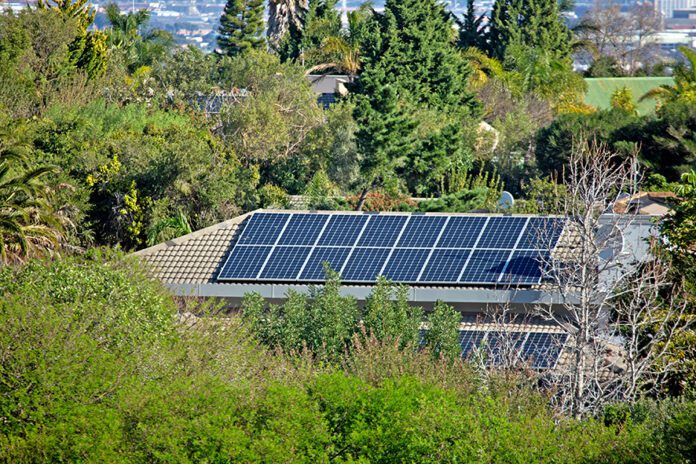
Across sub-Saharan Africa, off-grid solar has long been marketed as a cheaper, decentralised, cleaner and entrepreneurial alternative to limited public electricity.
However, new analysis reveals the poorest Africans are paying the highest unit price for the smallest amount of electricity. This is the poverty premium, and it is reshaping how governments, investors, and energy-access civic groups think about Africa’s just energy transition.
The off-grid solar sector accounted for 55% of all new electricity connections in sub-Saharan Africa between 2020 and 2022, according to the 2024 Off-Grid Solar Market Trends Report. Off-grid solar companies such as Sun King, Bboxx, d.light, M-KOPA, and Zola Electric have electrified millions of households and businesses across the continent.
But their business models depend on capital that is simply too expensive for people living on less than $2 (R34) a day.
Analysis by Habiba Ahut Daggash in partnership with the Rocky Mountain Institute find that venture investors often target returns of 20-40%.
Meanwhile, commercial lenders charge interest rates of 10-27% or more in markets like Nigeria, Congo, and Ethiopia.
Those costs are passed directly to rural customers through pay-as-you-go (PayGo) and lease-to-own repayment plans.
For instance, in Nigeria, A Sun King 50W solar system retails for $113.85 and under its 74-week PayGo plan, the same household pays $220.32 (94% increase). And that system still only provides enough power for lights, phone charging, and small appliances.
Wealthier urban households in Kenya or Nigeria, by contrast, pay subsidised grid tariffs for far more reliable electricity.
The economics get even harsher lower down the income ladder. Typical PayGo monthly payments are $10-30.
For a rural farming household earning about $60 a month, a typical PayGo repayment of $15 a month can consume a quarter of that income, which is far beyond global affordability benchmarks.
Research shows that half of households without electricity cannot afford even a basic Tier 1 (72 kWh annually) solar kit, and 97% cannot afford a Tier 2 (364 kWh annually) system.
This reality forces companies to abandon their low-income customer base and target peri-urban or emerging middle-income groups instead. Since Covid-19, some PayGo firms reported 50% of their customers either defaulted or fell into 30-day
arrears.
Companies respond by shortening repayment periods, raising deposits, or withdrawing from remote areas entirely.
The result is a commercial strategy misaligned with the very goal of equal access that it aims to achieve.
History shows that no country has achieved mass rural electrification through commercial capital alone.
Every successful rollout relied on public investment, subsidies and coordinated state-led planning. For example, the US electrified 90% of rural areas within two decades after the 1936 Rural Electrification Act, using affordable public loans.
Kenya’s Last Mile Connectivity Programme and Rwanda’s Results-Based Financing Scheme demonstrate that African markets follow the same pattern. Electricity access, especially renewable, is a public good, not a retail product.
The poorest households cannot be expected to pay commercial capital’s cost of capital.
To reach the truly unelectrified, governments and development partners must shift from a commercialisation-first approach to a public-good-first framework.
That means scaling subsidies that reduce retail prices, deploying catalytic finance to soften the cost of capital, and using public planning to guide private participation rather than replace it.