


For as long as the ANC remains the majority party in government, broad-based black economic empowerment (B-BBEE) will remain the preferred policy to redress racial
economic inequalities in South Africa.
This came out during the summit on the future of B-BBEE
hosted by Professor Onkgopotse Tabane’s Frank Dialogue Holdings in partnership Sunday World in
Durban on Saturday.
“This dialogue is timeous, particularly because after 30 years of democracy we can see entrenched
economic patterns excluding the majority of South Africans from the economy. Abandoning BEE is not
an option – the path forward is a reform process strengthening the policy and a disciplined
implementation plan accelerating transformation, especially in sectors that are lagging behind such as
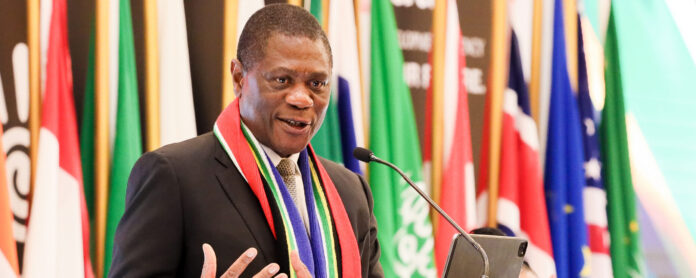
the ocean economy,” keynote speaker ANC Deputy President Paul Mashatile told the gathering.
“BEE is a vital tool for transformation and is also a moral obligation for those committed to economic
inclusion of the still excluded Black majority.’’
Solution lies in reform
Mashatile emphasised that while B-BBEE implementation has faced hurdles such as inconsistency, fronting and paper-based compliance, the solution lies in reform, better enforcement, and addressing barriers rather than scrapping it. He highlighted achievements such as growth in Black middle class, progress in mining and finance sectors, and data from the BEE Commission 2022 report showing advances in ownership, skills and supplier development.
Mashatile’s statement comes on the back of President Cyril Ramaphosa’s recent State of the Nation Address (Sona) wherein he defended BB-BEE as essential for addressing historical inequalities and economic exclusion of Black South Africans.
BEE can’t be scrapped
During his February 19 reply to the Sona, Ramaphosa strongly rejected opposition calls (notably from the Democratic Alliance) to scrap BEE emphasising the need to make the policy “more effective” rather than abandon it.
When asked about the DA’s opposition to B-BBEE as a race-based policy and how the ANC would overcome their partner in government, the DA’s, call for the abolition of B-BBEE, Mashatile said he was confident that “the progressive forces” in Parliament will support the continuation of B-BBEE and the establishment of the proposed R100-Billion Transformation Fund – in which private companies are expected to contributed.
The DA proposes replacing the Transformation Fund with an “economic inclusion for all bill” focusing on poverty-based, rather than race-based empowerment. The bill would emphasise job creation, skills development, and investment over BEE. The ANC has rejected the proposed bill, arguing that its “colour-blindness” overlooks the historical causes and impact of legalised racial inequalities under apartheid.
Refinement of B-BBEE
Also speaking at Frank Dialogue yesterday, Department of Trade Industry and Competition Minister Parks Tau confirmed that his department is reviewing the B-BBEE framework to refine it, reduce corruption, and promote inclusive growth. Tau also added that applications for funding from the Transformation Fund will resume in March. The fund is aimed running parallel with the reviewing of the B-BBEE legislation.
B-BBEE Loopholes
B-BBEE commissioner Tsediso Matona gave a report at the summit on research done in 2018 after 30 years of the enactment of the first B-BBEE legislation showing some shortcomings with regard to compliance.
For example, the research revealed that compliance skewed towards Enterprise and Supplier Development, trailed by ownership development – with little movement for management control. The study also revealed that after 2018 compliance for all elements faltered – suggesting that compliance stalls, once certain levels are met. The study also revealed that because the B-BBEE measurements are biased towards inputs (eg spend and point scoring) there was a lot of box-ticking.
According to the study the B-BBEE enabling and monitoring has not been optimal when it comes to operation of Sector Charter Councils and verification agencies – leading to data gathering and quality issues, various loopholes in practices undermining implementation monitoring and progress when coming to B-BBEE.
“B-BBee legislation needs to evolve to the next level addressing these and other challenges to enhance its efficacy and impact”, stated Matona.


