


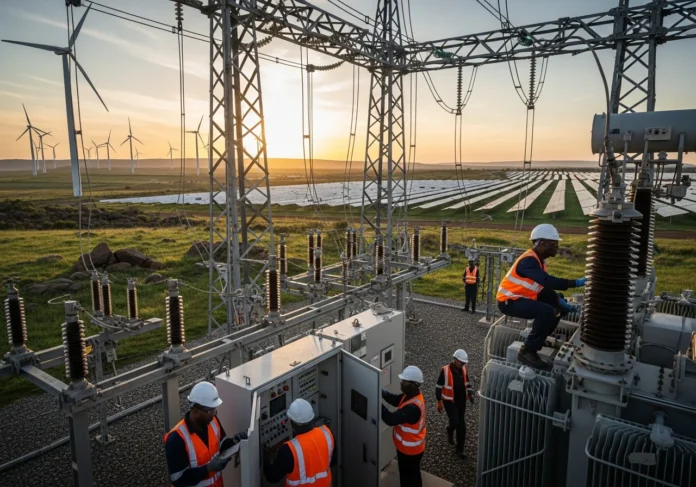
South Africa is at a critical inflection point in its energy transition, with billions of rands flowing into renewable power and investor confidence riding high, even as grid bottlenecks threaten to slow progress.
For stakeholders involved, the nation’s energy landscape offers both a compelling success story and a cautionary tale.
Since its Renewable Energy Independent Power Producer Procurement Programme (REIPPPP) began in 2011, South Africa has attracted over R292 billion of investment in wind, solar, and storage projects while securing more than 9.6 GW of contracted capacity for the national grid.
Shift from reliance on coal
According to the 2025 South African Renewable Energy Grid Survey, the private sector pipeline now includes 117 GW of advanced-stage renewable projects, dwarfing the capacity needed under the country’s current energy plan and underscoring robust investor confidence in the sector’s prospects.
From an environmental standpoint, increased deployment of solar and wind, along with the gradual scaling of battery storage, supports South Africa’s commitments to reducing greenhouse gas emissions and aligning with global climate goals.
BDO Global estimates that REIPPPP projects have already generated over 130 million tonnes of CO₂ equivalent emissions savings cumulatively while producing 133,000 GW of renewable electricity.
These developments mark a meaningful shift away from South Africa’s historical reliance on coal, still responsible for the majority of electricity generation, and help signal just how much cleaner energy can now be both viable and desirable.
Renewables are not only lowering carbon intensity but also offering a pathway toward energy security and resiliency.
On the social dimension, the renewable build-out has generated thousands of job opportunities, both during construction and, increasingly, in operations and maintenance roles.
Policy frameworks embedded in REIPPPP emphasise local participation and black economic empowerment, with some recent projects boasting nearly half South African equity and significant BEE ownership.
Distributed renewable systems, particularly rooftop solar for businesses and households, have also played a role in mitigating the impacts of load shedding, enhancing energy sovereignty for firms, and relieving pressure on national infrastructure.
However, the biggest challenge to sustainable energy expansion is not a lack of capital or project development, it’s the grid infrastructure itself.
Multiple industry reports by the Boston Consulting Group, Green Cape, the Presidential Climate Commission, etc., highlight that South Africa’s transmission network simply has not kept pace with generation ambitions.
Meanwhile, Eskom’s ageing transmission lines and substation networks are struggling to integrate the growing wave of renewables.
South Africa’s decarbonization
In practical terms, this has led to a situation where approved projects are delayed or even stalled because there simply isn’t capacity to connect them to the grid, especially in high-potential regions like the Northern Cape and Free State.
Moreover, the 4th annual South African Renewable Energy Grid Survey (SAREGS) indicates that supply might soon outgrow demand in midday periods, a sign of disproportionate renewable interest that the current system cannot optimally absorb without substantial upgrades in system flexibility and storage.
Even though both the Integrated Resource Plan (2025) and the Transmission Development Plan by the NTCSA acknowledge and plan for significant grid expansion, several execution gaps still remain.
Without decisive investment in transmission capacity, South Africa risks seeing its renewable ambitions undercut by logistical limitations.
Furthermore, policy frameworks, institutional coordination, and infrastructure investment must evolve in tandem with generation capacity to unlock the full potential of the energy transition.
In this light, success in South Africa’s decarbonization will ultimately be defined by how quickly and effectively grid bottlenecks are resolved and not just how many projects are built.
The country’s renewable future depends as much on transmission lines as it does on turbines and solar panels.


