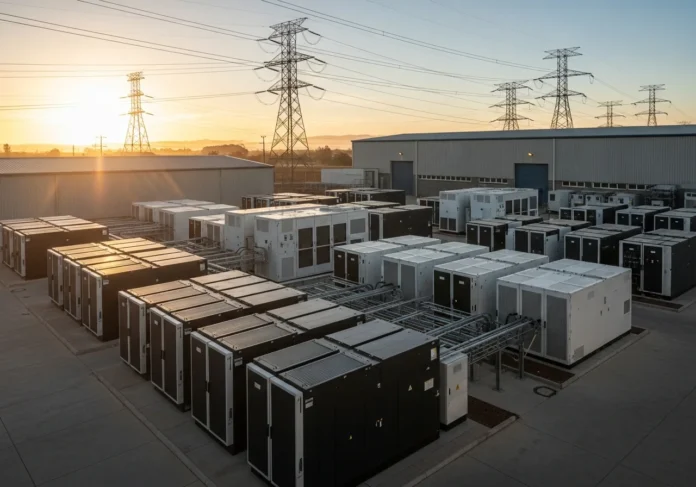
As load shedding recedes, South Africa’s battery boom is entering a new phase. Thousands of battery energy storage systems (BESS), installed by businesses to survive years of power cuts, now risk becoming underutilised assets.
A new industry brief by Green Cape argues that this shift opens a compelling opportunity to avoid using batteries for backup power but to use them for tariff arbitrage under time-of-use (TOU) electricity pricing in the Western Cape.
South Africa saw a sharp rise in lithium-ion battery imports between 2020 and 2025, with imports of battery components growing by an estimated 48%, according to South African Revenue Service data cited in the Green Cape report, titled Maximising the value of battery energy storage systems in the Western Cape by leveraging time-of-use tariffs.
That surge was driven largely by worsening load shedding, which peaked in 2023 with 6 838 hours of outages.
By mid-2025, outages had fallen dramatically to just 184 hours. This fundamentally changes how businesses can extract value from energy storage.
Peak and off-peak prices gap
The Green Cape analysis focuses on tariff arbitrage, which is essentially the practice of charging batteries during low-cost, off-peak periods (9pm to 6am) and discharging them during expensive peak periods (6am to 8am and 4pm to 7pm) under TOU tariffs.
The greater the gap between peak and off-peak prices, the stronger the savings potential. This opportunity is limited to businesses connected to Eskom or municipalities that offer TOU tariffs.
While not universal, TOU structures are available across much of the Western Cape, including the City of Cape Town, Drakenstein, Stellenbosch, and the Overstrand, as well as Eskom’s Megaflex and Ruraflex tariffs.
In high-demand winter months, peak-to-off-peak price gaps exceed R6/kWh in several municipalities and reach nearly R9/kWh in Breede Valley.
Even in summer, differentials often remain above R1/kWh, creating daily arbitrage opportunities for appropriately sized systems.
The most attractive economics emerge for businesses that already own batteries. For these users, the capital cost has already been sunk, and only modest upgrades, such as improved energy management systems, inverter adjustments or battery management system updates, may be required to enable arbitrage.
Under these conditions, the Green Cape report finds exceptionally high internal rates of return (IRRs).
Across municipalities, existing BESS upgrades deliver IRRs ranging from 55% to as high as 238%, depending on tariff escalation assumptions.
Because upgrade costs are relatively low, most arbitrage savings flow directly to the bottom line.
This finding reframes batteries from resilience tools into financial optimisation assets, particularly for businesses with variable demand profiles that can shift load without affecting operations.
At a system level, coordinated arbitrage also helps flatten peak demand, reducing stress on constrained distribution networks during high-load periods.
The case is more nuanced for businesses considering new battery installations purely for arbitrage.
Tariff arbitrage is not risk-free
Green Cape modelled a 100kW/500 kWh lithium iron phosphate system, assuming conservative operating conditions, a battery cost of R5 000/kWh, and one arbitrage cycle per day.
Over a 10-year horizon, new installations struggle to outperform South Africa’s prime lending rate of 10.5% under moderate tariff escalation scenarios.
Only when tariffs rise at historical averages of about 12% per year do several municipalities deliver above-prime returns, notably Mossel Bay, Overstrand, and Prince Albert.
The report cautions that tariff arbitrage is not risk-free because municipal and Eskom tariffs remain subject to regulatory approval by the National Energy Regulator of South Africa, and changes to TOU structures could weaken future returns.
Using the battery more often can also shorten battery lifespans if not carefully managed, while loadshedding may temporarily disrupt arbitrage operations.