
South Africa’s agricultural sector is under growing pressure from climate volatility, water scarcity and rising input costs. As farmers grapple with these structural risks, agricultural technology, also known as Agtech, is emerging as a critical enabler of productivity, resilience, and sustainability across the value chain.
Agtech refers to the application of advanced technologies such as drones, sensors, artificial intelligence (AI), data analytics and biotechnology to farming systems. These technologies are helping farmers optimise water use, reduce fertiliser and pesticide inputs and respond earlier to crop stress.
Precision agriculture tools have been shown to reduce fertiliser and chemical use by 20% to 30%, improve water efficiency by up to 15%, and cut crop losses by an approximate 10% through earlier detection of disease and pest outbreaks, according to Green Cape’s report titled, Market opportunities within the South African Agtech sector.
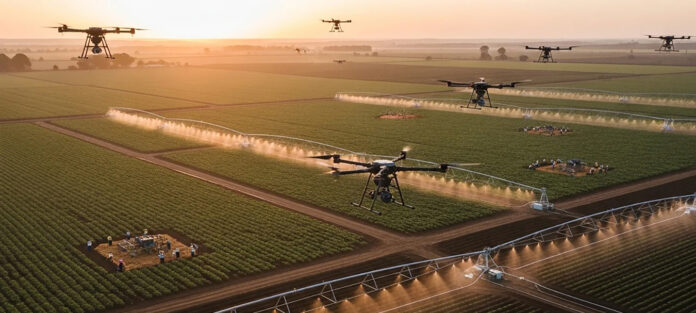
One of the fastest-growing sub-sectors within Agtech is agricultural drones, also known as unmanned aerial vehicles. According to Green Cape, the market for agricultural drones in South Africa is already valued at approximately R1-billion, with forecasts indicating it could exceed R3-billion by 2030, driven by demand for precision farming and climate adaptation tools.
Drone applications span a wide range of on-farm activities, including field monitoring, precision spraying, livestock tracking, yield prediction, and, in emerging cases, crop planting and pollination.
Precision spraying is gaining rapid traction, particularly on farms larger than 10 hectares.
Beyond input efficiency, automation, robotics and drone-enabled monitoring can reduce labour costs by 20% to 40% in activities such as livestock management, while improving operational oversight.
However, despite all these advantages, only 48 of South Africa’s 106 registered drone operators are active in agriculture. Stakeholder engagements conducted by Green Cape highlight three persistent barriers holding back Agtech investment in South Africa.
Limited access to patient capital, weak understanding of Agtech business cases, and low sustained demand driven by skills gaps and resistance to change among farmers
Early-stage Agtech companies, in particular, struggle to access financing suited to long research and development cycles, pilot programmes, and market education.
The brief points to the need for stronger collaboration between Agtech firms, research institutions, industry bodies, financiers, and government to build a robust pipeline from idea to commercial deployment. Demonstration projects, innovation funds, and blended finance structures are seen as critical for scaling. – ESG Now
- South Africa’s agricultural sector is under growing pressure from climate volatility, water scarcity and rising input costs.
- As farmers grapple with these structural risks, agricultural technology, also known as Agtech, is emerging as a critical enabler of productivity, resilience, and sustainability across the value chain.
- Agtech refers to the application of advanced technologies such as drones, sensors, artificial intelligence (AI), data analytics and biotechnology to farming systems.
- These technologies are helping farmers optimise water use, reduce fertiliser and pesticide inputs and respond earlier to crop stress.
- Precision agriculture tools have been shown to reduce fertiliser and chemical use by 20% to 30%, improve water efficiency by up to 15%, and cut crop losses by an approximate 10% through earlier detection of disease and pest outbreaks, according to Green Cape’s report titled, Market opportunities within the South African Agtech sector.