


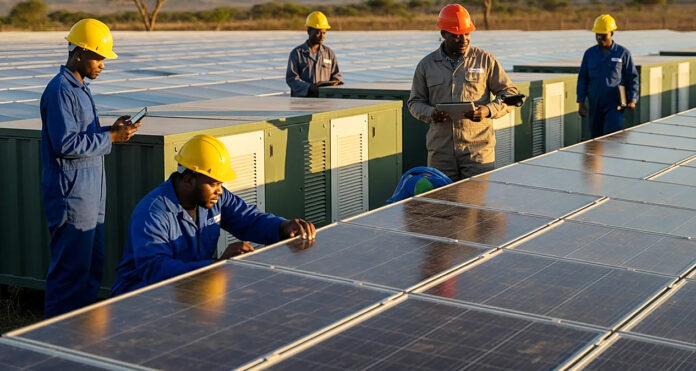
Angola has reached a meaningful milestone in its energy transition with the commissioning of Africa’s largest off-grid solar and battery energy storage system installation.
The Cazombo Photovoltaic Park is a strategic step toward cleaner, more accessible electricity across rural regions.
Situated in the remote Moxico Leste province, the Cazombo site pairs 25.40MW of solar PV with 75.26MWh of battery storage to deliver round-the-clock, fossil-fuel-free power to more than 136 000 residents, addressing long-standing energy access challenges in the region.
Financed through a combination of international support, including Standard Chartered and German export credit guarantees, this project represents the first delivery under Angola’s rural electrification project, which is essentially a government-led programme to deploy autonomous solar-battery mini-grids in off-grid communities.
Off-grid solar-plus-storage systems have become increasingly competitive. According to a 2025 report by Beyond the Grid Fund for Africa, capital costs associated with off-grid solar have decreased by 20% from 2020 to 2024 in some markets and are projected to continue declining. This is driven by the decline in solar panel and lithium‑ion battery storage prices by 90% since 2010.
Angola’s power system remains dominated by hydropower but is increasingly diversified. According to data from the International Energy Agency in 2024, hydropower is 62% of total energy generation in the country, while fossil-fuel generation is about 38%, and hybrid/solar integration is still nascently about 0.6%.
While hydropower provides a low-carbon backbone, its concentration creates systemic risk due to climate change, drought, decreased rainfall levels and aging infrastructure.
Government planning also anticipates a significant expansion in renewable generation capacity in the near term, with targets to increase clean energy’s share to over 70% by next year through hydro and solar projects.
While Cazombo stands out for its scale and socio-economic impact, it is part of a broader wave of renewable deployments designed to diversify Angola’s energy mix and reduce dependence on hydropower and fossil fuels.
In January, a 150 MW solar plant in Quipungo, backed by a power purchase agreement with Masdar, was announced. It forms the first phase of a 500 MW Project Royal Sable, which is expected to power roughly 300 000 homes and create over 2 000 jobs once fully developed.
In May 2025, a 35 MW solar park near Lubango, tagged as the largest privately owned solar facility under construction, will begin operating halfway through 2026. Meanwhile, two large PV installations generating 285 MW of power in Huíla and Cunene provinces will collectively add significant capacity and enhance grid-tied renewable power early this year.
Projects like Cazombo directly eliminate diesel consumption in mini grids, and reduce carbon emissions and local air pollution, contributing to its broader climate mitigation commitments.
Angola’s renewable push, spanning rural mini-grids to utility-scale solar corridors, demonstrates a clear strategic pivot toward cleaner, more resilient energy systems.
While hydropower remains the backbone of generation, growing solar infrastructure and storage solutions will reinforce grid stability, accelerate electrification, and support sustainable growth. – ESG NOW


