


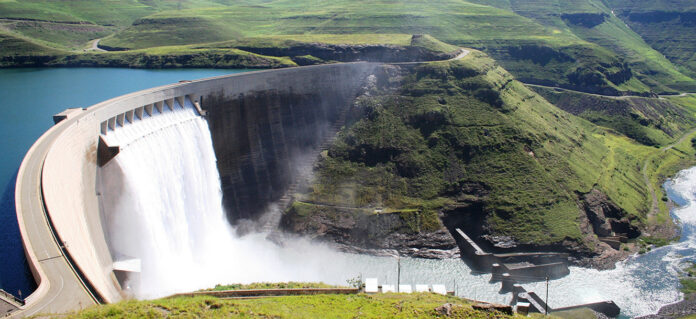
A transboundary water expert has warned that construction of a possible additional storage dam on the Orange River, to allow for the continuation of Phase 2 of the R53-billion Lesotho Highlands Water Project, was not feasible and would not attract interest from financial institutions.
Namibia is pressing South Africa to commit to building a new storage dam in Northern Cape as a precondition for its government to issue a critical “no-objection” letter needed by financiers for South Africa to fund Phase 2 of the critical water infrastructure project.
The Department of Water and Sanitation confirmed that the two countries were working on a feasibility study to determine the viability of such a storage dam.
But Dr Anthony Turton, a research associate at the University of the Free State’s environmental management department, told Sunday World that due to existing agreements between all countries that share the Orange River, any project to build an additional storage dam would not interest financiers, and talks could last up to a decade.
“No feasibility study will be bankable because of existing agreements between all riparian (owners of the riverbank) states under Orasecom. This means that no bank would finance it. The only way that such a project can become viable is for an upstream riparian (states) to relinquish their existing allocation. That would take a decade to negotiate,” Turton said in response to questions.
The Orasecom consists of Namibia, South Africa, Lesotho and Botswana, which all share the crucial water source.
This week, Sean Phillis, director-general of the water and sanitation department, told an infrastructure discussion forum hosted by Nedbank that Namibia was angry that the Lesotho Highlands Water Project is reducing its flow of water into the Orange River and is refusing to grant South Africa the “no objection” letter required by lenders to fund Phase 2 of the project.
The Lesotho Highlands Water Project is a partnership between Lesotho and South Africa, to transfer water from the Orange-Senqu River basin in the landlocked Mountain Kingdom to supply the water-distressed Gauteng region in exchange for providing hydropower to Lesotho.
The project aims to increase annual water delivery to 1.26-billion cubic metres by 2028/29, with a total cost of approximately R53-billion.
Financing of the project is done through the Trans Caledon Tunnel Authority (TCTA), a state-owned entity that finances and implements large bulk raw water infrastructure projects.
Namibia’s position stems from fears that the water project could reduce Orange River flows during drought periods and potentially threaten water supply to communities and economic activity in its southern parts.
“Namibia requested that South Africa build an additional storage dam on the Orange River in the Northern Cape to mitigate this risk. South Africa and Namibia are working on the feasibility study for this dam. Namibia has indicated a preference to obtain finality on the dam before issuing the no objection letter,” said water and sanitation spokesperson Wisane Mavasa.
Turton said the proposed additional storage dam on the Northern Cape side was difficult to justify because the river system already had about 270% storage capacity. This meant the existing dams could store nearly three times the river’s average annual flow, suggesting that further storage infrastructure might not be necessary from a purely technical point of view.
He raised concerns that building more dams would likely increase evaporation rather than improve supply. Turton said one of the challenges was the high ratio of rainfall to evaporation into the basin, where out of every 100 units of rain, only four units reach the river, while the remaining 96 are lost to evaporation.
“The biggest environmental risk is salinisation. This is already underway. There is also the recent discovery of a new form of red algae that has manifested in the system. Indications are that this alga, known technically as Euglena Sanguinea, is the result of deteriorating water quality,” Turton said.
While the “no objection” from Namibia has been requested as a funding precondition by two development finance institutions, Mavasa said their share represents less than 10% of the project’s borrowing requirements.
“The TCTA is in negotiations with the finance institutions to review this precondition. In the meantime, the TCTA has financed the project from its other lenders.
“This issue has therefore not had any material effect on the financing of the project. In the event that the two financing institutions do not agree to remove the precondition, the TCTA will raise those funds from other lenders.”
African countries enter into debt-for-food security deals
African countries using debt to fund sustainable initiatives, such as health, food, education, environment and urban planning.
Kenya is pursuing one of Africa’s first major debt-for-food security deals, marking a shift in debt-for-development swaps beyond their recent emphasis on nature-based outcomes. The $1-billion arrangement with the US International Development Finance Corporation, according to Reuters, is expected to refinance costly commercial debt and redirect the interest savings into food security, nutrition and agricultural resilience.
For a country grappling with high debt-service obligations, climate-driven food shocks and foreign-exchange pressure from imports, the approach carries both fiscal and political weight.
According to the Tony Blair Institute for Global Change, African countries spend an average of 18% of government revenues on interest payments alone, despite carrying lower debt-to-GDP ratios than G7 economies, where interest absorbs just 3%–5% of revenues. That imbalance has narrowed fiscal space across the continent, crowding out public investment.
At roughly $1-billion, Kenya’s proposed transaction would rank among the largest development-linked debt swaps globally. According to experts, its significance lies less in novelty.
Drawing on experience from one of Africa’s most cited debt swaps, Alexander Mali, a Gabonese development economist, argues that outcomes matter more than headline debt relief.
“In Gabon we learned that swaps succeed when they create functioning institutions, clear accountability and verifiable outcomes. The real payoff is policy signalling and fiscal reprioritisation, not dramatic headline debt reduction, because those changes shape budgets for years.”
Debt-for-nature swaps have historically dominated Africa’s engagement with outcome-linked debt instruments. Gabon’s $500-million marine conservation swap in 2023, alongside earlier transactions in Belize and Ecuador, demonstrated that sovereign liabilities could be partially re-engineered to fund public goods while reducing borrowing costs.
However, Afronomicslaw authors Adebayo Majekolagbe and Aurore Sokpoh argue that such deals were never intended to resolve Africa’s debt problem at scale. Instead, most debt-for-nature swaps deliver only “modest relief” relative to total public debt stocks, trimming debt service by limited margins.
“The real value of swaps lies less in headline debt reduction and more in policy signalling, targeted fiscal reprioritisation, and creditor coordination. That assessment helps explain why governments are now adapting the model rather than abandoning it.”
Kenya is also pursuing a parallel debt-for-food arrangement with the World Food Programme, expected to conclude in 2026. For Afronomicslaw, this pivot matters.
Majekolagbe and Sokpoh note that swaps linked to socially visible outcomes such as food, health, or education are more likely to command domestic legitimacy than narrowly environmental instruments.
The shift also reflects broader multilateral concern. IMF MD Kristalina Georgieva has warned that high debt servicing in low- and middle-income countries is increasingly crowding out spending on health, education and climate resilience.
Kenya’s approach mirrors developments elsewhere on the continent. In Côte d’Ivoire, the World Bank supported a $475-million debt-for-education swap that repurchased expensive commercial debt and redirected savings into school infrastructure and learning programmes.
The deal targeted about $439-million of high-cost commercial debt and is expected to free up approximately $392-million over five years for education spending, with no increase in the country’s net debt stock, according to World Bank and IMF documentation.
Also, in Southern Africa, Angola is advancing discussions on a debt-for-development swap expected to redirect fiscal space toward health and education by mid-2026, according to multilateral policy briefings.
The African Union estimates that more than 25 African countries are either in debt distress or at high risk. Africa’s development financing gap is also estimated around $200-billion per year. – Bird story agency


