
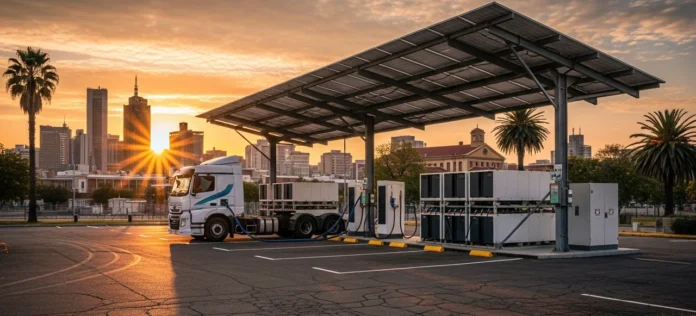
South Africa’s transition to low-carbon transport reached a critical milestone this month when the first electric truck in the country was successfully charged using a fully off-grid, solar-powered charging station.
The demonstration, led by Zero Carbon Charge (CHARGE) at its Wolmaransstad site, North West province, proves that heavy-duty electric vehicles can be powered entirely by renewable energy, without any reliance on Eskom’s electricity grid. In a country grappling with energy insecurity and transport emissions, the implications are profound.
Freight most carbon-intensive sectors
Freight transport is one of South Africa’s most carbon-intensive sectors. According to studies by Boston Consulting Group and Green Cape, the transport sector accounts for roughly 11% to 14% of the country’s total greenhouse-gas emissions. Road transport, mostly freight vehicles, are responsible for approximately 90% of that total.
Electrifying this segment has long been viewed as impractical. Mostly because of grid constraints, charging reliability, and power availability. CHARGE’s off-grid solar solution attempts to directly address these barriers.
By combining large-scale solar photovoltaic (PV) generation with battery energy storage, the charging station can deliver the high power required by electric trucks while remaining completely independent from the national grid. This not only eliminates exposure to load shedding, it also ensures that electrification does not shift emissions upstream to coal-fired power stations.
“Electric trucks are going to become a reality sooner than passenger EVs. This is because the economics, the routes, and the operational logic all align. And this is where the transition truly accelerates,” said CHARGE co-founder and chairperson, Joubert Roux.
Collaboration with various stakeholders
The Wolmaransstad trial included collaboration with commercial vehicle manufacturers and attracted massive interest. From government officials, financiers, and infrastructure developers. And this highlights growing institutional confidence in the model.
One of the most significant aspects of the project is that it does not require grid upgrades. South Africa’s electricity network remains constrained, particularly along freight corridors and industrial zones. Grid-dependent EV charging for trucks would place additional strain on already overstretched infrastructure. Off-grid solar charging bypasses this challenge entirely.
This presents an opportunity for government, businesses, and policy makers to accelerate decarbonisation. And for them to do so without waiting for large-scale grid reform, while also having energy autonomy.
CHARGE is now advancing plans to roll out solar-powered charging stations along major logistics routes. These include the N3 corridor between Gauteng and Durban, which is the busiest freight artery in the country. If deployed at scale, such infrastructure could reduce diesel consumption across long-haul routes. It could also cut freight-related emissions, and improve energy security for logistics operators.
Bankable infrastructure
The involvement of development finance institutions, such as the Development Bank of South Africa (DBSA) and the Climate Finance Accelerator (CFA), further signals that off-grid EV charging is increasingly seen as bankable infrastructure, not experimental technology.
This breakthrough arrives at a moment when global supply chains are under pressure to decarbonise rapidly. Export-oriented industries face rising scrutiny from investors. And trading partners demand credible emissions reductions.
Off-grid solar charging for electric trucks demonstrates that South Africa does not need to choose between economic growth, energy security, and climate responsibility. With the right infrastructure models, it can advance all three. Starting with the road freight sector that keeps the economy moving.