


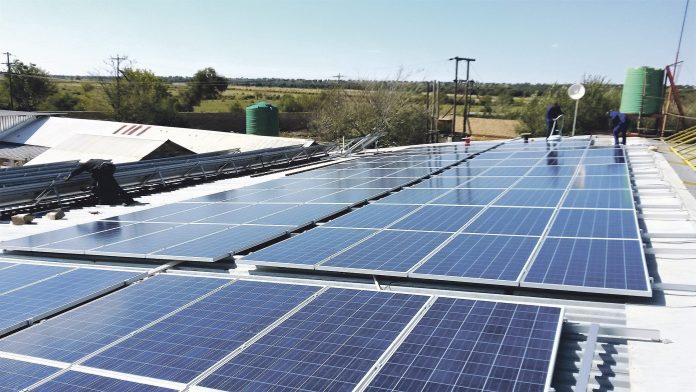
Now at more than 9,000 PV modules
The latest phase adds 2.1 MWp of installed capacity through 3, 582 solar panels, each rated at 585 W. Combined with the first 3.1 MWp installation phase completed in 2024, the project now comprises more than 9,000 PV modules. They are generating an estimated 7, 125 MWh of electricity annually. That output is equivalent to powering over 2, 000 middle-income South African homes for a year.
In 2018, renewables supplied just over 1% of the facility’s power. By 2023, that figure had climbed above 17%. And with the expanded PV system now online, the share is expected to rise even further.
For VWGA, it marks a shift toward stabilising both operational risk and long-term energy costs. With South Africa’s grid facing persistent uncertainty, industrial users have increasingly turned to on-site generation. This with the aim of protecting manufacturing uptime. VWGA’s solar capacity now offsets a growing share of its electricity consumption. It is reducing exposure to load shedding and rising tariffs.
Volkswagen says the Kariega plant has been steadily improving its environmental performance over the past decade.
Green energy target milestones
Between 2010 and 2023, the plant reduced its electricity use per vehicle manufactured by 54%. This was done through a long-term efficiency and demand-side management programme. Over the same period, the facility recorded a 57.7% overall reduction in environmental impact. This covered energy consumption, water use, waste generation, solvent reductions, and carbon-emission cuts.
Meanwhile, VWGA reduced cardboard waste by roughly 17 tonnes. And it reduced plastic waste by about 46 tonnes over the same period.
The project also speaks directly to the company’s carbon-neutrality ambitions. This with a total investment of roughly R90-million across two phases. Under Volkswagen’s global climate strategy, the group targets a 50.4% absolute reduction in CO₂ emissions from production (Scope 1 & 2) by 2030 (relative to 2018). While it also aims to cut the overall environmental footprint of its manufacturing sites by 37.5% by 2030. This will be under its “Zero Impact Factory” initiative.
As of August 2025, behind-the-meter rooftop solar capacity in South Africa (including private homes and businesses) reached 7,345 MW, according to Eskom. There is 31 GW of rooftop solar potential nationwide. However, a 2025 study by Planno finds only 7.4% of 178, 000 commercial or industrial rooftops currently have solar installed.
Global decarbonisation standards
South Africa’s automotive sector is responsible for nearly 5% of GDP and a critical export engine. It is under mounting pressure to align with international decarbonisation standards.
The European Union’s Carbon Border Adjustment Mechanism (CBAM), set to apply carbon pricing to imports, places local manufacturers at risk if carbon intensity remains high.
Volkswagen’s energy investments help mitigate this exposure. It is setting a benchmark others in the sector may be compelled to follow.
For now, VWGA’s Kariega expansion shows how industrial players can cut emissions. Also how they can stabilise operations and improve competitiveness without compromising production capacity. In an economy where energy reliability has become synonymous with economic survival, such investments are about environmental stewardship and company resilience.
- ESG Now
- Volkswagen Group Africa (VWGA) has taken another decisive step in its decarbonisation journey, completing the second phase of its solar-photovoltaic (PV) project at the Kariega manufacturing plant in the Eastern Cape.
- The expansion lifts the facility’s total onsite renewable-energy capacity to 5.2 MWp, strengthening the company’s position as one of South Africa’s advanced automotive manufacturers in terms of clean-energy adoption.
- Now at more than 9,000 PV modules The latest phase adds 2.1 MWp of installed capacity through 3, 582 solar panels, each rated at 585 W.
- Combined with the first 3.1 MWp installation phase completed in 2024, the project now comprises more than 9,000 PV modules.
- They are generating an estimated 7, 125 MWh of electricity annually.


