


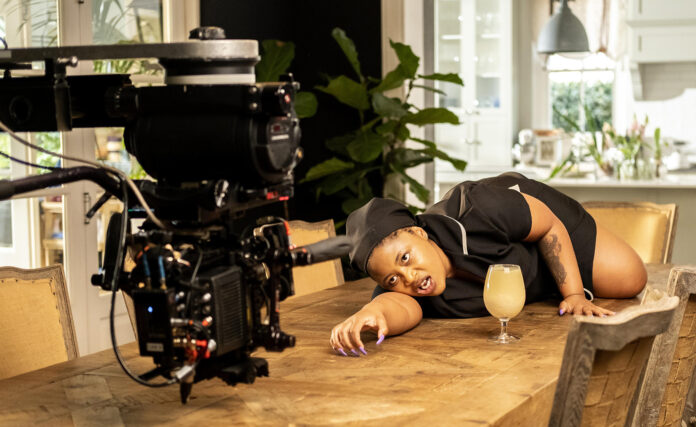
Award-winning actress, writer and director Kgomotso ‘Momo’ Matsunyane is entering what she calls her most experimental era yet, a phase defined by risk, reinvention, and a refusal to play by inherited rules. “I want to deliberately shatter the rules of theatre and just play,” she told Sunday World this week.
Her recent production, I’m Momo and I Have Issues, is a testament to her endeavour to push the boundaries of theatrical storytelling. She blends stand-up comedy with the traditional theatre art form of audience engagement in her biggest creative risk yet.
The show’s first run in February at the POPArt Theatre in Johannesburg received positive reviews and audience feedback, affirming her instinct to step outside her comfort zone.
Matsunyane’s earlier works include Ka Lebitso La Moya, which confronted the violation of Black women’s bodies and institutional abuse of power. With I’m Momo and I Have Issues, the Standard Bank Young Artist Award winner for theatre (2023/2024) shifts focus to interrogate the psyche of society itself.
“I’ve unpacked behaviour and how violence is inherited. Now I’m asking, why do we think the way we do? How have we become so passive?”
The show returns from March 26 to 28, and is expected to tour nationally.
Although much of Matsunyane’s artistic lineage is rooted in television and film, she has made theatre her playground, a space where she can create on her own terms.
Beyond her own artistic evolution, Matsunyane is equally concerned with the broader ecosystem of theatre, particularly its struggle to attract younger and more diverse audiences. “I don’t think theatre is supported in the ways it needs to be, especially in terms of marketability and its necessity in contributing to societal change… we need to sell it like we’re selling a bottle of Coca-Cola; it must be identifiable, desirable, and something that makes people want to come,” she explained.
“The idea that theatre must only happen within certain buildings is part of what’s holding us back. Of course, those spaces are convenient and supported. But because of the urgency of the work, we shouldn’t be afraid to perform in spaces that aren’t deemed theatre spaces.”
Matsunyane strongly believes that the formation phase of arts education should highlight the importance of the intersection between arts and financial sustainability.
“You can’t just be an actor. You have to diversify. I’m constantly working on multiple projects so I can cover my basic needs and still save.”
She does, however, push back against the stigma that artists are financially irresponsible. “We think about insurance. We think about funeral policies. We’re not ignorant. The problem is inconsistent income. It’s hard to buy a house. It’s hard to build credit.”
As her profile has grown, she has also learned to be firmer about her worth.
“You have to become stricter about your rates. You work incredibly hard. You deserve to be paid properly.”
When Matsunyane speaks of legacy, her vision extends far beyond accolades. “I want to leave behind a building, a space where artists can create freely. It should be a place where artists from all disciplines can freely develop their ideas,” she said.
Through her production firm, she ensures that each production includes a young creative who shadows professionals in areas such as stage management or directing.
More than infrastructure, she hopes to inspire courage in those who dare to dream. And perhaps one day she will get her wish of having her work studied at schools and universities as part of a broader conversation about independent theatre-making, political storytelling and the reconstitution of arts education.
- Award-winning actress, writer and director Kgomotso ‘Momo’ Matsunyane is entering what she calls her most experimental era yet, a phase defined by risk, reinvention, and a refusal to play by inherited rules.
- Her recent production, I’m Momo and I Have Issues, is a testament to her endeavour to push the boundaries of theatrical storytelling.
- She blends stand-up comedy with the traditional theatre art form of audience engagement in her biggest creative risk yet.
- The show’s first run in February at the POPArt Theatre in Johannesburg received positive reviews and audience feedback, affirming her instinct to step outside her comfort zone.


