


As a scientist who has spent years working across applied research, innovation systems, and startup–research partnerships, I know that progress requires more than good ideas.
It requires concentration: people, capital, expertise, and opportunity in one place at the same time.
For a long time, Africa has had the talent but rarely the concentrated ecosystem conditions needed to accelerate that talent.
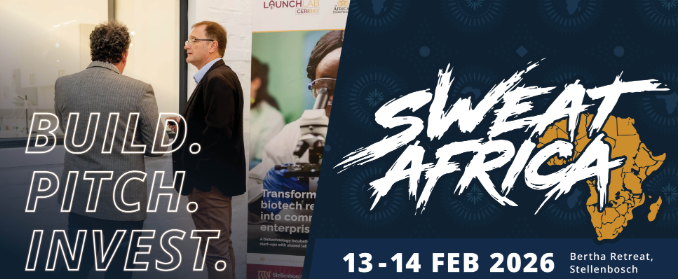
SWEAT Africa, taking place on February 13 and 14 at the Bertha Retreat outside Stellenbosch, is designed to create exactly those conditions.
The festival is supported jointly by industry partners, philanthropic organisations, and leading South African universities, all of whom have committed to building a platform where founders and innovators can engage directly with investors, researchers, engineers, and experienced entrepreneurs.
Opportunity to meet early-stage companies
This collaboration across sectors is uncommon in the region and forms the backbone of what SWEAT Africa aims to offer.
A defining feature of SWEAT Africa is the scale of activity taking place within just two days. The festival will bring together:
- More than 100 startups from across Africa, spanning health innovation, agritech, climate and environmental solutions, deep‑tech, hard‑tech engineering, AI, digital systems, and platform technologies;
- Over 50 international investors, including venture capital firms, angel investors, philanthropists, fund managers, and accelerators, are already looking for African investment opportunities;
- 150–200 structured investor‑founder meetings, specifically designed to create direct channels between high‑potential teams and capital decision‑makers;
- Live startup showcases demonstrating prototypes, pilots, and early-market solutions;
- Pitchin’ Picnics, small-format sessions that allow investors and founders to evaluate each other without formal pitch-stage pressure;
- Dozens of side meetings held across the winelands, enabling deeper discussions between ecosystem builders, investors, and research partners;
- Dedicated training sessions for young innovators, particularly those still in university or early in their entrepreneurial journey;
- A Friday the 13th fireside conversation focused on the realities of building companies in South Africa and Africa, covering what can go wrong and what experienced founders wish they had known;
- The Open Startup BRAIN 5.0 accelerator, connected to MIT’s global networks, will be concluding at the festival; and
- The festival will conclude by awarding non-dilutive prizes and partner‑supported opportunities to selected startups.
Bringing this level of activity into a single environment creates something rare on the continent: an unprecedented concentration of talent and capital.
For investors, this is an opportunity to meet early‑stage companies with genuine growth potential, including those that could become Africa’s next unicorn‑level successes.
For startups, it is a chance to meet investors who are not casually curious but who arrive with mandates and capital ready to deploy.
The breadth of sectors represented is another distinguishing factor. While many African innovation events focus narrowly on digital or health technology, SWEAT Africa deliberately includes emerging categories such as hard‑tech and deep‑tech, with startups working on engineering challenges, energy systems, satellite technologies, and advanced hardware.
These areas are often undersupported, despite their strategic importance for economic growth, and their inclusion signals a shift toward broader and more ambitious innovation categories on the continent.
Innovation is also cultural
The festival also recognises that innovation is not only technical; it is also cultural. Much of what holds back emerging ecosystems is the lack of shared experience, mentorship, and honest conversations about risk and failure.
SWEAT Africa responds to this gap by bringing together innovators from dozens of African countries, including founders whose companies have recently succeeded.
Their role is to teach, advise, and support younger innovators navigating early‑stage challenges.
Sessions are designed to expose students and emerging founders to practical lessons from the field, not high‑level abstractions.
For young Africans, engineers, designers, researchers, and first‑time entrepreneurs, this festival provides access that is rarely available.
It offers a “front‑row seat” to see how companies are built, how investment decisions are made, how ideas are evaluated, and how teams position themselves for growth.
These insights typically require travelling to Europe or the US. SWEAT Africa brings them home.
Another important dimension is the reversal of a longstanding pattern where African innovators have had to pitch African challenges to non-African audiences in Europe or the US. SWEAT Africa flips that dynamic.
Instead of exporting African founders to foreign ecosystems, the festival brings capital, networks, accelerators, mentors, and global expertise directly to Africa and does so in an environment shaped by African realities.
Building continent’s future together
This is not a passive event. It is intentionally built as an experiential festival where collaboration, not observation, is the goal.
Participants walk together, meet in informal outdoor settings, eat together, share technical challenges in small groups, and work through problem-solving in relaxed and human environments.
For those of us from scientific communities, this design feels familiar—it mirrors the environments in which productive interdisciplinary collaboration naturally occurs.
In two days, SWEAT Africa compresses a level of activity that normally takes months to coordinate. With 100+ startups, 50+ investors, up to 200 structured meetings, an MIT‑linked accelerator, and dozens of working sessions and side meetings, it represents a rare moment of alignment in Africa’s innovation landscape.
For the scientists, engineers, entrepreneurs, investors, and students who will be there, SWEAT Africa offers one thing above all: a chance to build the continent’s future together, in one place, with the right partners at the table.
De Oliveira is director of the Centre for Economic Response and Innovation (CERI) at Stellenbosch University


