


Nonkanyiso Mbonambi has built a career that intentionally cuts the distance between art, activism and economic sustainability, anchored in the belief that creativity is not a mere luxury but a vital tool for survival, liberation, and financial security.
Movement, resistance, and a steadfast belief in the power of African knowledge systems define Mbonambi’s calling as a visual artist, muralist and curator.
Her childhood unfolded across northern KwaZulu-Natal, the Free State and later Johannesburg, shaped by constant relocation after her father went into exile. Her experience moving between provinces, languages, and communities taught her adaptability at an early age.
“I became something of a shapeshifter, always finding ways to blend in and connect with different cultures.”
Raised by a matriarch who’s an educator, and a political activist father, love for education and social justice was ingrained in her from a young age.
“Growing up in this environment taught me that our culture is not something to be ashamed of. It is our greatest asset,” she said. Those lessons later formed the backbone of her artistic practice.
Teachers identified her talent early on and encouraged her to hone her craft – so much so that she was already earning income from her work in primary school. Over time, Mbonambi began to recognise art as a political force. “I saw art as a weapon and tool for preserving our stories, challenging injustices and reclaiming narratives that have been stolen or distorted.”
Her political consciousness sharpened as she entered the male-dominated world of murals and public art. Often the only woman in professional spaces, she recalled feeling isolated and frustrated.
“I hated the idea of women being left behind, as if we don’t have the skill or intelligence to execute at the highest level.”
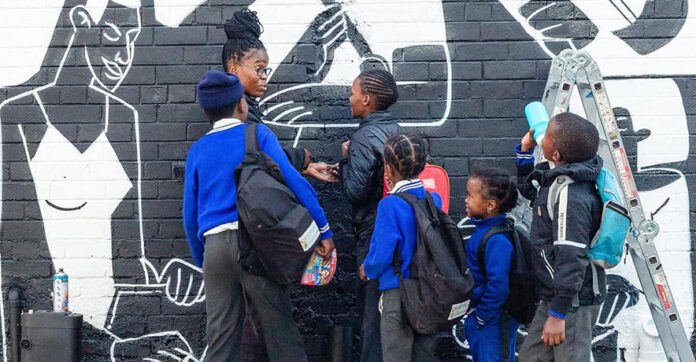
Rather than wait to be included, Mbonambi created her own platforms and founded an agency (Women in Street Art) that trains women to paint murals and build sustainable businesses around their skills.
“No one was coming to save us, and frankly, we don’t need saving. We need systems that recognise our worth.”
Working primarily in townships, villages and small towns, the programme addresses unemployment and inequality through community-based solutions. “We don’t just teach Western techniques. We encourage women to draw from their own cultural knowledge, their
aesthetics, and their stories.”
For Mbonambi, the process is collaborative rather than hierarchical. “I don’t really have students; it’s a knowledge exchange,” she added.
Her work recently received continental recognition in Lagos, where she won the Trailblazer Award for public art education and Outstanding Visual Artist through a public vote.
Looking ahead, Mbonambi envisions influencing cultural policy, building institutions that centre women’s histories, and expanding her agency across Africa.
She is equally determined to dismantle persistent myths about creative careers.
“When we say art doesn’t pay, we’re robbing our children of opportunity. Our creativity is currency. Our culture is capital,” Mbonambi said.
- Nonkanyiso Mbonambi has built a career that intentionally cuts the distance between art, activism and economic sustainability, anchored in the belief that creativity is not a mere luxury but a vital tool for survival, liberation, and financial security.
- Movement, resistance, and a steadfast belief in the power of African knowledge systems define Mbonambi’s calling as a visual artist, muralist and curator.
- Her childhood unfolded across northern KwaZulu-Natal, the Free State and later Johannesburg, shaped by constant relocation after her father went into exile.
- Her experience moving between provinces, languages, and communities taught her adaptability at an early age.
- “I became something of a shapeshifter, always finding ways to blend in and connect with different cultures.” Raised by a matriarch who’s an educator, and a political activist father, love for education and social justice was ingrained in her from a young age.


