


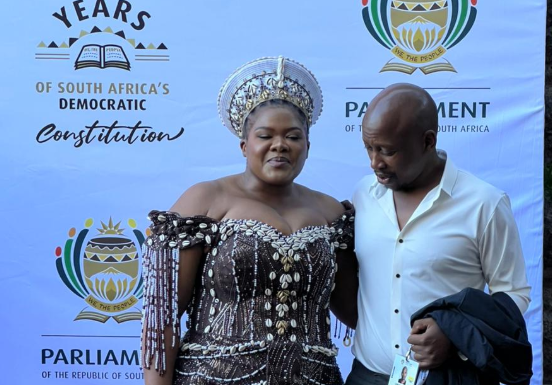
If the State of the Nation Address (SONA) at Cape Town City Hall sets the political tone for the year, then the red carpet sets the cultural one.
SONA 2026 delivered a fashion spectacle layered with craftsmanship, commentary and a little controversy. Hosted by socialite Thami Dish, with ongoing advocacy from Proudly South African’s chief marketing officer (CMO) Happy Ngidi, the afternoon wasn’t just about who wore what. It was about who wore local, who understood the assignment, and who… perhaps needed another fitting.
Mama Action’s local is lekker
One of the undeniable highlights of the evening was ANC veteran Nomvula Mokonyane — affectionately referred to in fashion circles as “Mama Action.”
“She has been consistently supporting local designers for a long time,” said journalist-turned-fashion-designer Craig Jacobs.
“She makes an effort. And she knows all the designers. She contacts us, she trades with us, she embraces and loves us. And I think that we need more of her.”
In a space where some public figures scramble for last-minute looks, Mokonyane’s intentionality stands out. Her embrace of beadwork, collaboration with co-operatives of young women, and commitment to craftsmanship, placed her firmly among the evening’s best dressed.
“She stands out from the same blanket, she mesmerises the audience. She looks beautiful and it’s a beautiful occasion.”
Deputy Minister in the Presidency Nonceba Mhlauli and cultural activist Ria Reen arrived sparking the question of who is best dressed.
Infusions of local cultures
Deputy Minister of Sports, Arts and Culture, Peace Mabe, is known for her confident presence and bold fashion choices. She did not disappoint.
“Who are you wearing?” Dish asked, eyeing the ensemble. “Interesting outfit. Very interesting.”
Mabe smiled, offering insight into the layered inspiration behind her look.
“It’s an infusion of different cultures, the Xhosa, Sesotho and a bit of Asian,” she explained. “Probably made by local women. My seamstress, she’s in Johannesburg.”
On a night where heritage and economic empowerment are front and centre, Mabe’s outfit felt intentional. A sartorial reflection of South Africa’s diversity, stitched together with global influence, but grounded at home.
By crediting her Johannesburg-based seamstress, Mabe reinforced a growing theme on the SONA 2026 red carpet. Leaders using their visibility to spotlight local talent.
Beads dominated the red carpet
Beads floated across the red carpet all night, shimmering under lights, moving with elegance. They reinforced the return to African craftsmanship as both an aesthetic and economic statement.
Not every stitch won universal applause, but the overarching verdict? Tasteful. Thoughtful. Intentional.
One recurring theme on the carpet was collaboration. The leaders who listen to their designers versus those who simply wear the garment.
“I love her orientation about the look,” said Londeka Buthelezi Ndaba. She is the founder, owner and creative director of Malondié . “She planned it, she listens to the designers, she takes input. We appreciate the craft.”
In 2026, fashion at SONA is no longer accidental. It is curated or at least, it should be. When it came to the Minister of Basic Education Siviwe Gwarube, the consensus was split. The craftsmanship? Undeniably strong.
“I love the texture. Ole’s textures are always beautiful. We are still the state. It’s the State of the Nation Address. Let’s put in more effort. We’re not saying wear a ballroom dress, but let’s try and make it nice,” noted Buthelezi-Ndaba.
Fashion meets national pride
SONA has increasingly become a political equivalent of the Durban July. A ceremonial moment where fashion meets national pride. The expectation is not excess, but elevation.
When tailoring enters the chat, there is little room for error.
“If you’re going to go for tailoring, you go to House of Ole’. He understands consistency,” said Jacobs.
Precision tailoring remains one of the strongest fashion categories on the SONA red carpet structured silhouettes, sharp cuts and clean finishes. When done right, it signals authority without overshadowing the event.
But tailoring without personality? That’s where some looks faded into the background.
UDM leader Bantu Holomisa offered a refreshingly candid response when asked about his look. He said he went into a shop and bought a nice suit. Whether it was locally made? He wasn’t sure. But, he noted, he was still contributing to the economy.
It was an honest answer, but one that sparked a bigger conversation about accountability and leadership. Because at an event like SONA, watched by millions and covered extensively across media platforms, details matter.
Fashion from outer space?
And then there was THAT outfit. The one that immediately sparked debate.
One of the guests on the red carpet stood out, wearing what looked like a spaceship. She definitely stole the show. Her outfit was out of this world, from outer space, obviously.
The material divided opinion. While the craftsmanship itself was praised, the overall styling left some unconvinced.
“It’s going to be a meme, you can just see it’s going to go viral,” said Jacobs.
Then came the now-iconic comparison: “She looked like she was about to go to a spaceship.” Brutal? Maybe. Memorable? Absolutely.
Verdict: all boxes ticked
This is not an ordinary parliamentary sitting. It is the State of the Nation Address broadcast live, politically dissected and culturally amplified. The red carpet has become a stage where economic messaging, cultural pride and personal branding converge.
Beads symbolised heritage. Local designers symbolised economic activism. Tailoring symbolised authority. And bold risks symbolised individuality.
Some leaders, like Nomvula Mokonyane, understood the assignment perfectly. Marrying consistency, collaboration and cultural pride.
Others treated it like a regular day at the office.
But if SONA 2026 proved anything, it’s that fashion is no longer a side conversation. It is central to the spectacle.


