


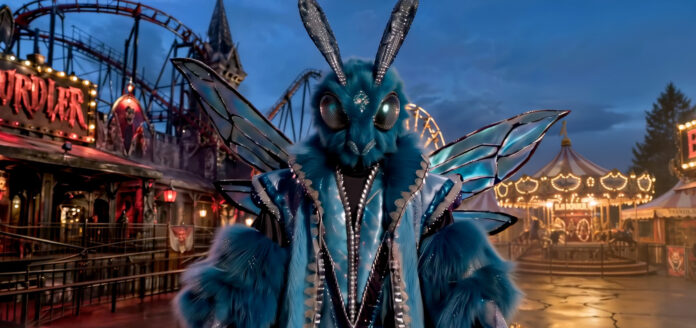
They might look like giant toys, mythical creatures or colourful works of art but the costumes on The Masked Singer South Africa are anything but simple.
Behind every feather, sculpted detail and outrageous silhouette is a team of craftspeople solving real problems: How to put a human inside a gigantic costume that allows them to sing, dance and perform live?
Heidi du Toit of Hollywood Costumes is involved in manufacturing the costumes and working backstage with the masks. She says that is where the magic happens.
“Something can look perfect on paper but behave very differently once it becomes a real, wearable mask,” she says.
The Hollywood Costumes team breaks each concept down into individual components before turning the designs into three-dimensional characters through pattern-making, sculpting, moulding, fabrication and construction.
Every decision had consequences. The head might look spectacular but end up being too heavy. A particular shape might restrict movement. A costume might have the perfect silhouette but leave the performer struggling to see.
Then there is the heat. Under television lights, ventilation and airflow inside the mask become critical; so do form and structure.
“The mask also has to be properly supported and balanced so that it remains secure while the performer is moving.”
In other words, the team is not simply asking whether a costume looks good. They must ask whether someone can perform in it. Fittings and rehearsals often expose problems that were impossible to spot during the design stage.
Live television adds another layer of pressure. Something can work perfectly during a fitting and then behave differently after repeated rehearsals or during a live performance.
The one character that pushed the team particularly hard this season was Gogga. The challenge was getting the hair exactly right, which required patience, experimentation and plenty of hands-on work.
“There were definitely moments when we wondered whether we would get it exactly right,” says Du Toit.
Eventually, they found a solution. For Du Toit, seeing Gogga completed on stage made the frustration worthwhile.
It is a reminder that even a detail that might appear insignificant to viewers can become one of the most demanding parts of creating a character.
Protea and Mosquito are among the costumes of which Du Toit is most proud.
“There is a special feeling when you stand backstage and watch something you have physically helped create come alive under the lights,” she says.
The team knows the story behind what viewers see: the adjustments, problems, long hours and countless decisions that went into making the final product look effortless.
While digital design and 3D printing can help create intricate shapes and details with greater precision, technology has not replaced traditional craftsmanship.
There is still extensive hands-on work involved in sewing, sculpting, moulding, painting and finishing.
“Technology doesn’t replace craftsmanship. You need both,” Du Toit says.
The combination of old-school skill and modern technology is what allows an idea on paper to become a character capable of performing on a television stage.
For Du Toit, another important part of the process was making sure the characters felt authentically South African.
Although The Masked Singer is an international format, she says it was important for the local version to have its own personality and visual identity.
“There is something special about taking an international format and giving it a distinctly South African personality through the characters, creativity and visual identity.”
The fact that the costumes were manufactured locally made the work even more meaningful for the team. Perhaps the biggest achievement is making viewers forget there is a celebrity underneath the costume.
The mask, silhouette, proportions, movement and personality work together to create the illusion.
“Once the costume and mask are put into place, you’re looking at somebody completely different,” Du Toit says. “The aim is for the person to disappear and the character to take over.”
And when that happens, the costume has succeeded.
For the people behind the masks, however, magic means something different.
They remember the costume as an idea, a drawing or a collection of materials. They remember every challenge, adjustment and late night.
Then the lights come on, the music starts and the audience sees the character for the first time.
The moment is a mixture of pride, relief and excitement.
“For us, that’s the reward: knowing that something we helped manufacture with our own hands has become a character that feels alive.”
- The Masked Singer South Africa costumes are created by Hollywood Costumes, involving detailed processes like pattern-making, sculpting, moulding, fabrication, and construction.
- The design team must ensure costumes are wearable, allowing performers to sing, dance, move freely, see, and stay cool despite heat and lighting conditions.
- The character Gogga presented a major challenge, especially in achieving the correct hair detail, requiring patience and experimentation until a solution was found.
- The costumes combine traditional craftsmanship with modern technology such as digital design and 3D printing, but hands-on work remains essential.
- Creating costumes locally and giving them a distinctly South African personality was important to the team, aiming to make viewers forget the celebrity inside and let the character fully take over.


