


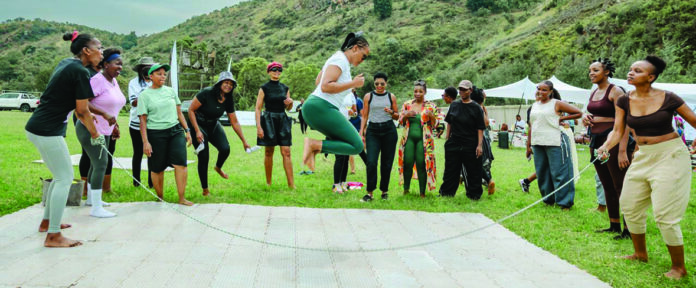
For many women, adulting is a serious business of juggling work demands, relationships, motherhood and family responsibilities — and not falling apart while they are at it. In the race to ensure that everyone else’s needs are met, there is often little room left for having fun.
Actress, author and creator Refilwe Madumo has created a platform where adult women can do something they have forgotten to do — play in a way that makes one forget one’s troubles for a minute and be in the presence of others who are also trying to let their hair down forget about the real world for a short period.
Madumo created The Sisterhood Playdate, an experience that uses many nostalgic childhood games, among them mgusha, bathi and kgati, and shared moments to get women to reconnect, laugh and intentionally create joyful spaces.
For her, the idea was born from a simple realisation that women need spaces where they can exist outside the roles they are expected to fulfil.
“Not just as mothers, wives, partners, professionals, caregivers or the ones who are always holding everything together. We are honestly the glue that holds the world together,” she says.
Madumo says women have perfected the art of putting others first, while their own needs take a backseat.
Through The Sisterhood Playdate, she creates spaces for women to practise self-love rather than merely talk about it.
She has also authored Just A Thought: The Choosing Self Journal, which she describes as an extension of the playdate and a tool to encourage women to intentionally choose themselves every day.
“I felt there was a gap for an experience that allowed women to step away from the seriousness of adulting and into something joyful, beautiful and completely unburdened by expectation,” she says.
For Madumo, play is not childish. It is a language women understand and one that can quickly dissolve the distance created by adult responsibilities.
“The sudden remembrance of exactly how it felt to be a child: carefree, silly, imaginative and completely present.”
In this adult playground, childhood fantasies are amplified. Instead of face painting, there are face beats. Traditional childhood treats have been replaced with something more adult appropriate — slushie cocktails. Games are played on grand lawns, with a marquee and bohemian picnic decor.
“It’s how I think my inner child would have imagined adulthood, as a time for luxurious revelry,” she says.
But beneath the aesthetics and nostalgia lies a serious conversation about adult friendship. Women can be surrounded by people and feel lonely. Social media may keep friendships alive digitally but meaningful connection often requires people to physically show up for one another.
Madumo believes childhood nostalgia provides an immediate point of connection.
“You can meet a woman for the first time who comes from a completely different part of the world and discover that you both remember the same game,” she says. “Suddenly you have something to talk about.”
The beauty of play, she adds, is that it dismantle the curated facades typically maintained by adults.
“When you’re laughing, running around, being competitive or being a little silly together, you aren’t presenting the polished version of yourself. You are revealing something much more human.”
Madumo’s philosophy challenges the idea that women should rest or have fun only once every demand has been met. “Joy is not a reward for surviving your responsibilities,” she says.
For friends who have known each other for years, playing together allows them to experience one another outside familiar adult roles. For strangers, it creates a natural environment for connection without the pressure of forcing conversation.
“Sometimes vulnerability doesn’t begin with a deep conversation,” Madumo says. “Sometimes it begins with laughing so hard that you forget to be self-conscious.”
For Madumo, nostalgia can also help women reconnect with who they were before life became complicated. It is not about wanting to be children again but about carrying some of that lightness into adulthood.
“I don’t think the intention is to go backwards or romanticise childhood,” she says.
“It’s about asking: What did that girl know about joy that I may have forgotten?”
- Refilwe Madumo created The Sisterhood Playdate, a platform where adult women play nostalgic childhood games to reconnect and create joyful spaces.
- The playdate includes games such as mgusha, bathi, and kgati, and features adult-themed treats like slushie cocktails and face beats.
- Madumo aims to provide women a space to exist outside their adult roles and practice self-love amid work, relationships, and family demands.
- The platform fosters meaningful physical connections and breaks down adult facades through shared playful activities.
- Madumo also authored Just A Thought: The Choosing Self Journal, which encourages women to intentionally choose themselves daily as an extension of the playdate experience.


