


Whether you like it hot, with or without milk, or drink it cold with ice or in other creative variations, rooibos tea remains a favourite in South African households. The cherished red bush tea, which is native to the Cederberg, is now poised to soar to new heights.
This October, South Africa’s most beloved plant will trade mountain air for the silence of space as more than 17 000 rooibos seeds are sent to the International Space Station (ISS).
For a plant that has spent centuries with its roots firmly planted in the Cederberg, it’s an adventure worthy of a blockbuster as it’s not every day that something found in your kitchen cupboard ends up orbiting earth.
The groundbreaking Rooibos in Space initiative, launched in Cape Town this month, is a collaboration between the South African Rooibos Council, MaxIQ Space and the South African National Space Agency. While it sounds delightfully fantastical, the mission is driven by serious science.
Researchers hope to discover how the conditions of space, including microgravity and radiation, could influence the way rooibos seeds germinate, grow and adapt, before comparing them with seeds that never left earth.
“Rooibos has long been part of South Africa’s agricultural heritage. This project places it within a broader scientific context, where plant biology, space research and education intersect. It also reflects the importance of investing in scientific literacy and skills development for the next generation of researchers and innovators,” said South African Rooibos Council’s Dawie de Villiers.
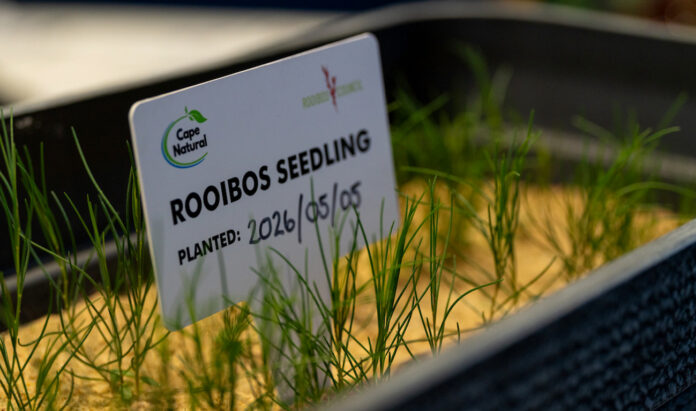
When the seeds return from space, they won’t disappear into a laboratory. Instead, they will find themselves back in the Cederberg, planted by pupils from seven local schools alongside ordinary rooibos seeds.
Over the next 18 months, these budding scientists will watch, measure and compare every stage of their growth, transforming classrooms into living laboratories and proving that curiosity can bloom just as beautifully as any plant.
For Judi Sandrock of MaxIQ Space, that’s exactly the point. “The value of this project lies in giving learners exposure to real research processes linked to space science. It provides a structured opportunity to develop scientific thinking, data analysis skills and an understanding of how experimentation works in practice.”
Of course, rooibos has never been content with being just tea.
Today, it stars in frothy cappuccinos, velvety lattes, sparkling iced teas and sophisticated mocktails. Chefs swirl it into syrups, bake it into cakes, churn it into ice cream and infuse it into chocolate.
Beauty lovers cherish it in facials and body lotions.
Few South African ingredients have reinvented themselves quite so gracefully. And if your morning cup of rooibos could talk; it would regale you with tales of the misty Cederberg mountains, crackling fires, grandmothers who believed it could cure almost anything, and lazy Sunday afternoons where time seemed to slow with every sip.
Now, rooibos can add the title of “intergalactic” to its profile and the rooibos story will be linked to outer space.
The mission also reflects a future where agriculture and space science are becoming companions.
As international space agencies prepare for longer missions to the moon and Mars, scientists are exploring how plants might one day feed astronauts, recycle air and help sustain life beyond earth.
Who would have thought that the same little red bush steeping in your favourite mug could one day help answer some of humanity’s biggest questions?
Perhaps that’s the magic of rooibos.
It has always had a way of making us feel at home. Soon, it might help us feel at home among the stars.
- Over 17,000 rooibos seeds from South Africa will be sent to the International Space Station in October as part of the Rooibos in Space initiative.
- The project, a collaboration between the South African Rooibos Council, MaxIQ Space, and the South African National Space Agency, aims to study how space conditions affect seed germination and growth.
- After returning to Earth, the seeds will be planted by students in the Cederberg to observe and compare growth with Earth-bound seeds, turning classrooms into living laboratories.
- The initiative seeks to promote scientific literacy and skills development by involving learners in real research connected to space science.
- Rooibos, a versatile South African plant widely used beyond tea, will now add "intergalactic" to its profile, linking agriculture with the future of space exploration.


