


Every month, thousands of South African girls walk into classrooms carrying more than just school bags. They carry anxiety, shame and fear, all because they are menstruating without access to sanitary pads.
Period poverty inside South African schools today is not an abstract concept; it is painfully visible. It boils down to girls missing three to five school days every month. And it looks like learners sitting through lessons worried about leaks and stains instead of focusing on maths or comprehension.
It also means girls using toilet paper, cloth, newspaper or nothing at all, because there is simply no alternative. Perhaps most damaging of all, it looks like silence. Girls not asking for help because menstruation is still treated as something shameful instead of a basic health and human occurrence.
Conspiracy of silence
According to Dr Vivian Mokome, founder of DGN Sanitary Pads, the silence surrounding menstruation is one of the biggest injustices facing young girls today.
“We are asking girls to compete academically while denying them the most basic tools to manage their bodies. That is not just unfair; it is a failure of the system,” she says.
Mokome’s journey into menstrual justice began during her work with the Mokome Foundation. Part of the foundation’s work involved school visits, which revealed a troubling pattern.
“I kept meeting girls who were absent from school for the same reason, they didn’t have sanitary pads. What shocked me was how normal this had become. Teachers expected it, learners accepted it, and no one was outraged,” she recalls.
What became clear was that donations alone could not solve the problem.
“Once-off charity makes us feel good, but it doesn’t change a girl’s reality month after month. We needed a sustainable, dignified solution that treats pads as a necessity, not a luxury,” Mokome explains.
Back-to-school pad drive
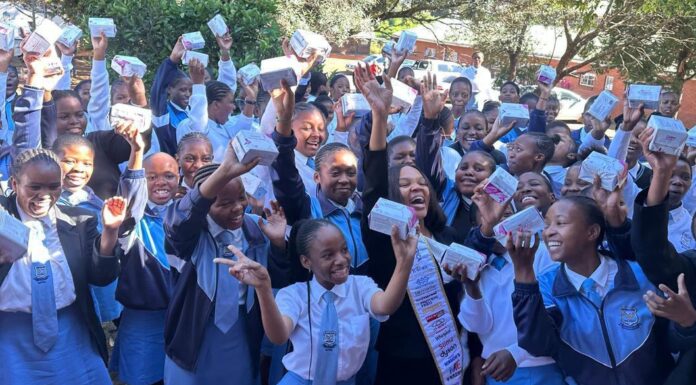
That realisation led to the establishment of DGN Sanitary Pads and initiatives such as the Back-to-School Pad Drive.
Research and school feedback show that girls can miss between three and five school days every month due to lack of menstrual products. Over a year, this results in weeks of lost learning. It contributes directly to poor academic performance and increased dropout rates.
Yet menstruation remains wrapped in stigma.
“Because periods are not openly discussed at home or in schools, girls are expected to suffer quietly. Silence becomes the rule, even when it costs them their education.
Unlike traditional donation campaigns, the Back-to-School Pad Drive is strategically timed at the start of the school term. This is when period-related absenteeism is at its highest.
“We deliberately connect menstrual health to education. Pads are not just hygiene products. They are learning tools, dignity tools and confidence tools,” she says.
This year, the initiative aims to reach thousands of learners in under-resourced township, rural and informal communities. The reach continues to grow as more partners come on board.
Breaking the stigma
The impact of period poverty goes far beyond attendance. Girls without pads live in constant fear of embarrassment, stains, odour and teasing.
“When a girl is anxious about her body, she cannot fully participate in class or social spaces. Access to pads restores her confidence and allows her to simply be a learner, not a problem,” Mokome explains.
A defining feature of DGN Sanitary Pads is its commitment to local, sustainable production.
“Locally produced, biodegradable pads lower costs, create jobs and ensure continuity. Sustainability is not just about the environment, it’s about reliability and dignity,” she says.
Despite progress, Mokome believes the education system still falls short of meeting menstruating learners’ needs.
“Menstrual health is not fully integrated into education planning. Many schools lack a consistent pad supply, private sanitation facilities and proper education. When these basics are missing, girls are left to cope alone.”
Where pads are consistently supplied, the difference is undeniable.
“Schools tell us attendance improves, participation increases and confidence grows. When girls know their period won’t stop them from learning, everything changes.”
Ending period poverty, she says, requires collective action.
Calling for support
“We need policy support, funding, local manufacturing, education and honest conversations. Pads must be treated as essential educational resources, not optional extras.”
She calls on both the public and private sectors to step in.
“Corporates, NGOs and government can support through funding, bulk procurement and distribution. Ordinary South Africans can help by supporting purpose-driven products and breaking the silence around menstruation.”
Period poverty is not inevitable. It is solvable.
“No girl should miss school simply because she is menstruating. Education should never be interrupted by biology.”



I really appreciate content like this—it’s clear, informative, and actually helpful. Definitely worth reading!
wow bro appreciate you sharing this blog post. link gacor Thanks Again. Cool bro nicee amazing