


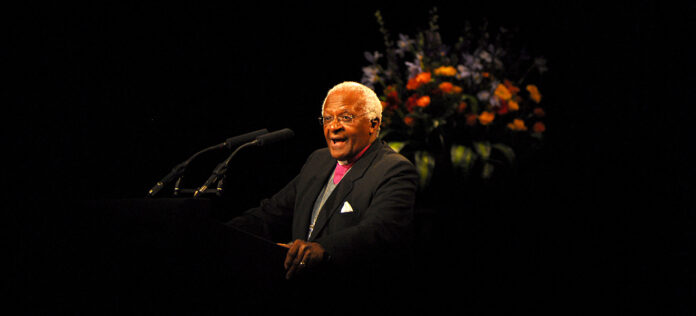
The life and times of Desmond Mpilo Tutu are captured in a powerful new documentary meant to draw attention to the legacy of the man who was affectionately known as the “Arch” to new generations – and to capture his many layers, from his candour and moral courage to his infectious laugh and larger-than-life personality.
The documentary, titled TUTU, recently won the prestigious Peace Film Prize at the Berlin International Film Festival, cementing its place as one of the most talked-about documentaries on the global festival circuit.
Those who are familiar with Tutu’s story get to witness him at work as well as outside of the glare of fame. The feature documentary is an intimate portrait of the man, the rebel cleric and the Nobel Peace Prize winner.
Directed by acclaimed filmmaker Sam Pollard, the documentary uses archive footage, including intimate behind-the-scenes material captured over more than twenty years, by South African journalist Roger Friedman and renowned photographer Benny Gool.
The documentary captures it all: Tutu intervenes to stop a mob from necklacing a man accused of being an informant and losing his temper over Ronald Reagan’s opposing sanctions, telling them, “The West… can go to hell.” In one scene, it shows him weeping while chairing the Truth and Reconciliation Commission, while in another, he is lovingly renewing his wedding vows.
Desmond & Leah Tutu Legacy Foundation CEO and spokesperson Janet Jobson said the project was always about showing audiences the man behind the global icon.
“When we first came alongside this project, our most sacred hope was simply that audiences would encounter the real Arch, not the statue, not the icon on the wall, but the man who laughed until his whole body shook, who wept in public without embarrassment, and who refused to separate love from confrontation,” Jobson said.
According to Jobson, the film’s emotional honesty is what makes it resonate so strongly with younger audiences today.
“Young people are acutely sensitive to authenticity. They will see through performance in seconds,” she said.
“What they encounter in this film is a man who never performed his faith or politics, who was the same person whether he was addressing the United Nations or comforting a widow in a township.”
The documentary arrives at a time when South Africa continues to grapple with inequality, youth unemployment and political division, issues Jobson believes Tutu spent his life confronting head-on.
“The Arch taught that dignity is non-negotiable and that reconciliation is not amnesia. Truth must be spoken before healing can begin.”
The film also revisits painful moments from apartheid history, something the foundation believes is critical as many elders from the generation who lived through the system’s atrocities are no longer around to tell the stories.
“The people who lived through apartheid are ageing. Within a generation, what is currently living memory will become an archive. The archive becomes an abstraction. Abstraction becomes denial.”
The documentary will premiere in South Africa at the Encounters International Documentary Festival next month, and Jobson hopes local audiences will leave cinemas changed.
“We hope audiences will laugh out loud the way everyone who ever spent time with the Arch laughed,” she said.
“We hope they will weep. We hope they will feel the heat of righteous anger at what was done to this country and recognise how much unfinished business remains.”
She added that the foundation wants younger South Africans, many of whom only know Tutu from textbooks, to get to experience him through film.
“For young South Africans who associate archbishop Tutu primarily with a face on a wall or a name on a building, we hope it will be a revelation,” she said.
“This man was young once too. He was angry. He was afraid. He chose every single day to act from love rather than fear.”
Jobson stated that the documentary’s success would ultimately depend on its impact on ordinary people, beyond awards and critical acclaim.
“Success looks like someone asking themselves what they believe about justice, dignity and what our shared humanity requires of us.”
- A new documentary highlights the life and legacy of Desmond Mpilo Tutu, affectionately known as “the Arch.”
- The film aims to introduce Tutu’s story to new generations.
- It captures his multifaceted personality, including his candour, moral courage, infectious laugh, and larger-than-life character.
- The documentary seeks to draw attention to Tutu’s enduring impact.
- Full story accessible via the e-edition of Sunday World.


