
There’s a quiet revolution happening on our roads. For years, diesel sport utility vehicles (SUVs) were the go-to choice for South African families who wanted range, torque and fuel economy.
After spending a week living with the Chery Tiggo 7 Super Hybrid (CHS) — courtesy of Chery South Africa — I’m more convinced that the plug-in hybrid electric vehicle (PHEV) might be the new sweet spot.
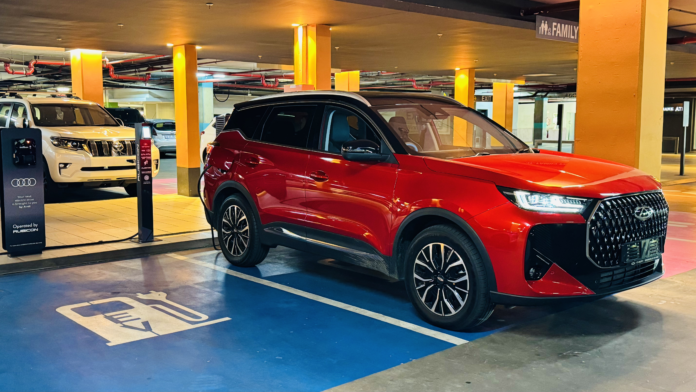
My test unit arrived dressed in a striking Bloodstone Red (a colour that turns heads) and riding on 18-inch wheels. Under the bonnet sits a turbocharged petrol engine paired with an electric motor, delivering a combined 265kW of power and a muscular 530 Nm of torque. That’s a serious punch for a family SUV.
The 18.3kWh battery delivered up to 93km of electric-only driving. That’s respectable, but it does fall short of rivals such as the Geely E5 EM-i PHEV, which pushes beyond the 105km mark — offering roughly 12km to 15km more usable range. In practical terms, that extra buffer can make the difference between squeezing in an additional late-afternoon errand or school run without the petrol engine cutting in. If you’re chasing maximum electric-only flexibility during the week, the Geely holds the advantage.
Smooth ride
On the road, the Tiggo 7 CHS feels smooth, refined and impressively responsive. The electric motor delivers instant shove off the line, while the transition between petrol and electric power is seamless. It’s the kind of drive that makes traffic feel less stressful.
Chery claims a combined range of up to 1,200km and fuel consumption of 5.4 L/100km. In practical terms? You could drive from Joburg to Durban and back with minimal fuel stops. That’s diesel territory and, in some cases, even better.
Charging proved painless. I plugged in at the DC fast charger at Design Quarter in Fourways, Johannesburg, and topped up from 25% to 100% in about 30 minutes—roughly the length of a coffee break at Vida e Caffè. That’s the beauty of a PHEV: charge when you can, refuel when you must.
Premium feel
Inside, the Tiggo doesn’t feel like a budget compromise. Dual digital displays dominate the dashboard, supported by a Qualcomm 8155 chipset that keeps everything quick and glitch-free. Wireless smartphone connectivity, intelligent voice control, an eight-speaker Sony sound system, and a 540-degree panoramic camera add to the premium feel.
Safety is equally reassuring, with eight airbags and a full suite of driver-assistance systems aligned with global NCAP standards. For families, that peace of mind matters.
Generous space
Boot space is generous too: 626 litres with the seats up and 1,672 litres with them folded down. Whether it’s school bags, a weekend getaway or groceries for “BoMma” back home in Limpopo, there’s room.
Rivals include the BYD Sealion 6 (R639,900), Geely E5 EM-i PHEV Apex (R675,995), and sister brands Jaecoo J7 SHS PHEV (R689,900) and Omoda C7 SHS PHEV (R689,900). The Tiggo is front-wheel-drive biased, and an all-wheel-drive option would certainly boost confidence on gravel roads in Limpopo, North West or rural KwaZulu-Natal and Eastern Cape.
Still, it already has feathers in its cap. It was named Eco Warrior of the Year at the 2025 TopGear SA Awards after achieving nearly 1,300km on a single tank in testing, and it’s a finalist in the 2026 South African Guild of Mobility Journalists (SAGMJ) Car of the Year competition.
Pricing starts at R599,900 for the CSH Plus and R679,900 for CSH Ultra, backed by a 5-year/150,000km vehicle warranty, 10-year/1,000,000km engine warranty and a 10-year unlimited mileage battery warranty.
Diesel should be worried. The plug-in era has arrived and it’s wearing red.


