
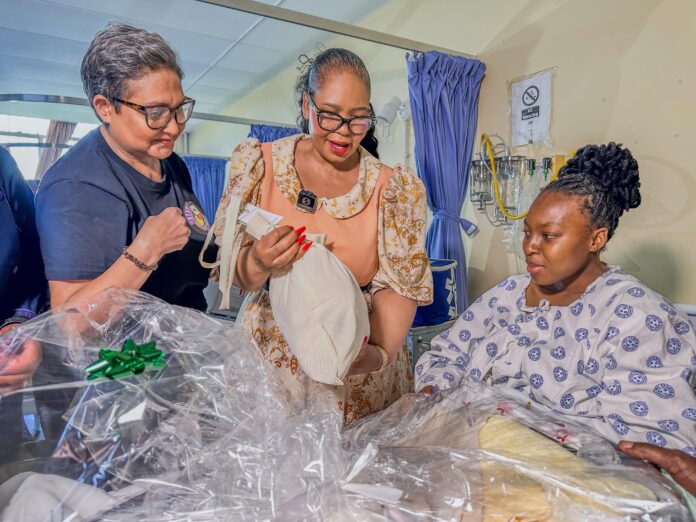
The persistent issue of children giving birth has once again clouded the nationwide celebration of New Year’s Day babies born on Thursday.
As with several other provinces, Gauteng welcomed hundreds of newborns, yet the persistence of teenage pregnancy—and the high risk of statutory rape—remained a major concern.
“A child giving birth to another child [is] a problem we need to deal with as a society,” said Gauteng Health MEC Nomantu Nkomo-Ralehoko, who visited Leratong Hospital to welcome mothers and newborns.
The department released official statistics on Friday, covering births recorded over a 24-hour cycle.
In total, 396 babies were born across Gauteng on New Year’s Day, with a strikingly even split of 198 boys and 198 girls.
Of these births, 204 took place at regional and district hospitals. Academic hospitals recorded the second-highest number with 79 births, followed by clinics and community health centres with 71.
Tertiary hospitals accounted for the remaining 42 births.
Nkomo-Ralehoko said addressing teenage pregnancy requires active collaboration beyond government, calling on religious and traditional leaders to work alongside the department.
“I’m working very closely with some of the religious [leaders]. We’ve trained some of them to be chaplains; hence, they are [within] the Department of Health chaplaincy,” she said.
“We trained them through the University of Wits. It’s helping us. I sincerely appreciate my team and other sister departments.
“We will be hitting the ground running, going to schools, and talking about teenage pregnancy and what must be done at home first.”
Call to protect women and children
Meanwhile, Limpopo Health MEC Dieketseng Mashego welcomed 106 New Year’s Day babies in her province.
Mashego visited Voortrekker Hospital and nearby community health centres, where she handed out gifts to new mothers.
Of the total births recorded in Limpopo, 51 were boys and 55 were girls, marking a hopeful start to the year for many families.
Mashego encouraged mothers to practice exclusive breastfeeding, noting that breastmilk provides essential nutrients crucial for healthy growth, development and immunity in newborns.
Her message also extended to the broader protection of women and children.
“I call on all community members, traditional leaders, faith-based organisations, and leaders from all walks of life to work together in protecting women and children.
We must report any form of gender-based violence and femicide as well as sexual abuse of minors,” said Mashego.
16-year-olds are youngest moms
Meanwhile, KwaZulu-Natal Health MEC Nomagugu Simelane, while welcoming dozens of New Year babies born across the province, sounded a strong warning over persistently high levels of child and teenage pregnancy.
She revealed that on Christmas Day alone, KwaZulu-Natal recorded 302 births—166 girls and 136 boys—with 70 of the mothers being teenagers.
For New Year’s Day, the youngest mothers were two 16-year-olds who gave birth at Benedictine Hospital and Queen Nandi Regional Hospital, respectively.
In both cases, the fathers were 21 years old. Alarmingly, both girls were just 15 years old when they fell pregnant.
Simelane further disclosed that the province recorded a total of nine teenage mothers on New Year’s Day.
This included one 17-year-old at Newcastle Provincial Hospital; four 18-year-olds at Prince Mshiyeni Memorial Hospital, Mseleni Hospital, and Queen Nandi Regional Hospital; as well as two 19-year-olds at Mahatma Gandhi and Eshowe hospitals.
“These statistics are a cause for deep concern and emphasise the need to continue providing education, guidance, and access to reproductive healthcare for teenagers,” said Simelane.
9 000 teen pregnancies recorded
Mpumalanga health MEC Sasekani Manzini has welcomed 50 New Year babies while lamenting the overall teenage pregnancy crisis facing the province, totalling more than 9 000 teenage pregnancies recorded in the province.
Manzini was talking about the issue of teenage pregnancies, with the youngest New Year mother in Mpumalanga being 14 years old out of six teenagers who gave birth on the same day.
“We have registered one case of a 14-year-old at Themba Hospital. It’s a grave matter. From the side of the health department, we need to fill out a form called Form 22 so that we can take it to the social development department for processing,” she said.
Manzini said the information will enable officials to take the matter up with the police and the National Prosecuting Authority.
Most shocking was the revelation that Mpumalanga registered a staggering 9 712 teenage pregnancy record in 2025 alone.
“As a province, we have recorded 9 712 teenage pregnancies,” she said. “Out of that are those that are above the age of 17.
“This is a programme that we are going to work on as a cluster…so that as a provincial government we are able to deal with these cases.”