
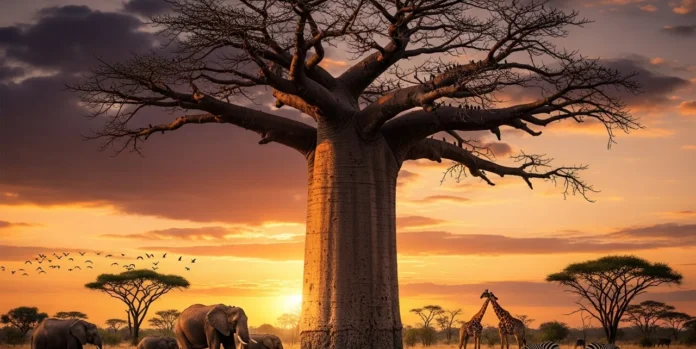
For centuries, the baobab has stood as one of Africa’s most powerful natural provider of food, medicine, water, and cultural meaning.
Today, the ancient tree is gaining global recognition as a prized “superfood” in international health, wellness, and cosmetics markets. But as global demand for baobab products accelerates, concern is growing that commercialisation may be outpacing conservation.
Baobab fruit pulp has been approved as a food ingredient in both the EU and the US, which helped catalyse its global market expansion. The global baobab ingredient market, including powders, pulp and oils, is already valued at around $5-5.4-billion in 2024-2025. And it is projected to grow toward more than $9-billion by 2035, according to Future Market Insights’ global report.
Countries such as Zimbabwe, Kenya and Malawi are increasingly integrated into these global supply chains. While exports from Africa, historically in the hundreds of tonnes, had ambitions to reach around 5,000 tonnes by 2025 as processing and trade infrastructure improves.
Not easily replaced
Yet unlike many commercial crops, baobabs are not easily replaced. The trees grow extremely slowly, often taking decades before they begin producing fruit. Some specimens across southern and eastern Africa are estimated to be more than 1, 000 years old. Overharvesting fruit today risks undermining regeneration for generations to come.
Baobabs play a critical ecological role in dryland ecosystems. Their massive trunks can store up to 136, 000 litres of water in its trunk, providing a buffer for surrounding vegetation and wildlife during prolonged droughts. They provide habitat for birds, insects and mammals. And they rely on specialised pollinators such as bats and bush babies to reproduce.
However, climate change is reshaping rainfall patterns and temperature regimes in many parts of Africa. This can disrupt flowering cycles, reduce pollinator populations, and hinder seedling survival. And as such, pose a threat to these long-lived giants and the ecosystems they sustain.
Natural regeneration weakened
Commercial harvesting adds another layer of stress because it involves climbing trees or striking branches to dislodge pods. This can damage bark and limbs. Excessive removal of fruit also reduces seed dispersal, weakening natural regeneration. Without clear harvesting guidelines, demand-driven extraction risks turning a resilient species into a vulnerable one.
In 2022, several mature baobab trees were uprooted in Kenya and exported for ornamental use abroad. None survived the journey. The incident highlighted regulatory gaps and raised alarm over biopiracy and the commodification of irreplaceable natural heritage.
Beyond ecology, many communities regard baobabs as sacred gathering places or spiritual landmarks. Traditionally, taboos and customs helped protect the trees from damage. However, modern land-use pressures, agricultural expansion, and commercial incentives are eroding these informal cultural and governance systems.
The regulation of harvesting, trade, and export remains inconsistent across countries. Few national frameworks set clear limits on sustainable yields or require replanting and conservation measures. Certification systems for ethically and sustainably sourced baobab are still emerging. This leaves buyers with limited transparency.
Biodiversity protection
At the same time, baobab presents a rare opportunity to build a different kind of natural resource economy. An economy rooted in biodiversity protection, indigenous knowledge, and community-led stewardship.
Sustainable harvesting protocols, community cooperatives, and benefit-sharing agreements could ensure that commercial demand strengthens rather than undermines conservation.
As investors, brands and consumers increasingly demand “natural” and “ethical” ingredients. Scrutiny must extend beyond carbon footprints to biodiversity, cultural heritage, and long-term resilience.