
When the conversation turns to electric vehicle (EV) adoption in South Africa and across the continent, one recurring concern dominates: charging infrastructure.
For many, the lack of accessible, reliable, and fast-charging stations is the single biggest obstacle to embracing cleaner mobility.
However, a bold new initiative is aiming not just to address the gap but to reimagine what’s possible. Enter CHARGE, formerly known as Zero Carbon Charge, a company on a mission to build South Africa’s first nationwide network of premium, entirely off-grid, solar-powered EV charging stations.
R100m equity investment
In 2025, the company secured a catalytic R100-million equity investment from the Development Bank of Southern Africa (DBSA)—a move that signals serious institutional belief in both the company and the viability of green mobility infrastructure.
“This is not a loan; it’s equity funding,” says Larissa Venter, the Chief Business Development Officer of CHARGE. “It demonstrates the DBSA’s long-term faith in our sustainability.
“This funding unlocks our ability to develop our first fully off-grid EV charging sites—a foundational step toward redefining energy and mobility in South Africa.”

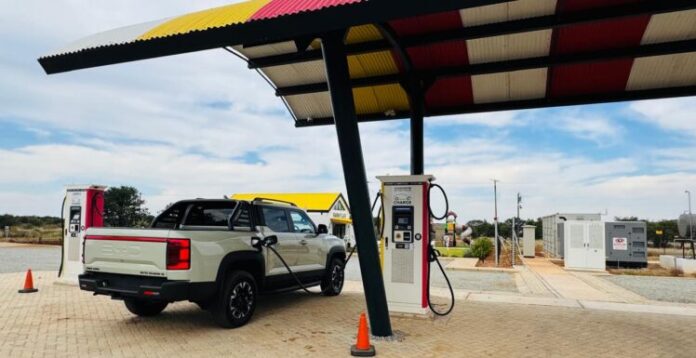
At its pilot site near Wolmaransstad, North West, CHARGE offers more than just kilowatts.
The station features four ultra-fast 480kW chargers, full battery redundancy, seamless software integration, and lifestyle amenities like Wi-Fi, a curated coffee shop, and secure rest stops—all powered by the sun.
“We’re delivering premium-grade charging—and a premium-grade experience,” says Venter. “There’s nothing like it on the continent.”
The goal is ambitious: 120 ultra-fast solar-powered stations by 2027, covering all of South Africa’s national roads.
30 sites along the N1 and N3
The rollout will begin with 30 sites along the N1 (Johannesburg to Cape Town) and the N3 (Johannesburg to Durban), with five stations constructed at a time for efficiency.
Each station will be strategically placed every 150km, ensuring continuous access and peace of mind for EV drivers. But CHARGE is not just in the business of building stations—it’s catalysing a new economy.
“We want to lead a transition that creates opportunities for local entrepreneurs and positions EV charging as a self-sustaining industry,” says Venter.
“We envision a future where green mobility is accessible, reliable, and proudly South African.”
Admittedly, CHARGE’s charging costs are currently higher than grid-tied alternatives like GridCars. But Venter makes a strong case for the premium.
“We generate clean power on-site, 24/7, independent of Eskom. Our rate is R8 plus VAT (value-added tax) per kW—slightly higher than the R7 to R7.50 rates of grid operators, but we offer speed, reliability, zero emissions and a controlled pricing model immune to Eskom’s tariff hikes.
While CHARGE’s vision is clear, Venter is quick to point out the friction between ambition and regulation.
“We need more than speeches about green economies—we need action. In places like the Western Cape, we see strong provincial rhetoric about sustainability, yet local regulations can delay or block off-grid infrastructure projects.”
She calls for faster permitting, reduced red tape, and a relook at counterproductive policies—including high import duties on EVs and critical components like batteries, which make EV ownership inaccessible to many South Africans.
“If we want jobs and skills in this sector, we must first create the market,” she says.
Role of Rubicon South Africa
Rubicon South Africa, another major player in the space, is approaching the problem differently.
The company has installed 119 AC and DC chargers across the country, with a goal of hitting 200 by February 2026.
However, they’re taking a more incremental, grid-tied approach.
“We don’t build bespoke solar-powered charging stations yet,” says Hilton Musk, head of e-mobility at Rubicon SA.
“Solar can always be added later, and our priority right now is increasing coverage in line with EV demand. A solar solution must have dual benefits—not just serve the charging station.”
Rubicon has developed a microgrid controller system to track the energy mix at charging sites, enabling precise reporting on how much solar power is being used.
Musk acknowledges that off-grid charging is the future, provided that EV volumes justify the investment.
He highlights a major barrier to growth: municipal electricity tariffs. “They often hinder rather than help network expansion.
Pro-EV policies, vehicle import reforms, and incentives for solar-powered stations could dramatically shift the investment landscape.”
Despite these challenges, the shift toward EVs in South Africa is unmistakable. Institutions like the Industrial Development Corporation and the Automotive Industry Transformation Fund are already ring-fencing funding to support entrepreneurs focused on EV infrastructure and localisation.
South Africa’s path to EV adoption may not mirror that of Europe or China—but, in typical African fashion, it’s carving out a path that is innovative, resilient, and deeply attuned to the realities of the continent.
CHARGE is proving that the future isn’t just about getting from A to B. It’s about how we power that journey—and who gets empowered along the way.
Edward is a freelance writer specialising in the automotive and technology sectors, with over 22 years of multi-industry experience in public relations and corporate communications. He currently contributes to a range of platforms and publications.


