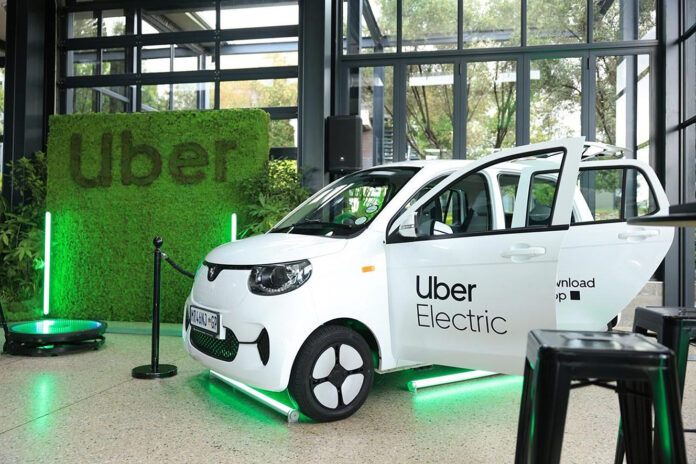
Uber has moved decisively into South Africa’s electric-mobility transition, launching its first fully electric ride-hailing service, Uber Go Electric, while expanding its low-cost Uber Moto offering across Johannesburg.
The dual rollout marks the company’s strongest attempt yet to respond to South Africa’s affordability crisis, the country’s lagging electric vehicle (EV) adoption, and the growing pressure to decarbonise urban transport.
South African commuters spend up to 30% of their monthly income on transport, which is among the highest shares globally, according to the National Association of Automobile Manufacturers of South Africa (Naamsa).
The country has about 250 000 ride-hailing drivers, but fewer than 1 000 registered electric vehicles, representing under 0.2% of the national vehicle fleet.
Against that backdrop, Uber’s 100 EV launch signals a strategic shift in a market where cost, climate, and congestion pressures are converging fast.
Uber Go Electric operates through compact, fully electric vehicles supplied by local fleet partner Valternative, which offers lease-to-own packages aimed at improving driver access. The service is rolling out initially in high-demand nodes such as Sandton, Rosebank and parts of northern Johannesburg.
Fuel is the largest expense for ride-hailing drivers, with many spending R3 500 to R6 000 per week on petrol, according to Uber and Bolt’s 2024 economic reports.
With petrol hovering around R22.50 per litre in 2024-2025, EVs offer a meaningful financial difference.
Uber says its EV category can reduce operating costs by 35% to 45%, depending on mileage and charging patterns.
Those savings create room for cheaper fares while improving driver take-home income, a crucial factor in a market burdened by rising living costs.
South Africa’s ride-hailing economy is valued at about R22-billion a year, and Uber commands nearly 70% of the formal market.
The pilot’s success could determine how quickly the wider ecosystem adopts electric mobility.
While the EV category tackles cost and climate constraints, Uber Moto targets extreme affordability. The motorcycle-based option, launched quietly as a pilot in early 2025, is now operational in more than 20 Johannesburg suburbs.
Moto completes over 1 500 trips per day, according to early platform data, with fares averaging 30% lower than Uber Go.
EV sales doubled in 2024, according to Naamsa, driven largely by commercial fleets and high-income early adopters.
National charging infrastructure has expanded to about 700 public charging points, with Johannesburg hosting around 35% of all installations. This density made it possible for Uber to pilot an electric fleet in the city.
From a climate perspective, the shift is significant.
Traditional ride-hailing vehicles emit 120-170g of CO₂ per kilometre, according to the Intergovernmental Panel on Climate Change’s Transport Emissions Factors.
If just 500 of Johannesburg’s ride-hailing cars became electric, the city could avoid 20 000 to 30 000 tonnes of CO₂ emissions annually, depending on trip distance and grid intensity.
While the national grid remains coal-heavy, EVs still offer lifecycle benefits.
Still, South Africa’s charging network remains uneven, there is no large-scale facilities equipped to service or refurbish electric-vehicle motors and battery systems, and EV affordability remains out of reach for most drivers without fleet support.
Moto, meanwhile, must navigate safety concerns, regulatory alignment and integration with local taxi associations.
Uber’s combined EV and Moto rollout signals a future where South Africa’s mobility ecosystem becomes multi-modal, lower-cost, and cleaner.
The shift is neither instant nor guaranteed, but it demonstrates how electrification and affordability can advance together.