


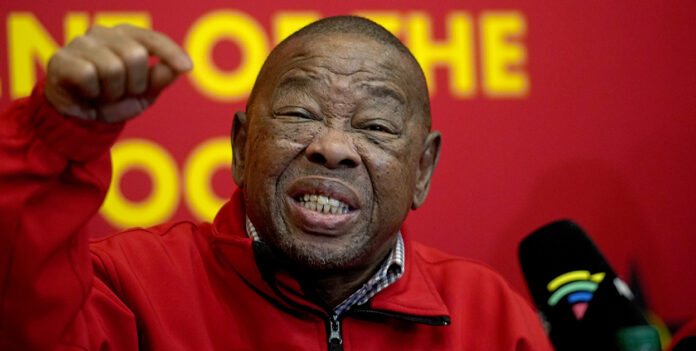
SACP national chairperson Blade Nzimande’s call for an emergency congress to halt the party’s planned independent run in the 2026 local elections against the ANC has triggered a ferocious reply from a former union leader who is also a party member in Gauteng.
Former Police and Prisons Civil Rights Union (Popcru) provincial secretary Phiri Matsemela argues in his rebuttal, dated November 11, that Nzimande’s intervention is a hypocritical and destructive act that feeds his successor, Solly Mapaila, to “the worst enemies of the revolution”.
Matsemela, whose SACP branch is based in Ekurhuleni, has branded Nzimande’s proposal as everything from a late-in-the-day act of sabotage to a calculated power play, exposing deep ideological and personal fractures that threaten to shatter the party’s long-standing alliance with the governing ANC.
The face-off centres on a resolution, first taken at the SACP’s 11th Congress in 2002, and later activated for implementation, for the party to contest elections independently.
This decision was “largely strategic and aspirational, with no immediate implementation mechanisms” for years, but recent congresses have built concrete electoral capacity towards the 2026 poll.
Now, Nzimande, the party’s former long-serving general secretary (GS) and also minister of science, technology and innovation, has thrown a wrench in the works.
In a discussion document, he argues for a strategic review, a move that has drawn a scorching rebuttal from within the party’s ranks.
A detailed response, penned by Matsemela, accuses Nzimande of a gross breach of protocol and a deliberate attempt to destabilise the current leadership. “One can’t help but be left with a deep sense of regret and disappointment by the manner in which this vanguard party of the working class has been grossly and without any regard for its historical role reduced to something that is of no historical significance and value,” the response states.
The core of the criticism against Nzimande is one of timing and intent. The response document poses a series of damning rhetorical questions, asking why the chairperson is only now raising objections.
“Shouldn’t these observations he is making have been presented or analysed by the CC (central committee) since the 15th Congress?” it demands.
“What is the national chairperson intending to achieve by these good thoughts at this time when almost huge damage has been done?”
Matsemela suggests a personal and factional motive, asking, “Should we then conclude that the reason Cde Blade has suddenly discovered his independent personal razor-sharp reasoning is because of the dissolution of the SACP KZN PEC recently, which largely and for most of its existence was his political guiding shield?”
Nzimande’s document reportedly raises substantive concerns, warning that the implementation of the resolution has “far-reaching implications, particularly for the principle of dual membership, which has been the fundamental glue of our alliance”.
He is quoted as cautioning that it has “already created confusion within party ranks, with no clear, unified approach on how it should be handled”.
But to his detractors, this is a case of too little, too late from a man who presided over the party for decades. “Cde Nzimande is directly responsible for planting confusion and division within the entire membership of the SACP, including animosity with the ANC leadership,” the response charges, arguing he should have used his “institutional memory” to guide the party earlier.
The rebuttal paints a picture of a ruthless political operator.
“Accordingly, having examined the volatility of the situation and calculated the vulnerability of the GS and the CC, he suddenly releases his personal document for the congress’s consideration, littered with extensive Marxist-Leninist expressions, with the sole intention of completely weakening the GS to a point of dislocation.”
Instead of Nzimande’s proposed special national congress, the response calls for a different kind of gathering.
“Shouldn’t we be making a noble call for the SACP for an all-inclusive national consultative congress, which shall be constituted by, amongst others, veterans of the SACP and SACP activists, many of whom were unfairly checked out of the party under the leadership of Cde Nzimande?”
This gathering, it argues, is needed to address historical failures under Nzimande’s own leadership.
“Under the leadership of Cde Blade Nzimande as the general secretary of the SACP, a lot of capable and grass-roots activists were destroyed, decimated politically and donated to be ultra-leftist organisations,” the document claims.
“Dissent was treated as the principal enemy instead of the capitalist system of production.”
- SACP national chairperson Blade Nzimande’s call for an emergency congress to halt the party’s planned independent run in the 2026 local elections against the ANC has triggered a ferocious reply from a former union leader who is also a party member in Gauteng.
- Former Police and Prisons Civil Rights Union (Popcru) provincial secretary Phiri Matsemela argues in his rebuttal, dated November 11, that Nzimande’s intervention is a hypocritical and destructive act that feeds his successor, Solly Mapaila, to “the worst enemies of the revolution”.
- Matsemela, whose SACP branch is based in Ekurhuleni, has branded Nzimande’s proposal as everything from a late-in-the-day act of sabotage to a calculated power play, exposing deep ideological and personal fractures that threaten to shatter the party’s long-standing alliance with the governing ANC.
- The face-off centres on a resolution, first taken at the SACP’s 11th Congress in 2002, and later activated for implementation, for the party to contest elections independently.
- This decision was “largely strategic and aspirational, with no immediate implementation mechanisms” for years, but recent congresses have built concrete electoral capacity towards the 2026 poll.


