


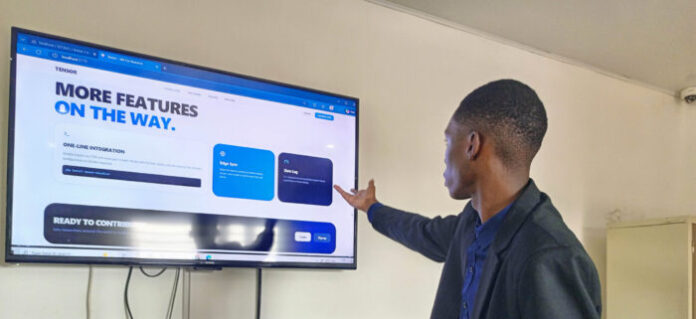
Twenty-year-old software engineering student Innocent Mugwadi presents a slideshow in the front of a classroom before his fellow classmates at the Information and Communications University (ICU) in Lusaka, Zambia.
“The reason why I built this project is to solve one specific problem, which is trying to build AI systems whilst understanding the mathematical aspect of it,” he said.
Mugwadi, currently in his second year at the private university, said his passion for programming began at a young age when he taught himself how to build games and systems while still in Grade 9.
His invention, called Tensor, is a system designed to explain the mathematical operations that organise neural networks. The platform targets students, researchers and machine-learning engineers to help them understand the mathematics behind AI. It is currently in the development stage. The idea for Tensor emerged from Mugwadi’s own academic challenges.
“When I started working on AI-related software projects, I realised I needed a certain level of mathematics. And I was generally not strong in that area. I attended several bootcamps and AI events. But most of them did not focus on the mathematical side of AI,” he said.
He believes this gap has made it easier for many developers to use AI tools without fully understanding how the systems work.
Challenge with AI systems
“Most software engineers can build with AI. But not everyone can build AI systems themselves because they struggle with the mathematics. That is where my project comes in,” he said.
One of Tensor’s key features uses AI to translate complex mathematical functions into more human-readable explanations. It enables users to better grasp the logic behind algorithms rather than simply interpreting numbers and symbols.
For Danny Musenge, dean of ICU’s school of engineering, locally crafted AI-enabled innovations like the one Mugwadi has created are what Zambia needs.
“Let us not wait for Western countries to decide which AI platforms we should use. We must innovate ourselves. The only way we will solve the challenges we face as a country is by developing our own tools and innovations,” Musenge told bird.
He believes that universities must play a vital role in the ecosystem to support and churn out the next generation of the country’s tech pioneers.
“AI is here to stay, and we need to embrace it. We need to encourage it in universities,” he said. “Our focus is on innovation and practical learning. So that students are not just consumers of knowledge but creators of solutions.”
Private sector coming on board
While educational institutions push onwards in their role, players in the private sector are also eager to help tech-driven ideas actualise into scalable businesses.
Dr Tafadzwa Munzwa, a specialist in tech businesses and the co-founder and executive director of DAWA Health, an AI-powered digital health platform focused on democratising access to sexual and reproductive, maternal, and child health services, believes Zambia’s innovation ecosystem is being reshaped by young people.
“Young Zambians are really embracing emerging technologies like artificial intelligence. Across the ecosystem, I know many young innovators who are integrating AI into different parts of the economy. From fraud detection to credit risk scoring to crop-field prediction. Diagnosing plants, in healthcare, understanding complications, all that, trying to really improve the ecosystem,” he said, adding that local solutions also drive domestic economic growth.
He is optimistic about Zambia’s future as a regional innovation leader. And he cites growing institutional and government support for young innovators.
“I truly believe Zambia will be a leader in innovation. Because young, ambitious innovators are being given platforms to create. The government is developing a Young Innovators bill that will specifically support innovation as a distinct sector. There is also a virtual fund to invest in young innovators. Alongside key partners such as ZICTA, a statutory parastatal that runs annual ICT innovation programmes offering business coaching and support to help innovators scale,” he said.
Africa’s emerging innovation hub
According to Dr Munzwa, these combined efforts are already positioning Zambia as one of Africa’s emerging innovation hubs.
“All of this is pushing Zambia to become one of the leading innovative countries on the continent. Particularly in Southern Africa. Our university education system is also quite strong, which gives young people the foundation they need to build globally competitive solutions,” he added.
Another engineering student who is channeling creativity through artificial intelligence is Enock Chisulo. As a child, Chisulo didn’t play with toys. He played with wires. While other children pushed plastic cars across the ground, Chisulo twisted scraps of wire together, imagining engines and motion.
From discarded metal and fence wire, he built tiny cars, rough and imperfect but alive with curiosity. Those early experiments were more than play. They were lessons in problem-solving, creativity, and persistence. Long before he knew what innovation meant.
Today, at 24, Chisulo is a fourth-year electrical engineering student at the University of Zambia (UNZA). He is the founder of Moteev, an AI-powered online grocery platform quietly transforming how students shop on campus.
Turning campus challenges into digital hit
When Chisulo arrived at UNZA in Lusaka from Copperbelt in 2021 as a first-year student, he was eager to begin his engineering journey. But campus life came with an unexpected challenge. Groceries were expensive, basic essentials were hard to find. And buying food often meant long walks to surrounding neighbourhoods like Kalingalinga. Or costly trips to shopping malls.
Students carried heavy bags back to their hostels. They were losing valuable time and spending money they could hardly afford. For many, it meant stepping away from assignments, study time, and rest, just to buy food.
“When I came to UNZA, the first thing I noticed about living on campus was the high cost of living. Buying groceries on campus is very expensive, and sometimes you don’t find everything you need. So students often opt to buy from outside,” Chisulo told bird.
Instead of accepting it as normal, Chisulo asked a simple question: What if students didn’t have to leave campus at all?
That question became the foundation of Moteev in 2022. What began as a small, informal WhatsApp-based service soon evolved into a structured digital platform.
With Moteev, students can order groceries and essentials directly from their phones, receive smart recommendations, and have their items delivered straight to their hostels. Today, the platform serves more than 800 students across the University of Zambia and the Copperbelt University.
Hobby that paid off big
“To be honest, it started as a hobby, and I didn’t expect it to grow to where it is now. However, when we saw the response from people, we realised that this is a real need we can focus on and turn into a solution. Even beyond students,” he said.
For Humphrey Chama, a fourth-year software engineering student at UNZA, Moteev has made a real difference.
“Before Moteev, we used to leave our assignments just to go and look for groceries, it took a lot of time. This app really helped us, and it’s inspiring knowing it was created by a fellow student,” Chama said.
Beyond convenience, Chama believes platforms like Moteev highlight the untapped potential of young innovators.
“As a software engineering student, I can tell you young people have good ideas that need support. We can’t keep outsourcing services when we have students who can build these solutions themselves,” he said.
According to Brenda Zulu, an expert in digital tech solutions, the platform demonstrates how technology can directly improve everyday life.
“Moteev is a real-world application of AI. It understands user needs, streamlines shopping, and optimises delivery. It is an excellent innovation that should serve as an example of the kinds of projects young people can pursue,” Zulu explained.
Key drivers of economic growth
Platforms like Moteev and Tensor reflect Zambia’s broader digital shift. Under the National Digital Transformation Strategy 2023–2027, digital entrepreneurship and AI are recognised as key drivers of economic growth. Moteev and Tensor sit squarely at the intersection of these national goals. Locally built, youth-led, and problem-focused.
Chisulo’s team of 18 is now planning to expand Moteev’s operation beyond university campuses. He has long-term ambitions to scale across Zambia and eventually into other African countries, including South Africa, Botswana, Kenya, Ghana, Nigeria, and the Democratic Republic of Congo.
In 2025, his work gained international recognition when he won the prestigious 2-Minute Drill Competition, hosted by renowned American entrepreneur David Meltzer. The win marked a turning point, validating a solution that began with a simple campus problem.
Meanwhile, Mugwadi envisions Tensor being adopted by universities, research centres and training bootcamps. As well as companies seeking to better understand how AI models operate within their businesses.
“At the moment, business and AI are areas that can help improve Zambia’s economy. Tools like this will help organisations understand how their AI systems can perform better,” he said.
Opportunities beyond borders
For Mugwadi and Chisulo, the horizon holds vast opportunities.
“We need to look at the problems we face as a country and understand that many of them are global. By consistently working on solutions, Zambia can develop innovations that are useful beyond our borders,” Mugwadi said.
They are part of a growing network of young Zambians who are boldly offering AI-powered solutions for real-world challenges. And they seek support from universities, public agencies, incubators and private sector players to scale up their initiatives.
Visit SW YouTube Channel for our video content
- Twenty-year-old software engineering student Innocent Mugwadi presents a slideshow in the front of a classroom before his fellow classmates at the Information and Communications University (ICU) in Lusaka, Zambia.
- “The reason why I built this project is to solve one specific problem, which is trying to build AI systems whilst understanding the mathematical aspect of it,” he said.
- Mugwadi, currently in his second year at the private university, said his passion for programming began at a young age when he taught himself how to build games and systems while still in Grade 9.
- His invention, called Tensor, is a system designed to explain the mathematical operations that organise neural networks.
- The platform targets students, researchers and machine-learning engineers to help them understand the mathematics behind AI.


