


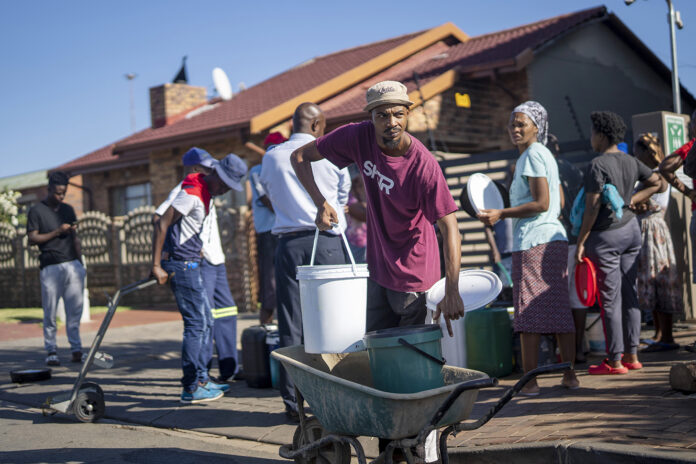
As South Africa’s water crisis deepens, a senior government official has argued that the country’s problem is not a lack of engineers but a failure to deploy them where they are most needed.
In an interview amid mounting scrutiny over deteriorating municipal water systems, the official said South Africa has approximately 40 000 engineers in total, of whom about 32 000 are actively practising. However, the majority of those professionals are concentrated in Gauteng, leaving rural provinces with severe technical shortages.
“We have about 40 000 engineers in this country. Around 32 000 are in practice,” the official said. “The bulk of them are in Gauteng. Other provinces do not have many engineers.”
The comments cut into a long-running debate over whether South Africa’s water failures stem primarily from funding constraints or from governance and skills deficits within local government. Across multiple municipalities, infrastructure breakdowns have become routine, with pump stations failing, reservoirs fluctuating, treatment plants operating below capacity and ageing pipelines leaking millions of litres of water daily.
According to the official, the issue is not an absolute national shortage of engineers but a structural imbalance in how technical expertise is distributed and retained. Many engineers are employed in the private sector, particularly in mining, construction and consulting firms clustered around Gauteng’s economic hub. Rural municipalities, often facing financial instability and political volatility, struggle to attract and retain qualified professionals.
In some cases, experienced former water staff were not rehired, while individuals without sufficient engineering or technical backgrounds were appointed to critical posts.
The capacity gap is particularly acute in poorer provinces. In Free State, it previously emerged that only six out of 76 municipal employees classified as engineers were professionally registered, exposing deep technical deficiencies within local government structures.
“Part of the water action plan is to make sure that there are engineers even in rural provinces,” the official said.
South Africa’s constitutional framework had further complicated intervention.
Water provision falls primarily under municipal authority, while the national government sets policy and regulatory oversight.
“Our Constitution gives a lot of power to municipalities,” the official noted, suggesting that any significant restructuring of water governance would require legislative reform.
That reform, however, takes time. For residents in struggling towns and rural districts, time is precisely what has run out.
During the debate on the State of the Nation Address this week, Minister in the Presidency Khumbudzo Ntshavheni said work had already begun through the Presidency and the Department of Water and Sanitation to conduct nationwide assessments toward a comprehensive Water Action Plan, which she indicated should be ready by mid-March 2026.
She said the plan focuses on mobilising technical capacity and expertise to support municipalities in crisis, addressing immediate breakdowns in water systems, driving sector reforms and unlocking investment in municipal water
infrastructure.
President Cyril Ramaphosa told Parliament that the government would elevate the response to the water crisis through the establishment of a National Water Crisis Committee, which will deploy technical experts and national resources to
municipalities facing water challenges.
Ramaphosa said criminal charges had already been laid against 56 municipalities that failed to meet their water obligations. He further announced an R54-billion incentive programme aimed at supporting metros to reform water, sanitation and electricity services to ensure revenue is reinvested into infrastructure upgrades and maintenance.
The president also committed to building new dams and upgrading existing infrastructure to strengthen long-term water security, establishing a National Water Resource Infrastructure Agency to mobilise funding and manage water projects more effectively.


