


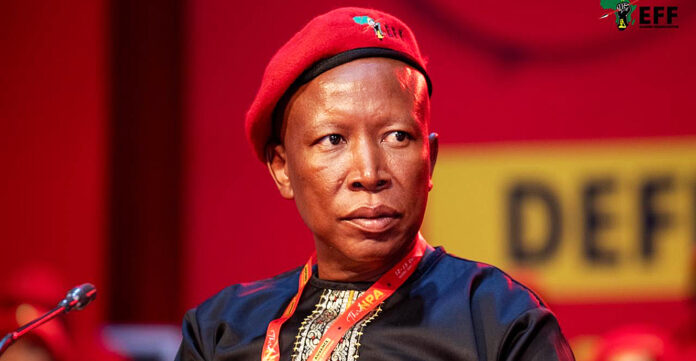
Julius Malema, the leader of the EFF, appeared before the East London Magistrate’s Court on Friday for pre-sentencing proceedings in his firearm-related case, raising questions about his political future.
In 2025, Malema was found guilty of unlawfully firing a firearm at a packed EFF rally in Mdantsane, just outside East London in the Eastern Cape.
Both the defence and the state have argued about what should be taken into account when deciding on a suitable punishment, but the court has not yet imposed a sentence.
Malema’s legal team called on a social worker to testify about his upbringing, personal circumstances, and social standing.
Additionally, a pre-sentencing report was provided to help the court determine the wider effects a sentence would have on the accused and his dependents.
Strong social support system
In her statement to the court, the social worker said Malema was brought up with a strong sense of family and community duty.
“He learned the importance of family from a young age and has maintained close relationships with his immediate and extended family throughout his life,” the social worker told the court.
She stated that Malema still depends on his family for emotional support and direction, especially during stressful times, and that this support system was crucial to his stability.
“He has a strong social support system, which acts as a protective factor and significantly reduces the risk of reoffending,” she testified.
According to the report, Malema’s conviction has a significant impact on his future prospects, professional relationships, and functions.
The conviction makes him ineligible to serve as a member of the National Assembly, even though he may apply for additional education and specific services within criminal investigation and reliability structures.
According to the law, this disqualification would last for five years after the completion of any sentence given, thereby barring Malema from serving as his constituency’s representative during that time.
Malema’s removal from public office would have broader social repercussions, the social worker cautioned.
“His absence would not only affect him personally but could also create a void for the communities he represents, many of whom view him as a voice for their concerns,” she said.
No evidence of pattern of criminal behaviour
The court also heard that imposing a custodial sentence on Malema would hinder his involvement in community-based projects.
The report warned that the EFF leader’s ongoing free projects might be compromised, which would be detrimental to the recipients.
The social worker informed the court that there was no evidence of a pattern of criminal behavior, despite acknowledging the seriousness of the offence.
“There is no evidence suggesting habitual or repeated offending. Based on my assessment, the risk of reoffending is low,” she said.
On this basis, the defence argued that alternative sentencing options should be considered.
It was further submitted that a harsh sentence would have a severe impact on the well-being of Malema’s children and would hinder his ability to fulfill his political responsibilities.
The state is currently cross-examining the social worker to oppose any suggestion of leniency, arguing that the offence undermines public safety and the rule of law.


