
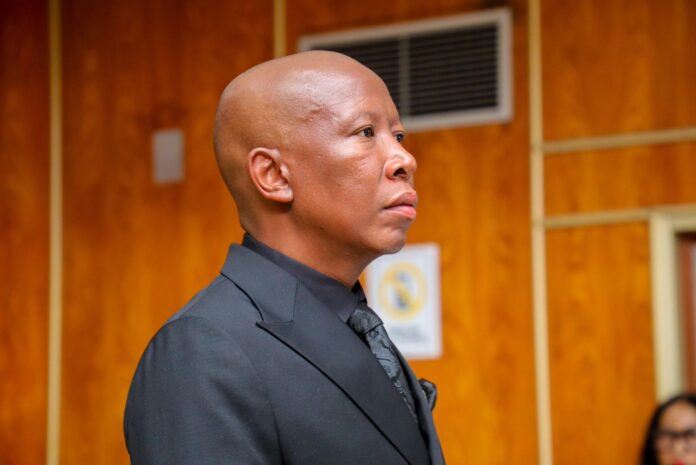
As the East London Magistrate’s Court continues to consider issues of responsibility, risk, regret, and the wider ramifications of firearm-related offences during his pre-sentencing proceedings, EFF leader Julius Malema’s political future is still in doubt.
Malema was convicted in 2025 of the unlawful discharge of a firearm at an EFF rally in Mdantsane. The court is weighing submissions from both the state and the defence before imposing sentence.
Tension rose on Friday as Magistrate Twanet Olivier, alongside the state, grilled the defence’s social worker, who had compiled a pre-sentencing report.
The magistrate emphasised the broader context of gun violence in South Africa and the importance of assessing both the risk of reoffending and the societal consequences of unlawful firearm use.
“What is unique in this country is the prevalence of gun-related violence,” Olivier said. “The court must consider the risks of committing crime again and the consequences of such conduct.”
The state argued that any humiliation or reputational harm suffered by Malema stemmed directly from his conviction and should not be treated as mitigation.
“The humiliation arose from the conviction. The publication flows from that conviction. It does not in itself create credibility or mitigation,” the prosecutor said.
Central to the cross-examination was accountability. The prosecutor reminded the court that Malema was “the author of his own misfortune” when he chose to discharge a firearm.
“He chose to take up a firearm and fire shots. That decision directly resulted in these consequences,” the state said. “Even if some outcomes were unintended, they were foreseeable.”
Court cautions against minimising offence
The social worker maintained that, while the conviction had consequences for Malema, these should be assessed in the context of his personal circumstances and the nature of the offence.
She drew a distinction between celebratory or one-off firearm use and criminal intent to commit further offences.
“In this case, the firearm was not obtained with the intention to commit other crimes or to contribute to ongoing violence in the country,” she said. “There was no violence, no injury.”
Magistrate Olivier pressed on the seriousness of the act, cautioning against minimising the offence because no one was harmed.
“The danger lies in the risk created,” she said. “The absence of injury does not remove the unlawful nature of the conduct or the potential for catastrophic consequences.”
The court also examined financial and family considerations cited in the report.
The state questioned the social worker on donations made by Malema and whether she had investigated the source of funds.
“Certain financial matters fall outside the scope of my mandate,” the social worker said. “Issues relating to third parties or confidential sources are inaccessible and unnecessary for my report.”
Olivier delved into the possible effects of Malema’s imprisonment on his family, specifically on his wife’s employment prospects.
“My report indicates that the wife is currently a full-time caregiver,” the social worker said. “She expressed the intention of eventually re-entering the workforce if necessary.”
The magistrate questioned an apparent contradiction in the report, which stated that imprisonment would not have a major impact while also noting financial strain.
“There will always be an impact when the primary breadwinner is removed,” the social worker clarified. “That does not mean the family will be destitute, but there will be financial strain.”
Low risk of reoffending
Remorse also became a focal point. Referring to page 19 of the report, the prosecutor asked whether Malema had accepted responsibility for his actions.
“What the accused expressed was more related to the consequences he faces rather than acknowledgement of the harm caused,” the social worker said. “That is a relevant factor when assessing rehabilitation and sentencing.”
Olivier underscored that, in South Africa’s context, sentencing must balance rehabilitation with deterrence and societal safety.
“The court must consider both the personal circumstances of the accused and the broader consequences of firearm misuse,” she said. “Even a single act can have far-reaching implications if not addressed appropriately.”
The social worker maintained that Malema posed a low risk of reoffending, citing strong family support, social stability, and the absence of a pattern of criminal behaviour.
The defence argued that a custodial sentence would carry far-reaching consequences, including disqualifying Malema from serving as a member of the National Assembly for five years after completing his sentence, effectively preventing him from representing his constituency.
The matter was adjourned to April 15 for submission of heads of argument.
- As the East London Magistrate’s Court continues to consider issues of responsibility, risk, regret, and the wider ramifications of firearm-related offences during his pre-sentencing proceedings, EFF leader Julius Malema’s political future is still in doubt.
- Malema was convicted in 2025 of the unlawful discharge of a firearm at an EFF rally in Mdantsane.
- The court is weighing submissions from both the state and the defence before imposing sentence.
- Tension rose on Friday as Magistrate Twanet Olivier, alongside the state, grilled the defence’s social worker, who had compiled a pre-sentencing report.
- The magistrate emphasised the broader context of gun violence in South Africa and the importance of assessing both the risk of reoffending and the societal consequences of unlawful firearm use.