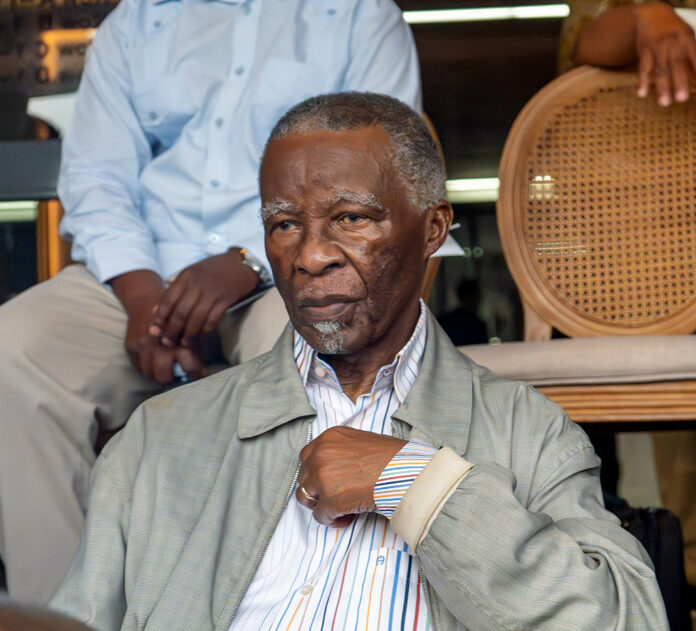
The uMkhonto weSizwe (MK) Party has launched a critique of former president Thabo Mbeki, accusing him of shielding multinational corporations that profited from apartheid and denying justice to its victims.
In a strongly worded statement, the MK Party alleges that Mbeki’s administration prioritised global capital over the dignity of the oppressed by refusing to support class-action litigation against 23 corporations that benefited from apartheid.
The accusations target Mbeki’s neoliberal economic policies and highlight a perceived betrayal of the liberation ideals that the MK Party champions, deepening the ideological rift within South Africa’s post-apartheid political landscape.
The MK Party’s allegations centre around Mbeki’s failure to back legal action against multinational companies accused of profiting from the exploitation of black South Africans during apartheid.
These companies, the MK Party claims, were shielded from accountability under Mbeki’s presidency, which prioritised protecting global capital interests over reparations for apartheid victims.
Shift from RDP policy
This, according to the MK Party, was a critical failure of Mbeki’s government that continued to deepen the systemic inequalities faced by the black majority.
The party further criticises Mbeki for his shift from the Reconstruction and Development Programme (RDP), which aimed to address the socioeconomic needs of the poor majority, in favour of the Growth, Employment, and Redistribution strategy.
The Jacob Zuma-led party describes this move as a “counter-revolutionary” action that entrenched neoliberal policies, benefiting global financial interests while neglecting the needs of the oppressed.
It argues that this policy pivot marked a betrayal of the liberation struggle, as it favored Western economic imperatives over the promises of social and economic justice.
Adding to the critique, the MK Party accuses Mbeki of neglecting the welfare of liberation soldiers, many of whom remain impoverished while a select elite of former commanders enjoy wealth and privilege.
The party points to Mbeki’s appointment of apartheid-era figures, such as Marthinus van Schalkwyk, to prominent positions within the ANC as a further sign of betrayal.
These decisions, the MK Party contends, reflect Mbeki’s willingness to align with former apartheid-era networks, further sidelining the needs of the black majority who had fought for a just, equal society.
Speech motivated by anger
The MK Party’s criticisms also come in the wake of remarks Mbeki made at the national conference of the MK Liberation War Veterans League.
The party claims that Mbeki’s speech was “historically disingenuous” and motivated by anger at the MK Party’s growing influence.
It accuses him of attempting to sow division among former liberation soldiers and deflect blame for his administration’s failures.
The MK Party’s statements draw parallels between Mbeki’s leadership and the current administration under President Cyril Ramaphosa.
The party argues that the ANC’s alliance with the DA in a government of national unity, proposed after the 2024 elections, mirrors Mbeki’s controversial decision in 2005 to merge the New National Party with the ANC.
Both actions, the MK Party claims, represent political betrayals, undermining the transformative mandate given by the black majority.
- The uMkhonto weSizwe (MK) Party has launched a critique of former president Thabo Mbeki, accusing him of shielding multinational corporations that profited from apartheid and denying justice to its victims.
- In a strongly worded statement, the MK Party alleges that Mbeki’s administration prioritised global capital over the dignity of the oppressed by refusing to support class-action litigation against 23 corporations that benefited from apartheid.
- The accusations target Mbeki’s neoliberal economic policies and highlight a perceived betrayal of the liberation ideals that the MK Party champions, deepening the ideological rift within South Africa’s post-apartheid political landscape.
- The MK Party’s allegations centre around Mbeki’s failure to back legal action against multinational companies accused of profiting from the exploitation of black South Africans during apartheid.
- These companies, the MK Party claims, were shielded from accountability under Mbeki’s presidency, which prioritised protecting global capital interests over reparations for apartheid victims.