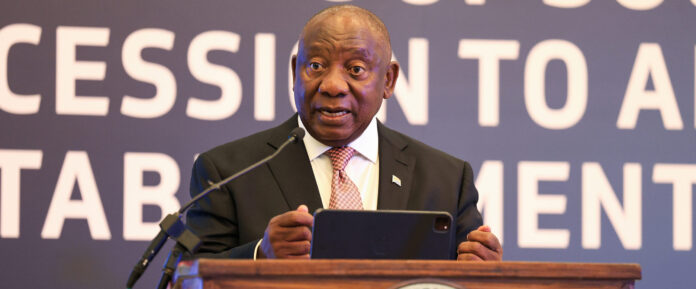
President Cyril Ramaphosa used his annual State of the Nation Address to declare that South Africa had “turned a corner” after years of stagnation and crisis. But he warned that organised crime, failing municipalities and unemployment still posed grave risks to the country’s recovery.
The speech on Thursday mixed cautious economic optimism with unusually blunt warnings on governance failures. Ramaphosa said the country was emerging from a prolonged period of decline, and now faced a narrow window to translate stabilisation into sustained growth.
Economy is growing again
“As we reflect on the state of our nation, we can say that we are stronger today than we were a year ago,” he told parliament. “Our economy is growing again, and this growth is gathering pace.”
He pointed to improved macroeconomic indicators, including “two consecutive primary budget surpluses”, declining inflation and borrowing costs, and a strengthening currency.
“Our credit rating has improved… The rand has strengthened against the dollar,” he said, adding that the Johannesburg Stock Exchange had “performed exceptionally well”.
Ramaphosa argued that reforms under Operation Vulindlela had helped restore investor confidence and stabilise infrastructure.
“We have brought an end to load shedding and built a more dynamic and resilient energy system,” he said, while improvements in rail and ports were “steadily increasing the volume of goods that we move in and out of our country”.
The president framed these developments as creating “a unique window of opportunity to translate these gains into sustained growth”. Yet he cautioned against complacency. “Although we are moving forward, we must not claim any easy victories… For too many people, life remains hard. Jobs are scarce, and opportunity is out of reach.”
Crime and corruption
The most forceful section of the address focused on crime and corruption, which Ramaphosa described as the central threats to economic recovery. “Organised crime is now the most immediate threat to our democracy, our society and our economic development,” he said.
He announced plans for intensified law enforcement and security interventions. This includes deployment of the military to support police operations against gangs and illegal mining.
“We cannot fight organised criminals by treading softly,” he said. “We must act with zero tolerance and bring the full force of the law to bear.”
Additional measures included recruiting 5, 500 new police officers this year. And establishing a national programme to disrupt illicit trade in sectors such as fuel, tobacco and counterfeit goods.
Ramaphosa also acknowledged corruption within policing structures. He cited findings from a judicial inquiry that exposed “rampant corruption in the SAPS and some metro police departments”. And he promised swift investigations, lifestyle audits and “far-reaching changes” to the criminal justice system.
Municipalities blamed form water crisis
Local government dysfunction emerged as another dominant theme. The president said water shortages had become “the single most important issue for many people in South Africa”. He blamed “poor planning and inadequate maintenance” by municipalities.
Ramaphosa warned that the national government would intervene where necessary. “We will not hesitate to use the powers enshrined in the constitution… to intervene in municipalities,” he said. And he noted that criminal charges had already been laid against dozens of local authorities. This could extend to municipal managers personally, he added.
To address systemic failures, Ramaphosa announced a National Water Crisis Committee, chaired by himself. He also announced R156-billion in public funding for water infrastructure over three years.
Economic policy centred on infrastructure-led growth and private investment mobilisation. The government planned more than R1-trillion in public infrastructure spending over three years, which Ramaphosa called “the largest allocation of its kind in our country’s history.”
“This will be transformative,” he said, highlighting new infrastructure bonds, public-private partnerships and specialised commercial courts to fast-track projects.
Energy, ports and rail
Energy reforms aimed to expand renewable generation and reduce electricity costs. This while logistics partnerships were intended to restore ports and rail to “world-class standards”.
The government also targeted R2-trillion in new investment commitments over five years. And he sought to position South Africa as a supplier of critical minerals and green industrial products.
Despite the pro-growth focus, Ramaphosa stressed social inclusion and employment. Public employment schemes had created more than 2.5 million opportunities, he said. While expanded social grants had reduced food poverty.
He confirmed that the Social Relief of Distress grant would continue and be redesigned to support “livelihoods, skills development, work opportunities and productive activity”.
The president framed the government of national unity (GNU) as central to the reform agenda.
“The [GNU] has shown that it is possible for South Africans to come together… To work on a common agenda for growth and progress,” he said.
Ramaphosa concluded by casting 2026 as a decisive year.
“Our nation has reached a turning point,” he said. “We are leaving behind an era of decline and turning towards an era of prosperity and growth.”
But he noted that delivery would now be decisive.
“Now is not the time to rest… We must fix local government. We must fight crime and corruption… and build a state that works for the people.”