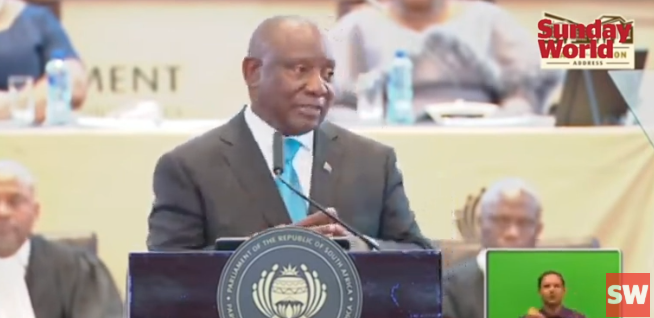
The most striking feature of President Cyril Ramaphosa’s 2026 State of the Nation Address was how sharply it departed from the tone and political positioning of 2025.
Where the previous year’s speech had sought to stabilise a new coalition government and reassure a fractured polity, the 2026 address signalled a presidency pivoting from persuasion to performance—and increasingly, to enforcement.
In 2025, the political overview had centred on building legitimacy for the Government of National Unity (GNU).
The tone had been conciliatory and nation-building, emphasising shared purpose and political cooperation after a watershed election.
It had framed coalition governance as a continuation of South Africa’s tradition of negotiated progress and presented unity as both a necessity and a virtue.
Firmer and declarative stance
By contrast, the 2026 address assumed the GNU’s legitimacy and shifted the focus to delivery and authority.
The coalition was no longer introduced as a fragile political experiment but as a governing instrument whose credibility now rested on results.
The emphasis moved from cooperation to consequence, from reassurance to execution.
The tonal shift was unmistakable. The 2025 speech had leaned heavily on aspirational language and historical continuity, stressing resilience and partnership.
The 2026 address adopted a firmer, more declarative stance, particularly on crime, corruption, and the collapse of local government.
Repetition remained central to Ramaphosa’s rhetorical style, but its function changed: in 2025 it reinforced unity; in 2026 it underscored urgency and command.
This shift reflected a presidency seeking to consolidate authority through performance and enforcement rather than persuasion alone.
The speech presented a government that believed it had stabilised key economic and institutional indicators sufficiently to move into a tougher governing phase.
Crime syndicates, failing municipalities, and corruption were framed not merely as policy challenges but as threats to democratic and economic stability that required decisive intervention.
In the early sections, Ramaphosa situated South Africa within a harsher global environment, describing “a world in which narrow self-interest has replaced the common good” and “a world in which trade is used as an instrument of coercion”.
This framing served to justify a more assertive domestic posture: in an adversarial global order, internal cohesion and institutional strength became strategic imperatives.
Evidence of political maturity
At home, the speech constructed a narrative of guarded progress. The president argued that “we are stronger today than we were a year ago” and that “our economy is growing again, and this growth is gathering pace”.
Yet he immediately tempered this with acknowledgement of persistent hardship: “Although we are moving forward, we must not claim any easy victories. For too many people, life remains hard.”
This dual framing—progress coupled with urgency—formed the political core of the address. It allowed the administration to claim credibility for stabilisation while justifying a more interventionist and disciplinary posture.
The GNU was framed as evidence of political maturity rather than compromise, with Ramaphosa stating that it “has shown that it is possible for South Africans to come together from across the political spectrum to work on a common agenda.”
The most notable shift, however, was the explicit pivot to enforcement.
Organised crime was identified as “the most immediate threat to our democracy, our society and our economic development”, accompanied by unusually blunt language: “We cannot fight organised criminals by treading softly. We must act with zero tolerance and bring the full force of the law to bear.”
This harder edge extended to local government dysfunction and service delivery failures.
The water crisis was framed as systemic, with the warning that the government “will not hesitate to use the powers enshrined in the Constitution … to intervene in municipalities where necessary”.
The speech signalled personal accountability for officials and hinted at criminal consequences for administrative failures—a rhetorical escalation from previous years.
Even in economic policy, the language emphasised scale and decisiveness rather than gradual reform.
From consolidation to execution
Commitments to “more than R1-trillion in public investment” and infrastructure spending that “will be transformative” were framed as part of a broader effort to demonstrate momentum and authority.
Stylistically, the address blended liberation-era symbolism with technocratic detail and enforcement rhetoric.
Historical references to the women’s march and constitutional values anchored the speech in moral legitimacy, while subsequent sections moved swiftly into operational plans and security interventions.
The result was a hybrid register: part liberation narrative, part executive directive.
Taken together, the contrast between 2025 and 2026 was stark. The earlier address had been about holding the political centre; this one was about asserting control from it.
The presidency appeared to believe the stabilisation phase had passed and that public patience now depended on visible enforcement and delivery.
In essence, the 2026 statement signalled a government transitioning from consolidation to execution.
The tone suggested that the window for persuasion had narrowed—and that the era of consequences had begun.
- The most striking feature of President Cyril Ramaphosa’s 2026 State of the Nation Address was how sharply it departed from the tone and political positioning of 2025.
- Where the previous year’s speech had sought to stabilise a new coalition government and reassure a fractured polity, the 2026 address signalled a presidency pivoting from persuasion to performance—and increasingly, to enforcement.
- In 2025, the political overview had centred on building legitimacy for the Government of National Unity (GNU).
- The tone had been conciliatory and nation-building, emphasising shared purpose and political cooperation after a watershed election.
- It had framed coalition governance as a continuation of South Africa’s tradition of negotiated progress and presented unity as both a necessity and a virtue.