


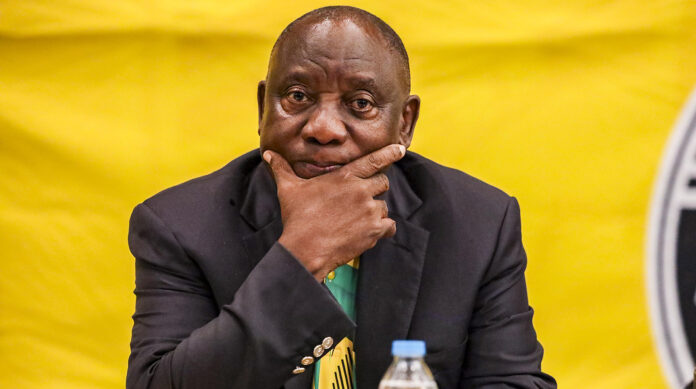
Tomorrow, the ANC’s top brass, its regional barons, and grassroots delegates will converge for a four-day national general council (NGC) meeting at the Birchwood Hotel and Conference Centre in Ekurhuleni.
On paper, it’s a routine mid-term policy review. In reality, it is the most consequential gathering since the party lost its parliamentary majority 18 months ago.
From December 8 to 11, the NGC will serve not as a dry committee meeting, but as a feverish ritual of diagnosis for a liberation movement turned governing party in profound distress.
Think of it less as a conference and more as a family intervention held in a public arena.
The patient—the 111-year-old ANC—is suffering from multiple acute conditions: the shock of forced coalition, a flatlining economy, and a base that feels increasingly alienated. The doctors—President Cyril Ramaphosa’s reformist bloc and his radical challengers—will argue over the cure in a high-stakes drama that will set the tone for the 2026 local elections and the 2027 leadership succession.
This may not be a conference that will unseat a president, but it is a crucial test of his authority. Hovering over everything is the ghost of the 2021 local elections and the looming spectre of 2026. The debate on “organisational renewal” will be intense. How does the party rebuild branches hollowed out by factionalism and apathy? Who gets to be a candidate in 2026?
The tension between the centre’s desire for “clean” candidates and the localities’ entrenched patronage networks will be a fierce, if mostly backroom, fight.
The elephant in the convention centre is the government of national unity (GNU). For the first time, the ANC enters an NGC having voluntarily shared executive power with the DA, the IFP, and others.
To Ramaphosa’s allies, this was a necessary, sober step to ensure stability and reassure markets.
To his internal critics, it is a form of ideological contamination—a betrayal of the party’s liberation ethos for the cold porridge of technocratic governance.
The tension here is between two competing identities: the ANC as a conservative manager of the state versus the ANC as a vanguard of radical, redistributive change. Every debate on policy will, underneath, be a referendum on this partnership. Watch for the symbolic skirmishes: will the GNU be praised as “mature leadership” or condemned as a “coalition of the elites?”
The phrasing will signal where the wind blows.
The centrepiece of policy debate will be the economy, but the term “Radical Economic Transformation (RET” will function as a loaded cultural signifier.
For the delegates from embattled townships and the party’s youth league, RET is a sacred covenant—the unfulfilled promise of 1994. It represents dignity, jobs, and land.
For the conservative wing, it is a necessary goal but also a slogan that has been weaponised by corrupt networks to justify patronage. The discussion will therefore be a minefield.
The NGC is the opening salvo of the 2027 leadership succession battle.
Factions within the ANC operate not just as ideological camps but as political kinship networks, bound by loyalty, patronage, and shared ambition. The Ramaphosa camp will frame the meeting around “renewal” and “discipline”, pointing to the stable, if awkward, GNU as an achievement.
His opponents—a loose alignment of those sidelined by his so-called anti-corruption drive, RET champions, and those simply sensing vulnerability—will use every open mic session to highlight failure: unemployment, crime, and the indignity of coalition.
So, what can we expect by Thursday, December 11?
Do not anticipate a dramatic breakup of the GNU or an immediate change in policy direction. The ANC’s rituals are designed to channel conflict into compromise, often through fudged, ambiguous language in the final “declarations”.
The most likely outcome is a statement of uneasy unity—a document that reaffirms the ANC’s commitment to both “radical economic change” and “fiscal sustainability”, to both “the principles of the GNU” and its “primary role as the leader of society”.
But the true outcomes will be measured in tone, energy, and subtle shifts.
An NGC that emboldens the radical wing will make Ramaphosa’s governance through the GNU far more treacherous, with increased sniping and sabotage. An NGC that reaffirms the current path will be read as a mandate for stability, however brittle. Ultimately, the world inside the Birchwood Hotel from Monday to Thursday will be a microcosm of South Africa’s own turbulent political soul—a house divided, anxiously searching for a path to survival.


