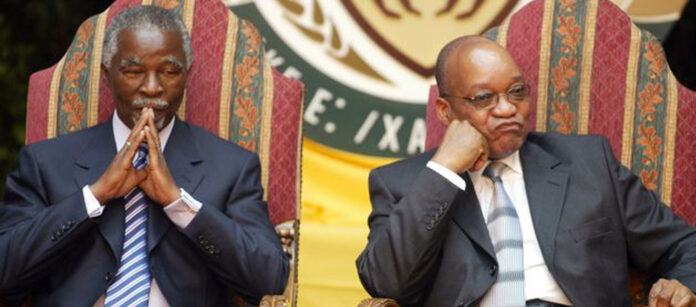
Former presidents Jacob Zuma and Thabo Mbeki have launched fierce legal attacks against a judge leading a critical inquiry but have pointedly not addressed the damning allegation at its heart: that they participated in a secret pact with apartheid generals for a mutual amnesty from prosecution.
The Judicial Commission of Inquiry into Alleged Interference in Truth and Reconciliation Commission (TRC) Cases is examining claims, based on evidence from author Michael Schmidt, of a clandestine seven-year project to secure a blanket amnesty for both ANC and
apartheid-era officials.
Central to the allegation is a claimed “quid pro quo” articulated by then-president Mbeki to former generals: “They don’t want us to be charged, and they don’t want them to be charged.”
Despite being formally implicated, neither former president has used their court filings to directly deny the existence of the alleged talks or the purported “quid pro quo”.
Instead, their strategy has focused on seeking to remove the commission’s chairperson, Justice Sisi Khampepe, and challenging the inquiry’s procedures. According to the annexures before the commission, Schmidt’s investigation alleges that from around 1997, senior ANC figures and former South African Defence Force generals, including Constand Viljoen and Magnus Malan, held secret meetings.
The goal was a new amnesty law to prevent trials for both sides. Schmidt’s account, which cites a 2019 interview with former deputy army chief, Maj-Gen Dirk Marais, states that Marais claimed “the government was seeking a quid pro quo”.
The talks allegedly involved a rotating cast of government ministers, including Brigitte Mabandla, Ronnie Kasrils and Charles Ngakula.
A draft amnesty law was reportedly agreed upon by late 2002 but was rejected by Mbeki in early 2003, after generals insisted on a blanket amnesty without full disclosure.
In his sworn affidavit, Mbeki avoids engaging with this historical substance.
His argument is procedural, claiming the commission’s use of evidence from a book and court papers is “untenable”.
His attorneys state in annexed correspondence that it is “difficult for clients to be convinced of their participation in this matter” and that “they do not know the full extent of the allegations against them”.
This forms the basis for his application for Khampepe’s recusal, arguing her tolerance of this “irregular” process creates a “reasonable apprehension of bias”.
Zuma’s separate recusal application also sidesteps the amnesty allegations. His affidavit attacks Khampepe’s impartiality based on her past roles in TRC and National Prosecuting Authority structures but does not confront the claim of a secret pact.
Together, their applications create a twin legal assault on the inquiry’s chair. Mbeki has framed the challenge as existential, arguing that if the chairperson should recuse herself but refuses, “all subsequent proceedings will be a nullity”, and that his aim is to “safeguard the integrity, impartiality, and public legitimacy of the commission’s process.”
The core allegations of a historic, secret quid pro quo amnesty deal, however, remain publicly unaddressed by the two former presidents.
- Former presidents Jacob Zuma and Thabo Mbeki have launched fierce legal attacks against a judge leading a critical inquiry but have pointedly not addressed the damning allegation at its heart: that they participated in a secret pact with apartheid generals for a mutual amnesty from prosecution.
- The Judicial Commission of Inquiry into Alleged Interference in Truth and Reconciliation Commission (TRC) Cases is examining claims, based on evidence from author Michael Schmidt, of a clandestine seven-year project to secure a blanket amnesty for both ANC and apartheid-era officials.
- Central to the allegation is a claimed “quid pro quo” articulated by then-president Mbeki to former generals: “They don’t want us to be charged, and they don’t want them to be charged.” Despite being formally implicated, neither former president has used their court filings to directly deny the existence of the alleged talks or the purported “quid pro quo”.
- Instead, their strategy has focused on seeking to remove the commission’s chairperson, Justice Sisi Khampepe, and challenging the inquiry’s procedures.
- According to the annexures before the commission, Schmidt’s investigation alleges that from around 1997, senior ANC figures and former South African Defence Force generals, including Constand Viljoen and Magnus Malan, held secret meetings.