


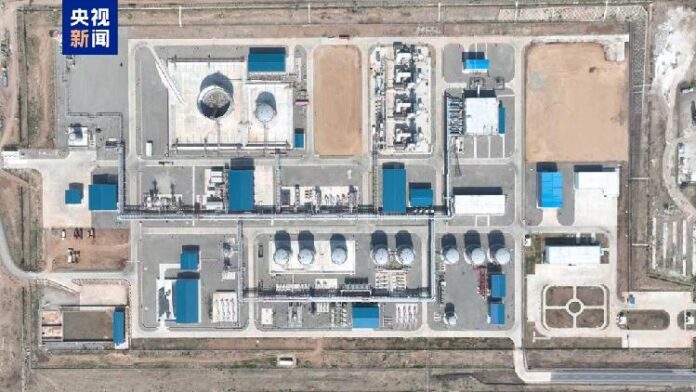
The core surface facilities of Uganda’s Kingfisher oilfield, a key China-Africa energy cooperation project, passed mechanical completion acceptance on Thursday, marking the completion of Uganda’s first commercial oilfield and its entry into the production preparation stage. Once operational, the field will help Uganda officially join the ranks of oil-producing countries.
Located in the Albertine Basin in western Uganda, the field has estimated geological reserves of about 560 million barrels of crude oil. The core surface facilities, built by China National Offshore Oil Corporation (CNOOC), include a central processing facility with an annual processing capacity of 2 million tonnes, four cluster well pads, a water intake station, inter-station pipelines and a 1,000-person camp.
The project sits on the shores of Lake Albert in the East African Rift Valley, where large areas of soft soil cannot support heavy equipment. The construction challenge was described as being similar to building a factory on a sponge. The project team overcame difficulties including large-scale soil replacement under special geological conditions and the installation of heavy equipment. It laid 783 kilometers of pipelines and cables and installed more than 300 pieces of equipment, forming a replicable case of efficient overseas engineering.
The project has also built a green, multi-energy complementary power supply system and a wastewater recycling system, helping create a green modern oilfield. It has employed more than 1,500 Ugandan workers, with a localization rate of 90%, and provided 135,000 man-hours of skills training, building Uganda’s first cohort of industrial workers with modern oil and gas engineering skills.
When fully operational, the Kingfisher oilfield is expected to reach a peak daily output of 40,000 barrels, boosting local employment, infrastructure and related industries.
- Uganda's Kingfisher oilfield core surface facilities passed mechanical completion acceptance, marking the completion of the country's first commercial oilfield.
- The oilfield is located in the Albertine Basin in western Uganda, with estimated geological reserves of about 560 million barrels of crude oil.
- The facilities, built by China National Offshore Oil Corporation (CNOOC), include a central processing facility with an annual capacity of 2 million tonnes, well pads, pipelines, and a 1,000-person camp.
- The project overcame geological challenges such as large-scale soil replacement and installed 783 kilometers of pipelines and over 300 pieces of equipment.
- The Kingfisher oilfield is expected to reach a peak daily output of 40,000 barrels and has employed over 1,500 Ugandan workers with a 90% localization rate.


