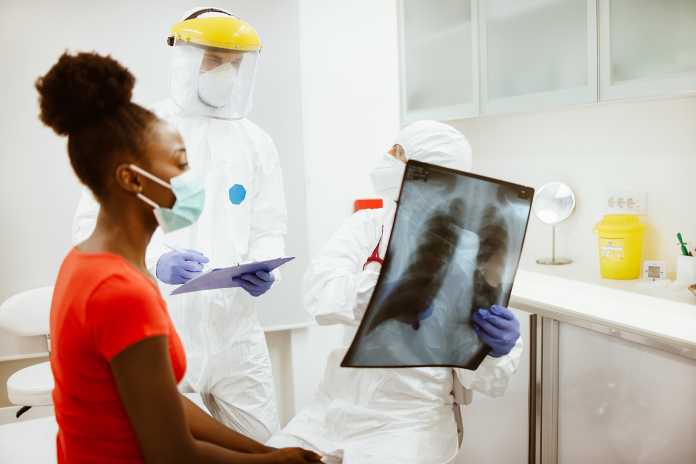
A patient arrives at a clinic with a cough that has lingered for weeks. The nurse suspects tuberculosis (TB) and asks for a sputum sample—the phlegm people cough up from deep in the lungs for TB testing.
But the patient struggles to produce the few millilitres needed. Coughing up sputum is difficult, especially for children, older patients, people with weakened immune systems, or those with a dry cough.
So the patient’s diagnosis stalls; they have to undergo more complex tests, which often means going to a larger hospital further from where they live.
In South Africa, where more than half of all people who fall ill with TB have HIV, this inability to cough makes diagnosing the disease much harder.
Because untreated HIV weakens someone’s immune system, it changes how TB develops in their bodies.
People with HIV often get a specific form of the disease that leaves them with a dry cough and virtually no sputum, making such people that much harder to diagnose.
In TB hotspots, these “sputum-scarce” cases can make up about half of all TB cases. To diagnose these patients, doctors have to use difficult backup plans to detect the TB bug, like forcing the patient to cough using a mist machine, washing out their stomach, or running a tube down into their lungs for a usable sample.
And even when a patient can cough up a sample, testing in South Africa usually depends on specialised laboratory machines, which are mostly based at larger centres, which could be far away from the patient.
Samples must be transported and results returned, meaning the sick patient must be asked to return to the clinic.
TB spreads through the air so easily that the only way to stop it from making more people sick is to find anyone who has it and treat them quickly so that they become uninfectious (usually within two to three weeks after starting treatment).
Now, the World Health Organisation (WHO) is recommending new tests to get around these problems. A cheap and portable device can be used in clinics or communities where patients are, using a sputum sample or simple tongue swab when the patient cannot cough up phlegm.
Because of South Africa’s high TB rates, it is one of 13 countries worldwide selected to introduce the new test cartridges and machines.
Inside the upcoming 7 000-patient trial
But taking the lab to the clinic comes with some compromises. The tongue swabs, which pick up TB bacteria that have traveled up from the lungs into the mouth, collect fewer bacteria than a deep cough.
Experts warn the new test system may be slightly less accurate than standard lab tests, even when analyzing sputum.
Furthermore, the portable, battery-operated machines cannot detect drug-resistant TB, strains of TB that have figured out how to fight the medicines normally used to treat the disease, rendering them ineffective.
To see if reaching millions more people is worth the trade-off, Nazir Ismail, head of the clinical microbiology and infectious diseases department at Wits University—who helped develop the WHO’s global guidelines for these tests—is leading the South African study to see exactly how they measure up to the country’s current standard.
The team will be testing over 7 000 samples, comparing the new tests directly against the lab tests the country uses right now.
The samples taken for the swab or sputum are then run through a small, portable $155 (R2 655) machine which returns results within an hour right in the clinic.
The current laboratory-based machines are almost 20 times more costly at $8 000 (R137 000), according to Nazir Ismail.
Tereza Kasaeva, director of the WHO’s department for HIV, TB, Hepatitis & STIs, says the new devices are designed to “ensure that everyone with TB can be diagnosed early and start lifesaving treatment without delay”.
This matters in countries like South Africa, where the disease makes more people sick than almost anywhere else in the world. To track down the disease, the health department wants to test 5-million people this year. That’s two million more than last year.
But for a national programme trying to reach that target, the $10 (R171) baseline cost of the existing individual tests can quickly add up.
The government had a TB budget of R4.5-billion for 2024/5, mostly funded by the state, and the department admits that using this baseline, there isn’t enough money to reach its new testing targets in the current financial year.
But cheaper tests — and far more affordable portable machines — change the maths completely.
Through global price negotiations, the cost of the new test has dropped to just $3.60 (R71), giving the South African government the chance to better use existing funds.
With money from the country’s current Global Fund grant for HIV and TB, South Africa can stretch its budget if it buys cheaper tests, freeing up funds to spend tracking down lost patients or improving services for patients.
The Gates Foundation, helped fund the early development of the test and is funding the two viability studies in South Africa, including the one led by Ismail.
Gaurang Tanna, a Gates Foundation senior programme officer for TB, says this dramatically lower price tag is already triggering new donor support.
Seeing a real chance for countries like South Africa to hit higher testing targets, the UK-based Children’s Investment Fund Foundation has provided a $50-million (R860-million) cash injection to the Global Fund to help fund the new tests in countries that need them most. Tanna says the spoils for South Africa are a first batch of roughly 200 000 tests to kick-start the roll-out.
Smarter sampling and pooled tests
The WHO also recommends “sputum pooling” to save money. This is batch testing from patients who are able to cough up sputum.
If the combined batch, which is usually taken from four different patient samples, test negative, everyone in that group is cleared for the cost of just one cartridge.
The tongue swab and pooled testing would allow South Africa to screen many more people, closer to where they live without breaking the budget.
But taking the lab to the clinic raises an important question: what is the trade-off?
For an individual patient, the most sensitive diagnostic test is always preferable; it increases the chance that the disease will be detected quickly and treated correctly.
But for a national TB programme trying to track down hidden infections, a slightly less sensitive test that can be decentralised may end up detecting more cases overall, because many more people can be tested.
But less sensitive tests mean that some people with TB are not identified.
“Maintaining high diagnostic accuracy is important”, says Foster Mohale, spokesperson for the health department, “but so is expanding access to testing, especially with South Africa’s high TB rates”. As Mohale puts it: “To end TB, you need to find TB.”
Just how much accuracy is lost?
A recent study of patients in the Western Cape compared standard sputum tests with tongue swabs. The researchers found the tongue swabs only detected between 72% and 76% of TB cases when compared to sputum tests, meaning they missed about a quarter of cases that sputum tests would have picked up.
But a study in four other TB hotspot countries showed that sputum tests are useless if a patient cannot cough. Testing over 1 600 people in the Philippines, Vietnam, Uganda and Zambia showed that roughly 15% of patients cannot cough up sputum.
By switching to tongue swabs, the clinics in the study successfully tested everyone.
Ultimately, the simple swabs caught almost the exact same total number of TB cases as the sputum tests simply because the tests could actually be performed on everyone.
The risk of missing drug-resistant TB
Because the new testing system isn’t able to detect drug-resistant TB, an extra step is needed for diagnosis.
If a patient tests positive, healthcare workers must collect and send a second sample to a specialised laboratory to check for resistance. For experts like Ismail, relying on busy, over-stretched clinics to do perfect follow-ups is the strategy’s biggest risk.
“There is a serious concern that we will be under-diagnosing resistance,” Ismail warns.
But Mohale says the country’s lab network can handle this extra step without losing track of patients.
Ismail says the trade-off is most likely worth it. Only about 5% of cases are drug-resistant, meaning most can be treated with standard medicines — and these are the ones the cheaper tests are good at detecting, he says.
Testing the tests
For Ismail, this work brings his long focus on affordable ways to detect TB full circle.
In a 2023 BMJ Global Health editorial, when he was a TB diagnostics team leader at the WHO, he argued for battery-operated tests priced “well below the $10 [R171] threshold” that could use tongue swabs to reach many more patients. Now, as a TB researcher at Wits University, he is testing whether those ideas actually hold up against South Africa’s routine lab tests.
“The equipment has just arrived in the country,” Ismail says. “It is happening.” From April, his team will test samples across six sites, including Helen Joseph and Edenvale hospitals.
The second study is testing how the tool works in the real world — at taxi ranks, in communities and even in people’s homes, and checking if any extra staff training is needed. The focus, says Gates Foundation senior programme officer for TB, Gaurang Tanna, is on the practicalities of rolling it out nationally.
Together, the studies will help show how, and how soon, the test can be used in everyday care.
For the patient in the clinic who struggles to produce sputum, there is still no answer. But as South Africa tests these tools, the goal remains the same: not just to test millions, but to make sure each patient gets the right diagnosis — and the right treatment.
—
The Gates Foundation is mentioned in this article. Bhekisisa receives funding from the Foundation, but operates editorially independent from them.
This story was produced by the Bhekisisa Centre for Health Journalism. Sign up for the newsletter.