


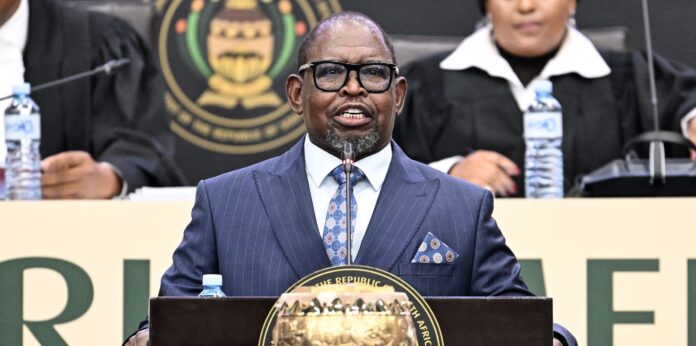
All political parties represented in parliament, those inside and outside the government of national unity (GNU), have unanimously welcomed the income tax relief announced by Finance Minister Enoch Godongwana during his budget speech on Wednesday.
Godongwana announced that there would be no personal tax increases in the upcoming financial year. This after tax collector SARS managed to collect R21-billion more than its set target.
The National Treasury also announced a fiscal anchor that will result in legislation changes to rein in unsustainable public sector practices resulting in wastage and runaway government debt.
All lauded the income tax relief
The proposal, announced in the 2026 Budget Review, comes as debt service costs increase to R432.4-billion in 2026. From R426-billion in 2025.
Political parties have lauded the tax relief as a positive development that will bring about a sigh of relief to suffocating consumers battling a high cost of living.
This cherry on top, though, all parties were in chorus, would be an economy growing faster in line with the growing demands of a growing population, worsened by a high unemployment rate.
While there was disagreement on some elements of the budget, even those outside the GNU such as the EFF and MKP welcomed the personal tax relief.
“The personal income tax adjustment is a very welcome position. Because the workers will at least have some money in their pockets,” said EFF leader Julius Malema.
He was echoed by EFF arch rivals in DA and ActionSA.
Said Action SA parliamentary leader Athol Trollip: “It is a much better budget than last year.
“We are pleased that there will be no additional tax hikes and that any tax bracket creep will be inflation-linked. That is very important. SARS collected R28-billion more than expected. That means the taxman does not have to go to our pockets. They must just go to people who owe SARS and get the money, and we can balance the budget.”
DA took credit for tax freeze
DA’s Dr Mark Burke was also impressed by the freeze on personal income taxes as well as corporate taxes. He took the glory for his party for influencing the budget direction.
“It was a budget reflective of the DA policy. We are not suffering increases from personal income tax and VAT. And not only that, there is bracket creep relief. Which means if you earn an amount and you get an increase from your employer, you will not lose that by moving to a higher tax bracket and paying more tax on your income. So, that is really good,” said Burke.
But all expressed concern that the country’s economy was growing very slowly. Umkhonto we Sizwe Party (MK Party) acting parliamentary leader Des van Rooyen pulled no punches. He said the government of the day was kicking the can down the road with bogus economic growth projections year after year.
MK Party slams unrealistic projections
“The bedrock of any reliable budget is proper projections. We have been raising this matter with the minister for the past three years. You will never get our budget properly if your projections are ill-informed. In 2024, he projected the growth of our economy to be at 1.1%. In 2025, he projected 1.4%, and now he is projecting 1.6%. It is baffling as to what informs these wrong projections since the birth of this GNU government,” said Van Rooyen.
He continued that the man on the street was not concerned about things such as reducing national debt. Theirs was a stress over daily bread-and-butter issues.
“Our people want jobs now, and you only get jobs out of a growing economy. Our economy is not growing; it is growing slowly while our population is growing fast. And as a result, our people are forever pushed into the poverty trap. Our people do not want to hear about debt stabilisation. Our people want to hear how their lives are going to improve. How they are going to get jobs, and how they are going to get out of the poverty trap.”
Malema concurred, adding that the obsession of the GNU administration with partnering with the private sector was misguided.
EFF says economy is not growing
“But the reality of the matter is that the economy is not growing. And we all know that without a growing economy, we will not be able to provide jobs. We will not grow the infrastructure even if SARS collects more revenue. It does not mean economic growth. So, we are worried that there is no plan for how the economy is going to grow.
“[Godongwana] keeps mentioning partnership between the public sector and the private sector. We have seen it happening in the electricity; did that adjust the electricity price? No! So, the private sector has never helped anywhere to reduce any costs. If anything, the costs go high. That is why he is saying he is going to put more money in the transport infrastructure, bring the private sector so that he can reduce the cost in the railway. But it is not true. The private sector is profit-driven, and therefore will never reduce any cost.”
FNB raises public infrastructure concerns
FNB’s economic desk touched on the infrastructure budget. It said investment in public infrastructure remains a fundamental priority to stimulate economic growth and improve public services.
“It is fundamental to long-term economic growth, service delivery, job creation and climate resilience. Planned infrastructure expenditure over the next three fiscal years amounts to R1.07-trillion. With significant funding allocated to transport and logistics, energy and water projects to remove growth constraints,” said the financial services institution.
Trade union federation Cosatu said it notes with extreme disappointment the lacklustre 2026/2027 budget and medium-term expenditure framework tabled at parliament by the government.
Cosatu says Budget fails the working class
“While appreciating that there are some progressive and important allocations that Cosatu campaigned for included in the Budget, as an overall package it fails to respond decisively to the fundamental crises facing the working class and the economy. In particular a 41.1% unemployment rate, economic growth far below the 3% needed to create jobs. Struggling public and municipal services and state-owned enterprises. Also entrenched levels of poverty and inequality, and endemic crime and corruption. Tragically, the Budget is focused on balancing the books. But not on aggressively kickstarting economic growth or tackling unemployment.
- All political parties represented in parliament, those inside and outside the government of national unity (GNU), have unanimously welcomed the income tax relief announced by Finance Minister Enoch Godongwana during his budget speech on Wednesday.
- Godongwana announced that there would be no personal tax increases in the upcoming financial year.
- This after tax collector SARS managed to collect R21-billion more than its set target.
- The National Treasury also announced a fiscal anchor that will result in legislation changes to rein in unsustainable public sector practices resulting in wastage and runaway government debt.
- All lauded the income tax relief The proposal, announced in the 2026 Budget Review, comes as debt service costs increase to R432.4-billion in 2026.


