


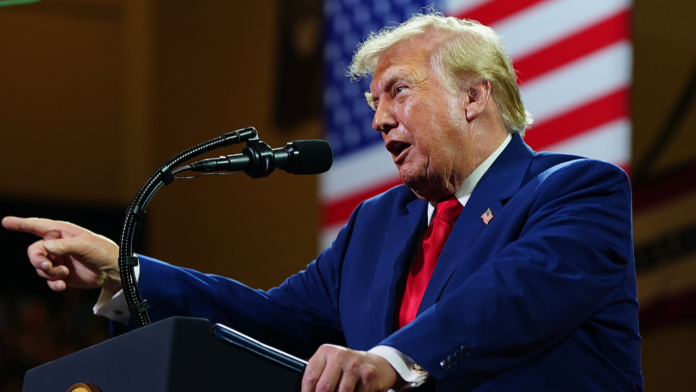
US President Donald Trump has said he is “seriously considering” launching a larger military campaign against Iran, while escalating tensions in the Red Sea are raising concerns that Washington could be drawn into a broader regional conflict on multiple fronts.
“I am considering a massive attack. Bigger than ever before. I am close to making a decision. We are all set for it,” Trump said in an interview, adding that Iran had not “received enough pain yet”.
Trump said Israel would join the operation “in two minutes” if he asked, while acknowledging that such involvement could bring “consequences” for Israel. He did not provide a timeline for his decision.
Tensions continue to escalate
The remarks came as tensions between Washington and Tehran continued to escalate. As of Wednesday, US forces had carried out strikes against Iranian military targets for 12 consecutive days following the collapse of a June memorandum of understanding aimed at reopening the Strait of Hormuz.
According to US media reports on Wednesday, Washington is deploying additional troops, medical personnel and military equipment to the Middle East in an effort to provide Trump with “more robust military options”.
Israeli officials said on Wednesday that the US had informed Israel of plans to expand attacks on Iran and would, for the first time in this year’s joint US-Israeli operations, deploy heavy bombers to strike targets inside Iran. Following notification from Washington, Israel raised its alert level to the highest level on Wednesday night, according to Israeli sources.
‘Major escalation’
Israeli analysts said such a move would represent a “major escalation” of the conflict and that Pickaxe Mountain is expected to be the target of the strikes.
Meanwhile, efforts in the US Congress to limit Trump’s authority to wage war against Iran have failed.
On Thursday, the Senate voted 49-47 to reject a Democratic-led resolution that sought to block the Trump administration from conducting military operations against Iran without congressional authorization. Earlier the same day, the House of Representatives passed a resolution calling on the administration to halt military action against Iran.
Red Sea tensions raise fears
Amid the intensifying US-Iran confrontation, risks to shipping in the Red Sea have also risen sharply.
Trump warned on Thursday that if Yemen’s Houthi movement attacks Saudi vessels again, the US would hold Iran responsible and impose “major military punishment” on both Iran and the Houthis.
The warning came after the Houthis announced early Thursday that they had used missiles and drones to attack two Saudi oil tankers in the Red Sea, accusing them of violating the group’s maritime restrictions.
The announcement followed the Houthis’ declaration on Monday of a maritime ban on Saudi Arabia, warning international shipping companies that vessels trading with Saudi ports could face military strikes.
The Bab el-Mandeb Strait, a narrow waterway linking the Red Sea with the Gulf of Aden and the Indian Ocean, is a critical global shipping route. Since the outbreak of the US-Israeli-Iranian conflict, Saudi Arabia has redirected more crude oil from its eastern oil fields to western ports for export through the Red Sea in order to avoid disruptions in the Strait of Hormuz.
Analysts warned that if shipping through the Bab el-Mandeb Strait is disrupted, the two major oil export routes in the Middle East could face simultaneous interruptions, posing additional risks to global energy markets.
Jason Campbell, a senior researcher at the Middle East Institute, warned that US involvement in the Red Sea crisis could force Washington into a two-front conflict.
He said the US military might have to redeploy warships from the Persian Gulf to waters near Yemen to strike Houthi targets and intercept missiles and drones. Such an expansion of operations could further strain America’s already limited ammunition supplies.
Regional allies divided over further escalation
Washington’s Gulf allies have become increasingly divided over how to respond as security risks and economic losses mount.
Some officials have urged Trump to intensify military operations, including the possible deployment of ground troops to parts of Iran or the seizure of Kharg Island, one of Iran’s most important oil export terminals.
However, countries including Qatar have opposed expanding the military campaign and called for efforts to de-escalate tensions. They warned that deploying ground forces or attempting to seize strategic energy facilities could trigger stronger Iranian retaliation and drive up oil prices.
Li Zixin, a Middle East expert at the China Institute of International Studies, said the escalation in the Red Sea is not merely a spillover from the US-Iran confrontation.
He said the Houthis’ decision at this moment was also driven by their assessment that the ongoing military confrontation had stretched US and allied resources, creating a strategic opportunity to strengthen their own geopolitical position.
The group appears to be seeking to use the Red Sea and the Bab el-Mandeb Strait as leverage, similar to how Iran has used the Strait of Hormuz as a strategic bargaining tool, Li said.
However, he warned that simultaneous disruptions in the Strait of Hormuz and the Bab el-Mandeb Strait could have a compounded impact on global trade, energy supplies and the world economy.
- US President Trump is "seriously considering" a massive military campaign against Iran, with Israel ready to join but facing potential consequences.
- US forces have conducted 12 consecutive days of strikes on Iranian military targets, while additional US troops and equipment are being deployed to the Middle East.
- Israel has raised its alert to the highest level after being informed of US plans to expand attacks on Iran, including deploying heavy bombers.
- Tensions in the Red Sea have escalated after Yemen's Houthi movement attacked Saudi oil tankers, prompting US warnings of punishing Iran and the Houthis.
- Regional allies are divided on further military escalation, with some urging intensification and others calling for de-escalation due to risks of broader conflict and economic fallout.


