


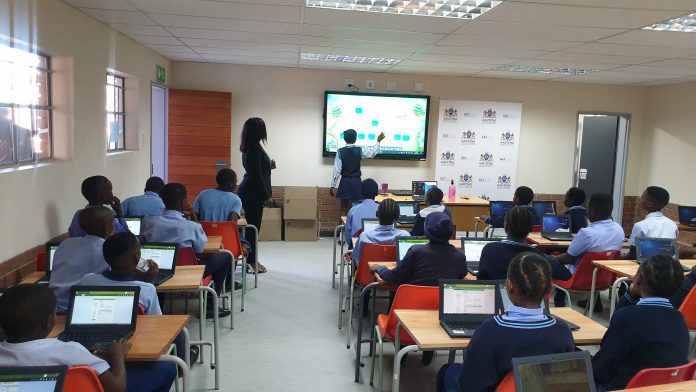
The democratic South Africa inherited deep structural inequalities with vast disparities in teacher quality, inadequate school resources and large swathes of learners entering schools underprepared for abstract mathematics. Consequently, Mathematical Literacy was introduced for Grade 10 learners in 2006, to ensure that every learner engages with mathematics, albeit minimalistic.
Mathematical Literacy is designed as a more accessible, context-based alternative mathematical engagement. What was intended to be a form of “bridging” ultimately embedded itself as the mainstream and de facto standard among those finding themselves on the wrong side of the mathematics equation.
Remedial alternative to pure maths
Mathematics Literacy is in substance a remedial alternative to pure Mathematics and its introduction was in partly motivated by the need to develop life skills among those who were deemed poorly prepared to master the complexities of pure mathematics. As an easier alternative, it seduced those fixated on pass rates to fallaciously defend it as a viable developmental lever.
It is worth noting that South Africa is the only country where such radical stratification of mathematical training in schools had been implemented. It is contended herein that this diversion will continue to frustrate and mitigate against the attainment of smart nation ideals.
In October 2025 South African schools were issued a directive by the Department of Basic Education, concerned about growing trend of schools violating national education policy by favouring Mathematics Literacy. Circular S13 of 2025 stated that the offering of Mathematics is not optional but a compulsory component of the National Senior Certificate. All schools must give pupils access to both Mathematics and Mathematics Literacy.
Maths literacy limitations
In two articles published previously by the Sunday World, I laid bare the existential threat to the development aspirations of the South African nation. I illustrated the narrowing path of opportunity for learners to enter lucrative STEM pathways1.
Learners matriculating with maths literacy are excluded from STEM and Accounting careers by virtue of not meeting admission requirements of tertiary institutions. In a follow up article in the Sunday World, I challenged the existence of a mathematics gene and the myth that mathematics mastery or capability is the preserve of an elite few.
Maths literacy push stunts inclusive development
South Africa elevated the eradication of poverty and inequality as apex objectives and hence it is of supreme irony that the uptake of Mathematics Literacy in township and rural schools skyrocketed to over 80% penetration. More concerning is the championing thereof by prominent academics, absent of healthy scepticism of intellectual discourse that would have revealed “unintended” obviating of social mobility and stunting of cognitive development.
This policy shortsightedness is minimalistic in expectation, patronising in its philosophy and downright defeatist. It is minimalistic because mathematics should not endow survive status but rather evoke thrive as a primary response. Smart decision-making is premised on generating available options, the probabilities attached to each and ultimately a calculated weighing of risks.
Misdirected mathematics ecosystem
To exclude defined demographics from inculcating this smartness will no doubt continue to stratify. It is patronising because the same reasoning is silent when debating the shunning of Mathematics Literacy in private and model C schools. It is also defeatist as we as a nation cannot and should not accept the mediocrity of an under-resourced and misdirected mathematics ecosystem.
Although this aversion to pure mathematics evinced itself psychosocially, mathematics capability and even mastery can be acquired through productive struggle and repetitive training of our highly malleable brains.
Except in extreme instances of dyscalculia that exist in small pockets (similar in pervasiveness of dyslexia ranging 3% to 7% of the general population), our innate brain plasticity can be mustered even moulding injured brains. In this article the empowering impact of mathematical intuition or nous in thriving in the modern world is described.
What is mathematical nous?
Nous is the ability to perceive invariant structure across different mathematical representations instantly.
The concept nous originates from ancient Greek philosophers Plato and Aristotle and refers to intellectual insight extrapolating to direct grasp of fundamental truths. Through a mathematical lens Plato describe nous as to how abstract forms like perfect numbers or geometric truths are apprehended. Aristotle describe it as the faculty that recognizes axioms without proof. Mathematical intuition or nous can be described as the ability to get to mathematical truth directly, without needing to step through formal proof. Attainment of mathematical nous is critical for academic progression into tertiary institutions and in the furtherance of STEM careers.
Mental acuity is not just required for effectiveness in our professional lives or social fluency but is critical when rapid judgement is required. The observed inability of maths literacy proponents to be mathematically attuned, surfaces when quick calculations are required in daily interactions. This deficiency is tantamount to stunted cognitive development.
In mathematics reasoning, nous is not about calculation but rather recognition of the truth it conveys. An order-of-magnitude check is one of the most practical exemplifications of mathematical nous as it provides a quick, approximate calculation to see if a result is plausible without having to do detailed work. Another illustration of mathematical nous is the quick understanding of percentage change and an appreciation of magnitude of impact of such changes. By way of example, when assessing salary increases across different strata of income levels, the concomitant impact on inequality would be an important metric. A 3% increase in an executive annual salary of R1million is much more impactful containing rising cost of living than a 10% increase of say an annual salary R100,000.
A word of caution. Mathematical nous is not insight into the full truth but rather a trained expectation about structure that must always be tested. A mathematician typically first sees with intuition, then proves with logic. A clever way of usage is to use nous to generate hypotheses, and then proof using data to verify.
Cognitive science and nous
Mathematical nous is not a mystical concept and neither ephemeral in nature but is rather attained through experience and constant exposure to productive struggle. Mathematical nous is evident and expressed when your brain is responding:
- “I’ve seen this structure before”
- “This behaves like something familiar”
- “This outcome is plausible / impossible”
People with well-developed mathematical nous often come across as smart and will;
- Detect when something does not add up and will be able to articulate their reasons succinctly though a simple extrapolation or calculation.
- Delay complicated computations and proceed straight to structure. They see relationships before detailed calculations and statistical regression reveals them.
- Predicts outcomes correctly before solving and instantly and intuitively whether respond an outcome is plausible and makes sense. They anticipate results before detailed computations
- Recognize patterns and distributions through symmetry and invariance in large datasets and in many ways uncannily select the right method earlier than others thus attaining a competitive advantage.
- Simplify problems for others by reframing them visually, diagrammatically or metaphorically.
It is worth noting that at advanced mathematics levels, where counterintuitive phenomena are at play, accessing nous as a first attempt to problem solving may be naïve and lead to erroneous results.
How to develop intuition (nous)
Mathematical intuition is not innate, but developed consciously through the;
- Repeated exposure through many variations of the same concept
- Rewriting problems in multiple forms translating Algebra into graphs then simulations followed by verbal explanations.
- Productive struggle before solution where productive confusion strengthens insight
- Reflection by studying connections, not topics.
- Understanding system and develop systemic approaches.
Diverting learners from engaging complexities and rigour of mathematics during their forming years at schools as a compensating mechanism for the ills of the Apartheid legacy led to self-defeating consequences. What was meant to be short term remedy has now entrenched itself as the mainstream pathway for township and rural schools, with devastating consequences for rolling back inequality.
This undesirable social drift limits access to lucrative STEM training, career progression and social mobility, denies cognitive development inherent in the productive struggle with mathematical concepts and impede nurturing of mathematical nous.
Successful interventions extend beyond those structural in nature, such as adequacy of physical infrastructure, lack of trained teachers and progressive curricula. It should encompass disavowing of mathematical genes and a deeper appreciation of cascading spillover effect of mathematical nous (smartness).
- Randall Carolissen (PhD) is an accomplished business leader with years of experience in developing and executing strategy, driving transformation programmes across multiple industries.
- The democratic South Africa inherited deep structural inequalities with vast disparities in teacher quality, inadequate school resources and large swathes of learners entering schools underprepared for abstract mathematics.
- Consequently, Mathematical Literacy was introduced for Grade 10 learners in 2006, to ensure that every learner engages with mathematics, albeit minimalistic.
- Mathematical Literacy is designed as a more accessible, context-based alternative mathematical engagement.
- What was intended to be a form of “bridging” ultimately embedded itself as the mainstream and de facto standard among those finding themselves on the wrong side of the mathematics equation.
- Remedial alternative to pure maths Mathematics Literacy is in substance a remedial alternative to pure Mathematics and its introduction was in partly motivated by the need to develop life skills among those who were deemed poorly prepared to master the complexities of pure mathematics.


