


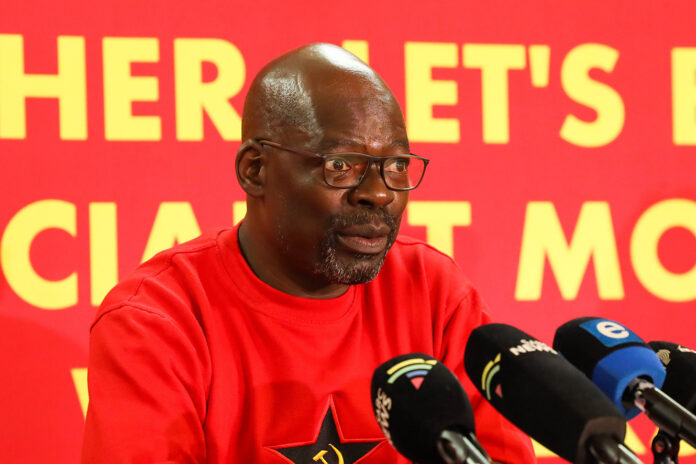
South African Communist Party (SACP) general secretary Solly Mapaila has launched one of his strongest attacks yet on ANC president Cyril Ramaphosa, accusing him of dishonesty and declaring that he will no longer hold one-on-one meetings with the ANC leader.
Speaking during the SACP’s message of support at the Police and Prisons Civil Rights Union (Popcru) Central Executive Committee meeting at the Birchwood Hotel in Boksburg, Mapaila described the state of relations between the communist party and its alliance partner as being at an all-time low.
According to Mapaila, a growing trust deficit and repeated distortions of discussions within alliance structures have convinced him that future engagements with Ramaphosa must take place only in the presence of other leaders.
“Leaders even lie. For instance, I am no longer prepared to meet with the president of the ANC one-on-one and I have told this to the alliance leadership,” Mapaila said.
“The only time I will meet him is when he is with someone and I am with someone in order to manage the dishonesty of leadership.”
Attack on Operation Vulindlela and ‘neo-liberal’ policies
The outspoken communist leader used his address to deliver a scathing assessment of the ANC government, arguing that the state has become captured by big business interests operating through policies promoted under Operation Vulindlela, a reform initiative located in the Presidency.
Mapaila claimed that “neo-liberal” forces within government were collaborating with business interests in ways that directly undermine workers and poor communities.
He argued that public assets and services were increasingly being opened to private sector involvement, a trend he said represented a fundamental attack on the working class.
“The state has been captured by capitalist forces. No one in the ANC and the alliance can say this is not true, unless they are naive. The state is fully captured, it has become the front of capital,” he charged.
Concerns over Eskom and water infrastructure
A key focus of Mapaila’s criticism was the restructuring of Eskom, which he described as a form of privatisation despite assurances that the utility would remain under public control.
He argued that the unbundling of the power utility and the creation of new entities had effectively stripped Eskom of assets and weakened public ownership.
“When you look at Eskom, it is gone and has been unbundled and they created new entities although we as the alliance were told that these things will remain under public control,” Mapaila said.
He warned that water infrastructure could be next, claiming that increasing calls for private investment in the sector amounted to privatisation by another name.
According to Mapaila, such developments could leave poor and rural communities vulnerable if access to water became increasingly driven by profit considerations.
Independent election contest rooted in ideological differences
Mapaila said these disputes were among the factors that pushed the SACP to take the historic decision to contest elections independently of the ANC.
The move, he argued, was not intended to destroy the ANC but rather to save it from outside the alliance structures, where the SACP believes its influence has been diminished.
He said efforts to change the ANC’s direction from within had failed because of what he described as the dominance of a neo-liberal faction within the governing party.
The SACP, he added, had repeatedly pushed for the reconfiguration of the alliance, only to be presented with proposals centred on government positions rather than policy change.
“Instead of reconfiguration of the alliance, the ANC gave us a document saying they will give us some quota, so they want to buy us with positions,” Mapaila said.
“We do not want positions, we want the revolution to resolve the crisis of the working class.”
Rallying workers to defend the National Democratic Revolution
Mapaila urged Popcru shop stewards and workers to mobilise in defence of the National Democratic Revolution (NDR), which he believes is under severe threat.
He argued that many within the broader Mass Democratic Movement had concluded that the ANC had compromised the goals of the NDR to such an extent that internal correction had become nearly impossible.
The SACP’s decision to chart a more independent political path, he said, followed years of frustration and failed attempts to resolve ideological and policy disagreements within the alliance.
As tensions between the ANC and SACP continue to intensify, Mapaila’s remarks underscore the widening gulf between two organisations that have been key alliance partners since the dawn of democracy.
- SACP general secretary Solly Mapaila accused ANC president Cyril Ramaphosa of dishonesty and stated he will no longer hold one-on-one meetings with him, insisting future talks include other leaders.
- Mapaila claimed the ANC government is captured by capitalist forces through policies promoted under Operation Vulindlela, which collaborate with business interests against workers and poor communities.
- He criticized the unbundling of Eskom and warned of potential privatization of water infrastructure, arguing these moves weaken public ownership and jeopardize access for vulnerable communities.
- The SACP decided to contest elections independently due to ideological clashes with the ANC, accusing the party of being dominated by a neo-liberal faction focused on positions rather than policy change.
- Mapaila called on Popcru workers to defend the National Democratic Revolution, stating that the ANC has compromised its goals, making internal reform nearly impossible.


