


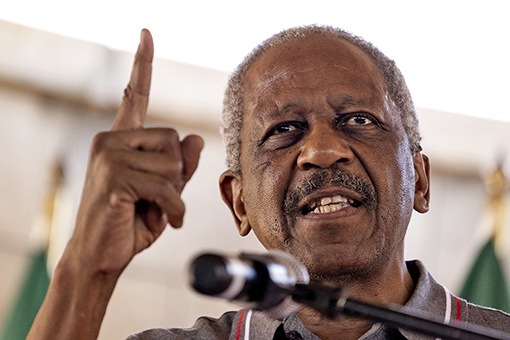
Veteran ANC stalwart Dr Mathews Phosa has delivered a blistering critique of his party’s governance failures, warning that its historic collapse in last week’s local government elections represents a profound rupture between politicians and the citizens they serve.
Delivering the keynote address at the FW de Klerk Foundation on Wednesday, November 11, Dr Phosa drew a sharp parallel between the political courage required to dismantle apartheid in the 1990s and the urgent structural reforms needed to rescue South Africa’s faltering democracy today.
Speaking just days after the Electoral Commission of South Africa announced the results of the November 4 municipal polls, Dr Phosa urged political leaders not to dismiss the outcome as a temporary fluctuation. The ANC’s national municipal vote share plummeted to 30.76%, a sharp drop from 45.59% in 2021, following its loss of a parliamentary majority in the 2024 national elections, where it secured 40.18%.
For the first time, the party failed to win an outright majority in any of South Africa’s eight metropolitan municipalities, finishing behind rival parties in six of them. Only the Democratic Alliance secured an outright majority in a metro, retaining Cape Town. Dr Phosa noted that the losses in economic hubs such as Johannesburg, Cape Town and eThekwini carry immense significance for the country’s future.
“How, then, has a movement that enjoyed such extraordinary public confidence experienced such a dramatic decline? I believe the answers are painfully evident,” Dr Phosa said.
Corruption and service failures under fire
He pointed directly to entrenched corruption, the abuse of public resources, crippling youth unemployment and the collapse of basic services, citing unreliable water supplies, electricity disruptions and neglected infrastructure. He also condemned cadre deployment, noting that political appointments have too often been driven by loyalty rather than competence.
In a pointed rebuke of political elitism, Dr Phosa criticised the “disconnect” between office-bearers and struggling citizens.
“There is something deeply troubling about the spectacle of flashing blue lights and expensive official vehicles moving through communities where families struggle to put food on the table,” he said, adding that public office has too often become “a refuge for personal entitlement” rather than an obligation to serve.
Call for fundamental state reform
Beyond changing leaders, Dr Phosa argued that South Africa must overhaul the broken machinery of the state.
“Too often we have changed the faces of leadership without changing the templates through which government operates and delivers,” he said, calling for fundamental changes in how decisions are made, how resources are protected and how accountability is enforced.
Reflecting on his role in the constitutional negotiations of the early 1990s, Dr Phosa paid tribute to the decisive leadership of Nelson Mandela and FW de Klerk, noting that De Klerk’s willingness to abandon an indefensible status quo, and the National Party’s eventual withdrawal from the first government of national unity in 1996, proved that political legitimacy must be continually earned, not assumed.
Constitutional reform debate rekindled
While reaffirming his deep commitment to the founding values of South Africa’s Constitution, Dr Phosa concluded his address by calling for a “serious national conversation about constitutional reform”.
He urged South Africans to examine whether the institutional structures established over three decades ago remain fit for purpose in confronting the country’s modern crises, stressing that any review process must aim to strengthen, rather than undermine, the nation’s democracy.
- Dr Mathews Phosa criticised the ANC's governance failures and linked its collapse in the local government elections to a disconnection between politicians and citizens.
- The ANC's national municipal vote share fell from 45.59% in 2021 to 30.76% in the November 4 municipal polls, failing to win an outright majority in any metropolitan municipality.
- Dr Phosa blamed corruption, misuse of public resources, youth unemployment, service delivery failures, and cadre deployment for the ANC's decline.
- He called for fundamental state reforms to change how government decisions are made, resources are protected, and accountability is enforced.
- Dr Phosa advocated for a national conversation on constitutional reform to assess if current institutional structures are suitable for addressing South Africa's modern challenges.
Veteran ANC stalwart Dr Mathews Phosa has delivered a blistering critique of his party’s governance failures, warning that its historic collapse in last week’s local government elections represents a profound rupture between politicians and the citizens they serve.
Delivering the keynote address at the FW de Klerk Foundation on Wednesday, November 11, Dr Phosa drew a sharp parallel between the political courage required to dismantle apartheid in the 1990s and the urgent structural reforms needed to rescue South Africa’s faltering democracy today.
Speaking just days after the Electoral Commission of South Africa announced the results of the November 4 municipal polls, Dr Phosa urged political leaders not to dismiss the outcome as a temporary fluctuation. The ANC’s national municipal vote share plummeted to 30.76%, a sharp drop from 45.59% in 2021, following its loss of a parliamentary majority in the 2024 national elections, where it secured 40.18%.
For the first time, the party failed to win an outright majority in any of South Africa’s eight metropolitan municipalities, finishing behind rival parties in six of them. Only the Democratic Alliance secured an outright majority in a metro, retaining Cape Town. Dr Phosa noted that the losses in economic hubs such as Johannesburg, Cape Town and eThekwini carry immense significance for the country's future.
"How, then, has a movement that enjoyed such extraordinary public confidence experienced such a dramatic decline? I believe the answers are painfully evident," Dr Phosa said.
He pointed directly to entrenched corruption, the abuse of public resources, crippling youth unemployment and the collapse of basic services, citing unreliable water supplies, electricity disruptions and neglected infrastructure. He also condemned cadre deployment, noting that political appointments have too often been driven by loyalty rather than competence.
In a pointed rebuke of political elitism, Dr Phosa criticised the "disconnect" between office-bearers and struggling citizens.
"There is something deeply troubling about the spectacle of flashing blue lights and expensive official vehicles moving through communities where families struggle to put food on the table," he said, adding that public office has too often become "a refuge for personal entitlement" rather than an obligation to serve.
Beyond changing leaders, Dr Phosa argued that South Africa must overhaul the broken machinery of the state.
"Too often we have changed the faces of leadership without changing the templates through which government operates and delivers," he said, calling for fundamental changes in how decisions are made, how resources are protected and how accountability is enforced.
Reflecting on his role in the constitutional negotiations of the early 1990s, Dr Phosa paid tribute to the decisive leadership of Nelson Mandela and FW de Klerk, noting that De Klerk’s willingness to abandon an indefensible status quo, and the National Party's eventual withdrawal from the first government of national unity in 1996, proved that political legitimacy must be continually earned, not assumed.
While reaffirming his deep commitment to the founding values of South Africa’s Constitution, Dr Phosa concluded his address by calling for a "serious national conversation about constitutional reform".
He urged South Africans to examine whether the institutional structures established over three decades ago remain fit for purpose in confronting the country's modern crises, stressing that any review process must aim to strengthen, rather than undermine, the nation's democracy.


