


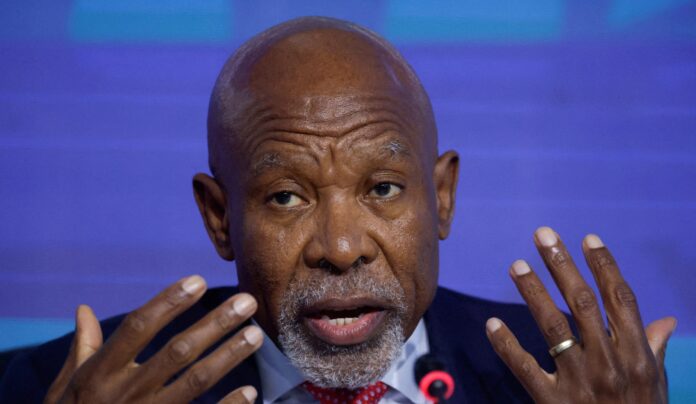
Reserve bank governor Lesetja Kganyago says it is difficult to see a near-term path for easing interest rates due to the volatility from the conflict in the Middle East and its impact on inflation.
Kganyago also says the bank would not update its inflation or growth forecasts between meetings and was relying on “scenarios” to help it understand the impact of wildly gyrating prices for commodities including fuel and fertilizers.
“All that we know is that it is growth-negative and would also lead to a rise in inflation,” Kganyago said of the conflict’s impact in an interview with Reuters on the sidelines of the International Monetary Fund and World Bank Group spring meetings in Washington.
“In an environment where you are expecting inflation to rise, I don’t think that anybody can still be talking about a relax in monetary policy in an environment like that,” he said.
Need for caution
The bank kept its policy rate at 6.75% last month, citing the need for caution due to the eventual impact of higher energy prices on inflation.
Before that meeting, the bank redrafted its risk scenarios to gauge the impact of the Middle East conflict. The adverse scenario considered oil averaging at $94 a barrel throughout the year and a 20% exchange rate depreciation.
“That was in March. We are now in a completely different environment,” he said. “We will do new scenarios in May.”
The Middle East war, and the wild swings in commodity prices it has caused, largely short-circuited a monetary easing push among emerging market central banks.
Still, he said South Africa faced no fuel shortages and would not have a sense of the fertilizer shortage impact on its farmers until the autumn planting season.
“Prices have moved in all directions…the one thing that we are certain of is that uncertainty is with us.”
- South African Reserve Bank Governor Lesetja Kganyago sees no near-term path for easing interest rates due to volatility from the Middle East conflict impacting inflation.
- The bank refrains from updating inflation or growth forecasts between meetings, relying instead on scenarios to assess commodity price fluctuations, including fuel and fertilizers.
- Kganyago highlighted that the conflict is growth-negative and inflationary, making monetary policy relaxation unlikely amid rising inflation expectations.
- The bank kept its policy rate at 6.75% in March, emphasizing caution amid higher energy prices and redrafted risk scenarios considering high oil prices and currency depreciation.
- Despite the challenges, South Africa faces no fuel shortages currently, with fertilizer impact on farming uncertain until the autumn planting season, amid ongoing economic uncertainty.


