


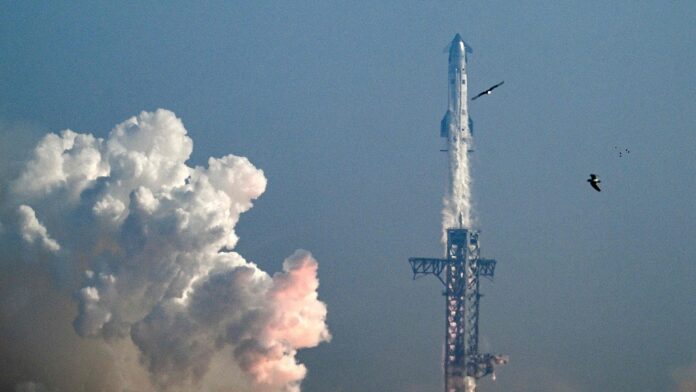
SpaceX completed a largely successful test flight of its next-generation Starship rocket on Friday, deploying mock satellites and executing a controlled splashdown in the Indian Ocean, marking a key milestone as the company prepares for a potential initial public offering (IPO) next month.
The uncrewed launch – Starship’s 12th test flight since 2023 and the first of its upgraded V3 version – is designed to support future Starlink satellite launches and NASA missions to the moon.
Most major objectives achieved
The flight achieved most major objectives despite minor anomalies, including the loss of one engine during ascent and a failed booster re-entry burn. Starship still completed payload deployment, atmospheric re-entry and a controlled ocean splashdown after just over an hour of flight.
The Super Heavy booster separated as planned and splashed down in the Gulf of Mexico, though it did not complete a planned boost back burn.
During its suborbital cruise phase, Starship successfully released its payload of 20 mock Starlink satellites one by one, plus two actual modified satellites that scanned the spacecraft’s heat shield and transmitted data back to operators on the ground during the vehicle’s descent.
Elon Musk hails team
SpaceX founder Elon Musk welcomed the outcome with a message posted to his X platform, congratulating his “SpaceX team on an epic first Starship V3 launch & landing!”
Kathleen Curlee, a research analyst at Georgetown University’s Center for Security and Emerging Technology, hailed the flight as “another meaningful step forward in SpaceX’s broader strategy of building the launch capacity needed to support the company’s expanding ambitions in space”.
Flight was closely watched by investors
Although the flight encountered “some anomalies,” Curlee said, “the test appears to have achieved several key objectives and will provide SpaceX with significant operational and engineering data moving forward”.
Starship, which SpaceX has spent more than $15-billion developing as a fully reusable spacecraft, is critical to Musk’s goals of cutting launch costs, expanding his Starlink business and pursuing ambitions ranging from deep-space exploration to orbital data centers – all factored into his targeted $1.75-trillion IPO valuation.
The flight was closely watched by investors ahead of SpaceX’s expected IPO, which could become the largest in history and is projected to value the company at up to $1.75-trillion.
- SpaceX successfully completed the 12th test flight of its upgraded Starship V3 rocket, deploying mock Starlink satellites and conducting a controlled splashdown in the Indian Ocean.
- Despite minor issues like one engine loss during ascent and a failed booster re-entry burn, the mission met most major objectives including payload deployment and ocean splashdown.
- The Super Heavy booster separated and landed in the Gulf of Mexico but missed its planned boost-back burn.
- SpaceX founder Elon Musk praised the team’s performance, while analysts highlighted the flight as a key step in advancing SpaceX’s space launch capabilities and broader ambitions.
- The test flight was closely monitored by investors ahead of SpaceX’s anticipated IPO valued up to $1.75 trillion, aiming to support expansion in Starlink, lunar missions, and deep-space exploration.


