


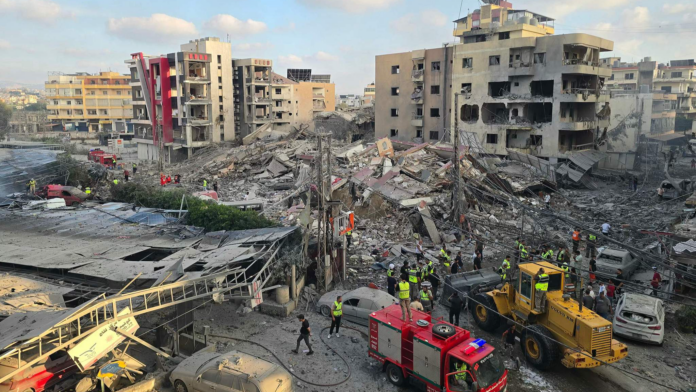
The UN Security Council met late on Monday at France’s request as the conflict between Israel and Hezbollah intensified, raising concerns over possible Israeli strikes on Beirut and casting further uncertainty over US-Iran talks, according to the United Nations.
The Security Council meeting came amid an escalation between Israel and Hezbollah that has threatened to unravel the fragile ceasefire reached in April. Israel intensified military operations in Lebanon in recent days, threatening strikes on Beirut and advancing deeper into southern Lebanon, including the capture of the strategic Beaufort Ridge.
Lebanon’s representative Ahmad Arafa accused Israel of exploiting regional tensions to escalate its military campaign and target civilian infrastructure, including hospitals, schools and media workers, and urged Israel to commit to a ceasefire.
Israel claims self-defence
Israel’s representative Danny Danon said Israel “had no choice” but to act after Hezbollah attacks, accusing Iran of using the group as a proxy force against Israel. He said attacks on Israel’s northern communities over the weekend marked the heaviest fire since the ceasefire.
US representative Michael Waltz mentioned President Donald Trump’s diplomatic efforts and said peace could be achieved if Hezbollah halted its attacks.
China’s permanent representative to the United Nations, Fu Cong, said Israel’s continued military operations had claimed more than 3 400 lives in Lebanon. He called on Israel to immediately cease hostilities and fully abide by the ceasefire arrangements, stressing that Lebanon’s sovereignty, security and territorial integrity must be respected.
France’s representative Jerome Bonnafont, whose delegation requested the meeting, said that while Israel has the right to self-defense, the scale of its military operations in Lebanon was unjustifiable. The ongoing operations in Lebanon had caused heavy civilian casualties and displacement, violated commitments made under the April ceasefire arrangement and contradicted Security Council resolutions, he said.
The latest escalation in Lebanon has cast a shadow on ongoing US-Iran talks. Iranian media reported that indirect contacts with Washington had been suspended until Israel halts its military operations in Gaza and Lebanon, though Trump later said talks with Tehran were continuing “at a rapid pace”.
- The UN Security Council met at France's request as the conflict between Israel and Hezbollah intensified, raising concerns over possible Israeli strikes on Beirut.
- Israel intensified military operations in Lebanon, capturing the strategic Beaufort Ridge and threatening strikes on Beirut.
- Lebanon's representative Ahmad Arafa accused Israel of targeting civilian infrastructure and urged a ceasefire commitment.
- China's UN representative Fu Cong reported over 3,400 lives lost in Lebanon due to Israeli military operations and called for a cessation of hostilities.
- Iranian media stated indirect US-Iran contacts were suspended until Israel halted its military actions, though President Trump said talks continued rapidly.


