


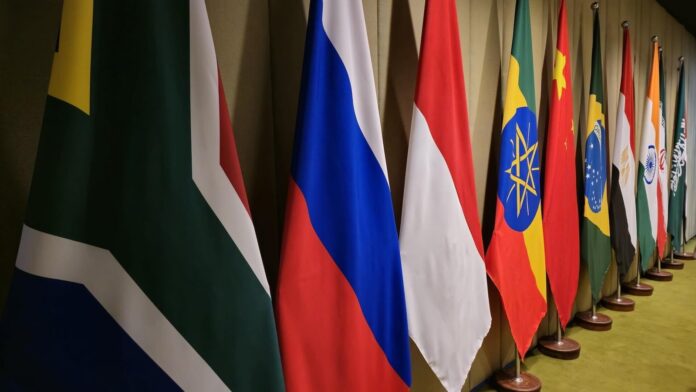
The New Delhi declaration at the Brics leaders’ meeting on Saturday expressed deep concern over the continued escalation of tensions in West Asia/Middle East and called for “exercising maximum restraint” and not to take any action that could worsen the situation.
Besides accent on West Asia, the declaration also emphasised reforms in global trade and finance, promoting trade settlements and investments through local currencies, steps to work on climate resilience and encourage greater cultural and people-to-people exchanges.
De-escalation and diplomacy in West Asia
The inclusion of the situation in West Asia was a sticking point since both Iran and the United Arab Emirates are member countries of Brics and disagreement over the approach had cast a shadow on the Foreign Ministers’ meeting earlier this year. While these countries were not identified as such, the declaration took note of the situation in Gaza, Syria and Lebanon and humanitarian suffferings.
“We express deep concern over the continued escalation of tensions in the Middle East/West Asia and, recalling our respective national positions, call for exercising maximum restraint, as well as avoiding actions that could further aggravate the situation. Furthermore, we urge to ensure the protection of civilians and civilian infrastructure in accordance with the purposes and principles of the Charter of the United Nations in their entirety and interconnectedness, including respect for the sovereignty and territorial integrity of the states. We encourage increasing efforts, through dialogue and diplomacy, towards a long-term understanding that will contribute to lasting peace, security and stability in the region,” the declaration said.
Protection of critical infrastructure
Serious concern was expressed over the deliberate attacks on civilian infrastructure and peaceful nuclear facilities under safeguards of the International Atomic Energy Agency, violating international law and relevant resolutions of the agency. This inclusion assumes significance in reports of attacks on such facilities in the West Asia conflict.
At a press conference, India’s External Affairs Secretary (Economic Relations) and Brics sherpa Sudhakar Dalela said the declaration was a major diplomatic achievement that reflected the consensus among its members. Dialogue and diplomacy, he said, was the way to resolve conflicts. As the chair, India’s approach was people-centric through practical cooperation.
Reforms in multi-lateral institutions
The declaration observed that, with emerging markets and developing economies’ share in global output and growth on the increase, reform of global economic governance should remain consistent with the priorities of Brics. In this, the member countries will strengthen coordination to make international financial institutions more representative, transparent and accountable and stressed the need to urgently reform the Bretton Woods Institutions.
“In light of the ongoing selection process of the next secretary-general of the UN and bearing in mind the relevant provisions of the UN Charter, we note that no woman has ever been elected for the role of secretary-general, and only one national from Latin America and the Caribbean, and only two nationals from Africa and Asia each have ever occupied this position”, the declaration said.
On the World Trade Organisation (WTO), it reiterated its support for reforms in the world body to strengthen a “non-discriminatory, open, equitable, transparent, fair, inclusive, predictable and rules-based multilateral trading system, with the WTO at its core, while upholding the foundational principles, such as Most-Favoured-Nation Treatment and Special and Differential Treatment for developing members, particularly LDCs.”
- The New Delhi declaration at the Brics leaders' meeting expressed deep concern over escalating tensions in West Asia/Middle East and called for maximum restraint to avoid worsening the situation.
- The declaration noted the humanitarian sufferings in Gaza, Syria, and Lebanon, urging the protection of civilians and their infrastructure in accordance with the UN Charter.
- Members expressed serious concern over deliberate attacks on civilian infrastructure and nuclear facilities safeguarded by the International Atomic Energy Agency, condemning violations of international law.
- The declaration emphasized reforms in global economic governance, calling for more representative, transparent, and accountable international financial institutions and urgent reform of the Bretton Woods Institutions.
- It supported reforms in the World Trade Organisation to maintain a non-discriminatory, open, equitable, transparent, and rules-based multilateral trading system with the WTO at its core.


