


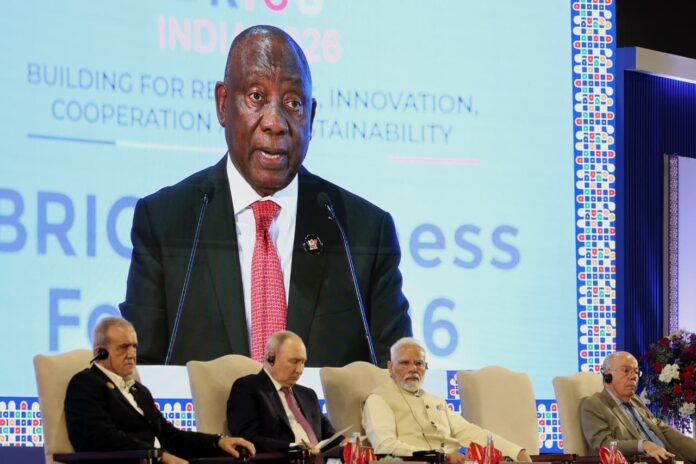
President Cyril Ramaphosa on Saturday underscored that Brics could contribute in four ways to strengthen and reform the existing systems of global governance and work together to ensure that voices of Africa and the Global South find reflection in shaping a future international order.
In his address at a session on Inclusive Global Governance and Strengthening Multilateralism at the 18th Brics Summit meet in New Delhi, he stressed Brics should speak in one voice for reform and push for a UN system that reflects current realities in which all regions find effective representation.
‘Brics can push the envelope on key issues’
While demonstrating that multilateral cooperation delivers results, he said it was through the New Development Bank and other areas Brics can push the envelope on key issues such as infrastructure development, sustainable growth, food security, health, industrialisation and climate resilience.
Brics should help shape approaches to global governance that are fair, accountable and development-oriented, and in a fragmented world where dialogue and not confrontation should be the approach, the platform should be a bridge across geopolitical divides.
“We should ensure that countries with developing economies have a meaningful voice in global decision-making and that power remains constrained by law…strengthen multilateralism through reform and action… uphold international law and allow no one to act with impunity…and we must ensure that the voices of Africa and the Global South are fully reflected in shaping the future international order”, he said in a release on The Presidency.
Modi’s vision
Welcoming the leaders, Indian Prime Minister Modi emphasised India’s chairship was guided by a people-centric and humanity-first approach. Recalling the historic milestone of the Summit celebrating its 20th anniversary of Brics, he likened it to the ‘coming of age’ moment and proposed the establishment of a Brics Continuity and Implementation Mechanism through a ‘Trioka Mechanism” as the Chair keeps revolving. This could be achieved through the creation of a digital repository in which every decision, the nodal point, timeline, and implementation status can be recorded. This, in a way, is adopting digital technology, obviating the need for an institutional mechanism.
Referring to the Global South as being in the “ front row of global crises, but in the back row of decision-making,” PM Modi said Brics must transform this “pyramid of privilege” into a “platform of partnership”, where every country has a voice, every member has a stake, and the advancement of humanity remains at the heart of every endeavour.
To work in this direction, he suggested ten proposals for global governance reform, through which member countries could seek to develop a Brics Reform Roadmap by the next Summit to be hosted by China. In drawing the roadmap, three key aspects must be in focus – Representation, Responsiveness and Rule Making.
‘We must work to transform the Global South from rule-takers into rule-shapers. Through Brics we can provide young diplomats and policymakers from the countries of the Global South with negotiation skills, practical training, and legal expertise”, PM Modi said.
Xi Jinping’s idea
President Xi Jinping of China underscored that Brics countries should stand on the right side of history and urged the member countries to take the lead in advancing development, which is driven by innovation. According to a report on China’s CGTN, President Xi said Brics countries should uphold peace and stability, assist in mutual learning, and work to improve global governance.
- President Cyril Ramaphosa emphasized that Brics could strengthen global governance by ensuring Africa and the Global South have effective representation in shaping the future international order.
- Ramaphosa highlighted Brics' potential to drive progress on infrastructure, sustainable growth, food security, health, industrialization, and climate resilience through multilateral cooperation and the New Development Bank.
- Indian Prime Minister Modi proposed establishing a Brics Continuity and Implementation Mechanism using a digital repository to track decisions and implementation across rotating chairs.
- Modi called for transforming the Global South from passive rule-takers into active rule-shapers and suggested developing a Brics Reform Roadmap focusing on representation, responsiveness, and rule-making.
- Chinese President Xi Jinping urged Brics countries to promote development driven by innovation, uphold peace and stability, support mutual learning, and improve global governance.


