


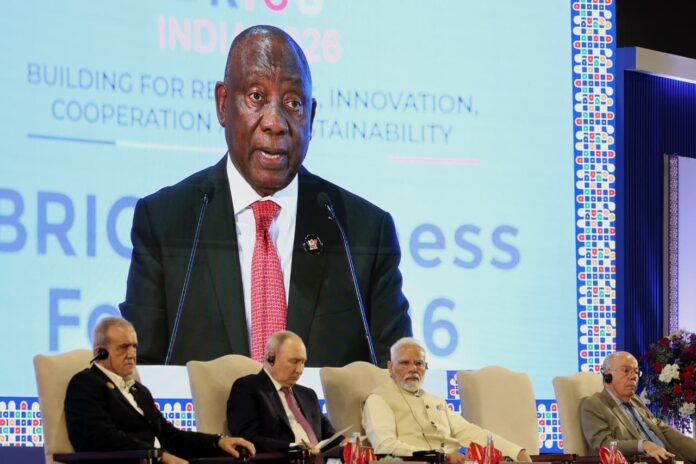
President Cyril Ramaphosa on Friday strongly favoured developing economies and countries in the expanded Brics not to remain suppliers of raw materials, with high-value manufacturing elsewhere.
Sensing an opportunity for Brics to shape a “more resilient, diversified and inclusive economic future for the Global South”, President Ramaphosa, addressing the Brics Business Forum in New Delhi on Friday, said: “For too long, developing economies have participated in global value chains mainly as suppliers of raw commodities. Value creation, technology and higher-value manufacturing remained concentrated elsewhere. We should not reproduce that pattern within the expanded Brics. Our ambition must extend beyond increasing intra-Brics trade to deepening the productive relationships between our economies.”
Africa must beneficiate its resources
Drawing attention to the global economy that was being reshaped, he said countries and companies are compelled to reconsider where they source, produce and invest. As for Africa, President Ramaphosa said the continent cannot accept a future where it supplies minerals on which the next generation of industries depend while value addition and manufacturing take place elsewhere.
For the situation to change, where value is created, countries must also direct investment towards manufacturing and beneficiation, industrial technologies, energy systems, infrastructure and logistics. Companies must invest not only to access markets but to establish production facilities and develop local capabilities.
Business crucial to Brics economic integration
With the accent being placed on resilience, he said it was not simply the capacity to withstand disruption but the capacity to transform disruption into new capabilities and partnerships. It was no longer about potential within Brics, but whether the members have the ambition, the instruments and the partnerships to convert this potential into economic value for their people.
“The council must serve not simply as a forum for consultation, but as a mechanism for developing commercial relationships and productive partnerships. As Brics, we find ourselves at an inflection point”, he said.
As governments and business communities, he urged them to make Brics a platform through which investment and trade reshape existing economic patterns to transform the destinies of countries and their peoples.
Modi calls for removal of trade barriers
Indian Prime Minister Narendra Modi underscored the rising trade barriers and restrictions being placed on sea lanes of communication while stating that under its presidency of Brics, New Delhi was building bridges and establishing new networks for cooperation among the member nations.
Since 2014, India has entered into free trade agreements with about 40 countries of the world, and its approach in Brics remained the same by reducing barriers and increasing opportunities for businesses.
New cooperation platforms for SMEs and start-ups
“Therefore, under our chairmanship, we have formed new co-operation networks in areas like agriculture, health, skills, and smart grids. To connect start-ups and SMEs with markets and finance, we have taken initiatives such as the Brics Incubator Network, the Brics MSME Portal, and the Brics Startup Innovation Fund. All of you can take advantage of all these co-operation frameworks. And we can increase investment and talent exchange between our countries”, he said at the Business meet.
As Brics moves forward entering into its third decade, he urged the Brics Business Council to make a report to remove the top 10 trade barriers among member countries. “Can we support a hundred Brics startups to scale to other Brics markets every year? Can we develop thousands of new partnerships between our businesses? We have to review our progress every year on these three parameters. Let us transform the ambition of Brics into action, and collective strength into global solutions. Brics should move forward, and also take the world forward”.
Putin says emerging economies replacing old powers
Russian President Vladimir Putin said new emerging economies were replacing leading powers of the late 20th Century. This competition was taking “ugly forms” in the form of military attacks and threats of secondary sanctions. Attacks were in the form of destroying pipelines, blocking international transport corridors, and seizing maritime vessels, as well as placing restrictions. Despite such adverse conditions, he said Russia was working actively and managed economic growth during the last three years, which was higher than the world average.
- President Cyril Ramaphosa urged Brics countries to move beyond supplying raw materials and focus on value creation, technology, and high-value manufacturing within the group.
- Ramaphosa emphasized Africa's need to add value to its minerals and invest in manufacturing, industrial technologies, energy systems, infrastructure, and logistics.
- The Brics Business Council, established in 2013, aims to foster economic cooperation by creating trade and investment opportunities and developing commercial partnerships among member countries.
- Indian Prime Minister Narendra Modi highlighted India's efforts to reduce trade barriers through free trade agreements and introduced new cooperation platforms for agriculture, health, skills, smart grids, and start-ups within Brics.
- Russian President Vladimir Putin noted that emerging economies are replacing traditional powers despite military conflicts, sanctions, and trade restrictions, with Russia maintaining economic growth above the world average in recent years.


