


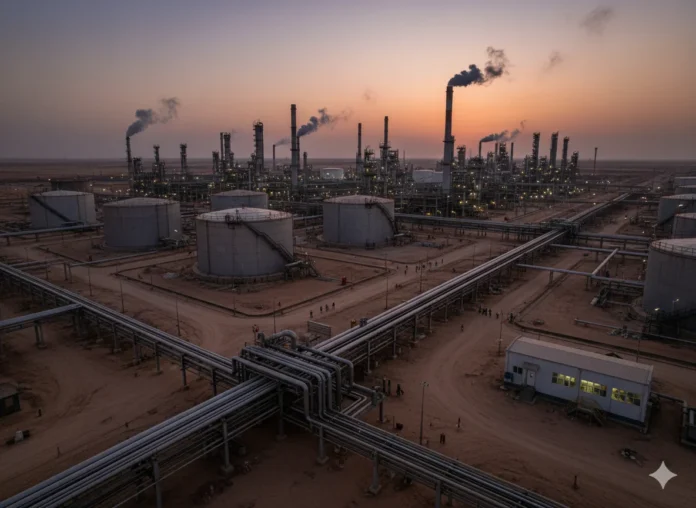
The newly formed African Energy Bank (AEB) has announced the rollout of $10-billion (R160-billion) in first-phase funding, targeting major oil and gas projects in Nigeria, Angola, and Libya, as the continent moves to secure independent financing for its energy sector amid tightening global capital flows.
The funding marks the first operational step for the multilateral bank, which was established through a partnership between the African Petroleum Producers’ Organisation (APPO) and the African Export-Import Bank (Afreximbank).
The institution aims to close a growing financing gap created by Western lenders and development institutions scaling back support for fossil fuel projects due to climate commitments.
Africa’s oil-producing nations
The AEB will channel funds into exploration, pipelines, storage facilities, refineries, and distribution networks.
The initial focus is on Nigeria, Angola, and Libya, as these are some of Africa’s largest oil-producing nations that suffer from constrained access to investment capital.
“The African Energy Bank is positioned to ensure Africa develops its energy resources on its own terms,” said APPO secretary-general Omar Farouk Ibrahim, emphasising the need for African-controlled financing mechanisms as global investors increasingly shift away from hydrocarbons.
Afreximbank president Benedict Oramah previously highlighted the urgency of the initiative, noting that Africa must mobilise its capital to ensure energy security and economic stability.
“Africa cannot afford to abandon its natural resources,” Oramah said. “The African Energy Bank will play a critical role in ensuring energy availability while supporting economic growth.”
The $10-billion first phase represents only a portion of the bank’s longer-term ambition.
Officials expect the institution to mobilise significantly larger capital pools over time by leveraging public funding to attract private and institutional investors.
Projections suggest the initiative could unlock more than $200-billion in energy investments by 2030, supporting oil, gas, and associated infrastructure development across multiple African markets.
Energy access remains a challenge
Energy remains a critical pillar of African economies, accounting for a large share of export earnings in countries such as Nigeria and Angola.
However, underinvestment, aging infrastructure, and global financing constraints have slowed production growth recently.
Also, energy access remains a major challenge across Africa, where more than 600-million people still lack reliable electricity, according to Boston Consulting Group.
By providing alternative financing, the AEB aims to reverse this trend and stabilise long-term production capacity.
While many developed countries are accelerating the transition away from fossil fuels, African leaders argue that hydrocarbons remain essential to economic development, poverty reduction, and energy security.
The bank has stated it will support energy transition initiatives alongside hydrocarbons, but oil and gas are expected to remain a core focus, particularly in the early phases.
This approach reflects Africa’s position that it must balance emissions reduction with economic growth and energy access.
The rollout of the first $10-billion signals that Africa is taking concrete steps to reshape how its energy sector is financed.
By creating its financing institution, the continent is seeking to reduce exposure to external capital constraints while maintaining control over its natural resources.
- The newly formed African Energy Bank (AEB) has announced the rollout of $10-billion (R160-billion) in first-phase funding, targeting major oil and gas projects in Nigeria, Angola, and Libya, as the continent moves to secure independent financing for its energy sector amid tightening global capital flows.
- The funding marks the first operational step for the multilateral bank, which was established through a partnership between the African Petroleum Producers’ Organisation (APPO) and the African Export-Import Bank (Afreximbank).
- The institution aims to close a growing financing gap created by Western lenders and development institutions scaling back support for fossil fuel projects due to climate commitments.
- Africa’s oil-producing nations The AEB will channel funds into exploration, pipelines, storage facilities, refineries, and distribution networks.
- The initial focus is on Nigeria, Angola, and Libya, as these are some of Africa’s largest oil-producing nations that suffer from constrained access to investment capital.


