


A record-breaking cosmic signal detected by South Africa’s MeerKAT telescope is signalling a deeper shift in where frontier astronomy is happening.
Astronomers at the University of Pretoria recently observed the most distant hydroxyl megamaser ever detected using MeerKAT. The system, HATLAS J142935.3–002836, lies more than eight billion light-years away and emits an extraordinarily powerful radio signal, known as a “cosmic laser”.
According to the South African Radio Astronomy Observatory, the signal is “so luminous it warrants classification as a gigamaser, a rare cosmic phenomenon” produced when radio waves are amplified by hydroxyl molecules in gas-rich merging galaxies.
Hydroxyl megamasers form under extreme conditions, typically when galaxies collide, and massive gas reservoirs trigger intense star formation. They also feed supermassive black holes, making these signals powerful probes of early-universe dynamics.
MeerKAT detected the signal thanks to a rare cosmic alignment. A foreground galaxy acted as a gravitational lens, magnifying the radio waves and allowing the telescope to capture them despite the vast distance.
“This system is truly extraordinary,” said Dr Thato Manamela, Sarao-funded post-doctoral researcher at the University of Pretoria and lead author of the study. “We are seeing the radio equivalent of a laser halfway across the universe. Not only that, during its journey to Earth, the radio waves are further amplified by a perfectly aligned, yet unrelated foreground galaxy.
According to the discovery team, the observation offers scientists a direct view of the universe when it was less than half its current age. It also underscores that Africa-hosted instruments can make frontier science discoveries.
“This is just the beginning,” Manamela said. “We don’t want to find just one system, we want to find hundreds to thousands.”
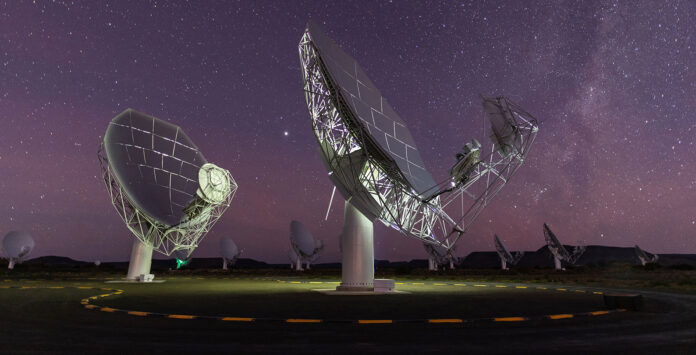
MeerKAT radiotelescope, a 64-dish radio telescope located in South Africa’s Karoo, was built as a precursor to the Square Kilometre Array Observatory, testing technologies and scientific workflows that will scale to the much larger array now under construction. – Bird Story Agency
Visit the SW YouTube Channel for our video content
- A record-breaking cosmic signal detected by South Africa’s MeerKAT telescope is signalling a deeper shift in where frontier astronomy is happening.
- Astronomers at the University of Pretoria recently observed the most distant hydroxyl megamaser ever detected using MeerKAT.
- The system, HATLAS J142935.3–002836, lies more than eight billion light-years away and emits an extraordinarily powerful radio signal, known as a “cosmic laser”.
- According to the South African Radio Astronomy Observatory, the signal is “so luminous it warrants classification as a gigamaser, a rare cosmic phenomenon” produced when radio waves are amplified by hydroxyl molecules in gas-rich merging galaxies.
- Hydroxyl megamasers form under extreme conditions, typically when galaxies collide, and massive gas reservoirs trigger intense star formation.


