


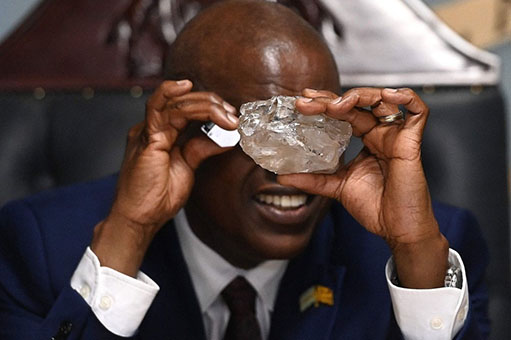
Botswana is accelerating efforts to reduce its dependence on diamonds as global demand weakens, and synthetic alternatives reshape the market.
The country is expanding partnerships, sovereign investment tools, and regional integration strategies to build new sources of growth.
“Diversification and investment in different sectors is the way forward. Africa has to learn from Saudi Arabia and not depend on only mineral resources”, according to Herbert Kirumira, a sector analyst.
Botswana’s economy has been plummeting in recent years, and in 2025, diamond production fell by roughly 40%, while revenues dropped by about half, according to government-linked estimates and industry reporting.
Diamonds still account for about a quarter of GDP and up to 80% of export earnings, making the contraction structurally significant.
The fiscal impact has been immediate, with the budget deficit widening to nearly 9% of GDP as growth forecasts were repeatedly revised downward.
“The scale of adjustment required is now materially larger than earlier projections,” Waswa said, pointing to weakening export inflows and tightening fiscal space.
By early 2026, diamond stockpiles had reached around 12 million carats, nearly double the government’s comfort level of about 6.5 million carats.
The build-up reflects weak global absorption, softer demand in major markets such as the United States and China, and intensifying competition from lab-grown diamonds.
This shift is reshaping Botswana’s external position. Mineral revenues are projected at about 10.3 billion pula in 2025/26, far below historical averages of more than 25 billion pula, underscoring a prolonged erosion in export earnings and fiscal buffers.
Policy response has focused on adjustment rather than rupture.
In 2025, Botswana renegotiated its agreement with De Beers, increasing the state’s allocation of Debswana output through the Okavango Diamond Company from about 25% to 30%, with a phased pathway toward as much as 50% over the next decade, according to the joint terms of the deal.
Alongside this, the Botswana Economic Transformation Programme has been launched, targeting services-led growth, investment attraction, financial sector expansion, and broader economic diversification.
Diversification is also increasingly external.
In 2026, Botswana signed agreements with Oman covering mineral exploration, oil storage infrastructure, and renewable energy cooperation. The southern African nation has also participated in discussions regarding logistics and mineral export infrastructure in Angola’s Lobito Corridor.
Private capital activity is also emerging, including a reported £50-million (about R1-billion) in the Botswana Tech Fund, which is aimed at technology and venture investment, with ambitions to position the country as a regional fund domiciliation hub within Southern Africa. – bird news agency
- Botswana's diamond production dropped by 40% in 2025, with revenues halving, heavily impacting its economy as diamonds still represent up to 80% of export earnings.
- The country is widening budget deficits (nearly 9% of GDP) amid weaker exports and is grappling with a stockpile of 12 million carats, nearly double the government's comfort level.
- Botswana renegotiated its deal with De Beers to increase state diamond allocations from 25% to 30%, aiming for up to 50% over the next decade.
- The Botswana Economic Transformation Programme focuses on economic diversification into services, finance, and investment attraction to reduce diamond dependence.
- New external partnerships with Oman and Angola, plus private investments like the £50-million Botswana Tech Fund, signal efforts to diversify the economy and develop regional integration.


